
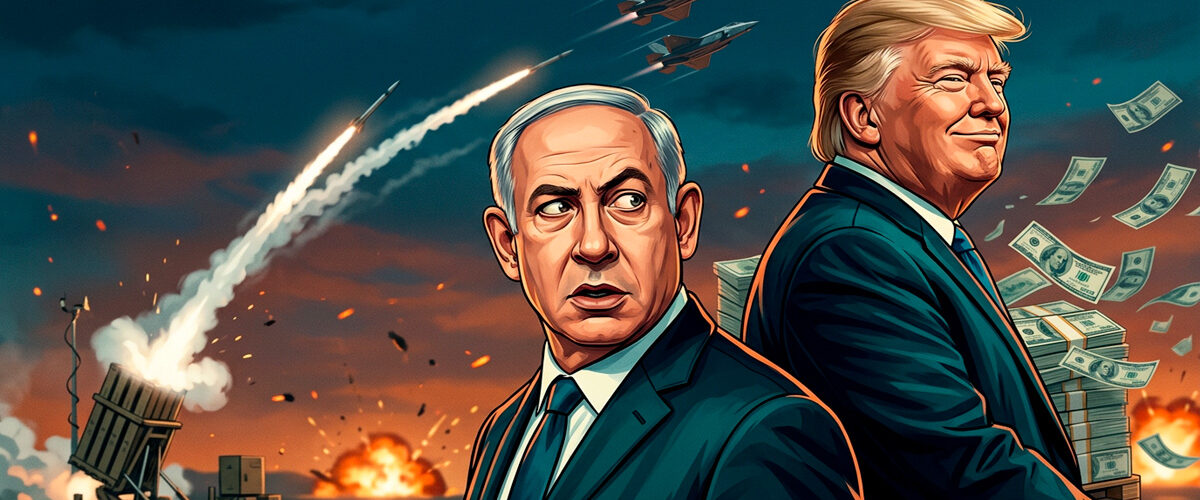

On Tuesday morning, while Americans were lining up to vote in the midterms, Donald Trump phoned into Fox News and announced that the United States is cutting off Israel’s military aid. Not in 2028, when the current deal expires. At the end of this year. As in, less than two months from now.
According to Trump, this was Bibi’s idea. “He brought it up,” Trump said. According to Israel’s Finance Ministry, Defense Ministry and the IDF, this was news to them. They found out the same way you did.
So I want to do two things here. First, sort out what actually happened, because the timing of this thing is a mess and Netanyahu does not come out of it looking good. Second, the more interesting question: what does the end of American aid actually mean for Israel’s defense industry, for the civilian tech that spins out of it, and for Israel’s ability to buy weapons from someone other than the Americans? The short answer is less than the headlines suggest, in both directions.
What is this money, anyway?
US military aid to Israel runs on ten-year deals called Memoranda of Understanding, or MOUs. The current one was signed in 2016 under Obama and covers 2019 through 2028. It’s worth $38 billion total, which works out to $3.8 billion a year: $3.3 billion in grants to buy weapons and $500 million for joint missile defense programs like Iron Dome and Arrow. Trump keeps calling it $4 billion. It isn’t, but close enough for Fox.
The $3.3 billion part is called Foreign Military Financing. The key thing to understand is that it’s not a check Israel can spend however it likes. It’s money Israel has to spend on American weapons, from American companies. Israel used to be allowed to spend a slice of it at home on Israeli-made gear, a perk called off-shore procurement, but the 2016 deal phases that out by 2028 anyway.
And it matters a lot less than it used to. By one estimate, US aid covered close to 10% of Israel’s defense spending in 2025, when Israel spent about $52 billion on defense. In earlier decades it was a much bigger share of a much smaller budget.
Wait, didn’t Bibi want this?
Yes, and he’s been saying so all year. In January he told The Economist, “I want to taper off military aid within the next 10 years.” Asked if he meant all the way to zero, he said yes. In May he told CBS’s 60 Minutes, “I want to draw down to zero the American financial support,” adding that “it’s time that we weaned ourselves from the remaining military support” (via The Hill). In June he wrote to Republican congressman Marlin Stutzman, backing a resolution to phase out the aid: “The time has now arrived for us to move from aid recipient to partner” (via JPost).
That same month, Israel’s Defense Ministry and the Trump administration opened formal talks on a new framework to replace the MOU. The stated goal was to “gradually transition from aid to a completely reciprocal partnership,” meaning joint research, joint development and joint production instead of grants. US Ambassador Mike Huckabee put it plainly: “New MOU w/ Israel ends aid & will be based on trade.”
And in October, Bibi told Israeli TV, “If you think we’re going to continue receiving what I secured twice, and that’s tens of billions of dollars in American aid for the defence budget, prepare yourselves and get used to the fact that it won’t happen, because America has changed” (via CBC).
So the end of aid isn’t the scandal. It was coming. Support for Israel among American Democrats has collapsed, and the America First crowd on the right doesn’t love foreign aid of any kind. The logic of Bibi’s plan was sound enough: give it up voluntarily, on your own timeline, and get something better in return. As one analyst told JNS, “It’s much better to say that we voluntarily want to reduce aid than to lose it all at the negotiations.”
The key words there being “on your own timeline” and “in return.”
So why does Bibi look bad?
His own government found out from television. A Finance Ministry official told Walla that “No formal document was submitted from the Prime Minister’s Office regarding the end of aid” (via ToI). The ministry knew aid was ending eventually. It did not know it was ending in eight weeks. A senior defense official told Kan, “We did not expect this announcement, certainly not today.” Bibi’s public plan was a gradual phase-out over about a decade. Trump described a hard stop on December 31. Either Trump is freelancing, or Bibi agreed to something he didn’t tell the people who have to write next year’s defense budget. Neither option is great.
Then he said nothing. His office declined to comment. Bibi did post on social media that day, twice, about unsubstantiated allegations of foreign interference in Israel’s elections. Not about the $3.8 billion. On Wednesday, Trump went back on Fox and said Bibi “barely even pushed back.” Great. Thanks, guys.
The bargaining chip got spent as a campaign prop. The whole point of volunteering to give up the aid was to trade it for a partnership. Instead Trump announced it on Election Day morning as a Republican talking point. He said Republicans “suffer the slings” from Democrats over Israel aid (via ABC), and he name-checked Abdul El-Sayed, the Democrat running for Senate in Michigan who made the aid a campaign issue. How’d that work out? El-Sayed won. Democrats took the Senate and the House. So Israel’s aid got burned as a campaign gimmick, and the campaign lost anyway.
And it gets worse. Congress, not the president, controls the money. Starting in January, Congress belongs to a party where 103 of 212 House Democrats voted in July to cut the $3.3 billion immediately. The “partnership” half of the deal, a new US-Israel defense technology initiative at the Pentagon, is sitting in this year’s defense bill, which the House and Senate still have to reconcile. So Israel publicly gave up the aid before it had the replacement locked in. That’s not how you negotiate.
And the Israeli timing is awful too. This dropped a week after Israel’s own election, in which Trump endorsed Netanyahu, and while Bibi is still trying to put together a coalition. The opposition had a field day. Avigdor Liberman wrote that “the price of Trump’s support for Netanyahu [is] 3.8 billion dollars a year.” Yair Lapid called it “one of the most severe political and security failures in the state’s history.” Yair Golan, the former IDF deputy chief of staff who now leads the Democrats party, said “a responsible prime minister would have fought to increase American aid, not eliminate it” (all via JTA). Gadi Eisenkot said the fact that the defense establishment learned about a change in the strategic relationship through the media “shows just how much Netanyahu’s conduct poses a real danger” (via ToI). Netanyahu biographer Anshel Pfeffer told CNN it was a personal failure for Bibi and for Ron Dermer, the inner-circle guy who was managing the Trump relationship.
Now, to be fair to Bibi: he told the country this was coming, more than once. And Trump says things. It’s entirely possible the “end of this year” part is Trump being Trump, and the real deal looks like the gradual phase-out Bibi has been describing all along. If so, the Prime Minister’s job was to say that out loud, the same day, before his own ministries had to read about it in the papers. As of Thursday morning, I haven’t seen him do it.
Can Trump actually turn it off by December?
Probably not by himself. The MOU is a political agreement between two governments, not a law. Every year’s money has to be appropriated by Congress. Thomas Warrick of the Atlantic Council told Al Jazeera that Trump “will probably not cut off US military aid to Israel by the end of 2026,” pointing to joint missile defense and counter-drone programs that can’t easily be switched over to straight purchases.
Realistically you get a fight, a fudge, or a phase-out that’s faster than 2028 and slower than New Year’s. Even Democratic leader Hakeem Jeffries, who voted against the July cut, has said he’s open to phasing out direct aid once the current MOU ends. Whatever the date, the money is going. Israel should plan like it’s already gone.
What it does to Israel’s defense industry
Here’s the counterintuitive part. Because the grant money had to be spent in America, cutting it doesn’t directly take orders away from Rafael, Elbit or IAI, Israel’s three big defense companies. The money was mostly buying American planes and American bombs.
The problem is that Israel still needs those American planes. In May, Netanyahu announced Israel would buy two more squadrons of F-35s and F-15IAs. There’s roughly $8 billion in aid money that was expected through 2028, and big purchases were planned around it: fighters, tankers, armored vehicles. Now those get paid for in Israeli money. That’s the squeeze. Every shekel that goes to Lockheed Martin to cover the gap is a shekel that doesn’t go to an Israeli factory.
On the other hand, Israel had already decided to spend big at home. In December 2025, Netanyahu announced a 350 billion shekel (about $110 billion) ten-year plan to build an independent arms industry. That includes, per Maariv, 250 billion shekels in new budget money. The lesson of the war was that foreign export approvals are a chokepoint. When the Biden administration held up a shipment of heavy bombs in 2024, and when European countries froze licenses, the IDF felt it. So Elbit got contracts for a heavy bomb factory and a raw materials plant, more aerial munitions deals followed, and Rafael got a multi-billion-dollar contract to expand Iron Dome production.
And the industry is not exactly struggling. Israeli defense exports hit a record $19.2 billion in 2025, up nearly 30%, the fifth record year in a row (via ToI). About 85% of that came from the big three (via Calcalist). Rafael alone posted 21.7 billion shekels in sales. Ending US aid doesn’t change any of that. If anything, a defense budget that has to replace $3.8 billion a year with Israeli money will lean even harder on buying Israeli, wherever an Israeli product exists.
The civilian side
This is the part that gets overlooked. Israeli defense tech has a long history of turning into civilian businesses. The PillCam, the camera you swallow instead of getting a scope, was invented by Gavriel Iddan, an electro-optics engineer who spent years working on guided-missile cameras at Rafael (via MDDI). Rafael helped found Given Imaging to sell it. Alumni of Unit 8200, the IDF’s signals intelligence unit, founded Check Point and, more recently, Wiz, which Google bought for $32 billion, the biggest exit in Israeli history.
Right now that pipeline is running hot. Israeli defense-tech startups working with the Defense Ministry raised nearly $3 billion in the first half of 2026, triple what they raised in all of 2025 (via VC Cafe). Defense and “dual-use” companies (tech that works for both military and civilian customers) took almost 30% of all private investment in Israeli high-tech in that period, and about 800 startups are filling direct orders for the ministry. Drone maker Heven became Israel’s first defense-tech unicorn. Dual-use is also a smart business model, because companies whose products aren’t strictly weapons face fewer export restrictions and can sell to everyone.
Does ending aid help this? Indirectly, maybe. American aid never funded much Israeli research and development. It bought American hardware. Civilian spin-offs come from Israeli R&D money and from people moving between the army, the defense companies and the startup world. If the money that replaces US aid gets spent developing things in Israel, you’ll probably see more spillover. If it all gets eaten by F-35 payments, you won’t.
One thing to watch: the “partnership” that’s supposed to replace aid cuts the other way. The Pentagon initiative in the defense bill is designed in part to integrate Israeli-origin technologies into US systems (via J Street). That’s great for Israeli companies, since the Pentagon is the biggest customer on earth. But when you develop something jointly with the Americans, the Americans get a say over what happens to it. Israel is trading some independence for integration. That may well be the right trade. Just don’t call it independence.
Can Israel shop somewhere else now?
This is where people get carried away. Ending aid removes a financial constraint. Most of what limits where Israel buys, and who Israel sells to, has nothing to do with the aid money.
| What ending aid changes | What ending aid doesn’t change |
|---|---|
| Israel’s procurement money no longer has to be spent in America | Anything with American parts still needs American permission to sell on (US export law applies no matter who paid) |
| Some conditions that come attached to US-funded purchases fall away | Israel’s 2000s understandings with Washington not to sell arms to China |
| Washington loses one lever over Israeli programs | European embargoes and license freezes |
| More room to fund homegrown production | Israel still can’t build a fighter jet engine |
The Congressional Research Service notes that without aid, Israel may face fewer financial constraints on buying from other suppliers or making more at home, and that some US restrictions wouldn’t apply to purchases paid for entirely with Israeli money. That’s real. The Lavi story shows why. In the 1980s Israel was building its own fighter, partly with American money. In 1987 the government canceled it, mainly due to heavy US pressure. When Washington is paying, Washington gets a vote.
But the bigger restrictions stay put.
China. In 2000, Israel had a signed deal to sell China the Phalcon airborne radar system. The Chinese had already paid. The Phalcon had no American technology in it. The US killed the deal anyway (via MEI). A few years later, after a fight over upgrading Harpy drones Israel had sold to China, Israel agreed to cancel its arms sales to China and let the US review its future weapons deals. None of that was about aid money, and none of it goes away when the aid does. Buying critical military tech from China, say a jet engine, would blow up the US relationship, would tie Israel’s air force to Iran’s most important economic partner, and would mean flying Chinese-powered jets alongside American F-35s whose software and spare parts come from Washington. It’s not happening, and it shouldn’t.
Europe. The other obvious supplier is getting harder to buy from, not easier. Spain passed a law banning all arms trade with Israel. Slovenia did the same. Italy suspended new licenses (via JINSA). Germany, which used to be Israel’s second-largest supplier, approved nothing new for months in 2025 before lifting its restrictions after the Gaza ceasefire. Meanwhile, Europe bought 36% of Israel’s defense exports last year, $6.9 billion worth. Europe is happy to buy Israeli weapons. Selling them to Israel is a different story. The more realistic partners are countries like India, which has a long defense relationship with Israel, and Greece, which signed a $750 million deal for Elbit rocket artillery this year.
About that Israeli stealth fighter
Bibi wants one. “I want our own fighter jet, our own fighter jet, a stealth jet, an unmanned aircraft, a next-generation aircraft,” he said on Gadi Taub’s podcast. In July an Israeli official told Bloomberg and JPost that building a domestic stealth fighter and an unmanned combat aircraft is a ten-year goal.
Israel can do most of the hard parts. Israeli companies already make world-class radars, electronic warfare systems, sensors, missiles and entire families of drones. What Israel has never built is a fighter jet engine. Not for the Nesher, not for the Kfir, not for the Lavi. The Kfir is the cautionary tale. Israel built it after France cut it off, then powered it with an American GE J79 engine, which gave Washington a veto over who Israel could sell it to. Whoever makes the engine decides where the plane goes.
So the most likely version of an Israeli stealth fighter is an Israeli airframe and Israeli electronics around an American or European engine, with a flying demonstrator maybe around 2036. The unmanned combat drone is the more realistic project, since you don’t need a cockpit or life support and the engines are smaller. Israel is working on that piece: Bet Shemesh Engines has set up a venture with a German partner to make small jet and rocket engines, including for the Israeli defense market. Even Bibi has admitted the limits: “I don’t know if a country can be completely independent, but we will strive to ensure our arms are produced as much as possible in Israel” (via Legal Insurrection).
The fighter jet is a 2030s question. Bombs, interceptors, drones and small engines are the 2027 question, and that’s where the real independence is going to come from.
The bottom line
The end of US military aid was coming no matter what. Israel can afford it. Its defense industry will probably come out fine, maybe better, as more of the budget gets spent at home. Whether the civilian tech sector benefits depends on whether that money goes into Israeli R&D or just gets swallowed by F-35 payments. And the dream of breaking free of America is limited by things that have nothing to do with aid: engines, US export law, old promises about China, and a Europe that likes our weapons more than it likes us.
The real damage this week wasn’t the $3.8 billion. It was how it happened. A strategic decision about Israel’s security got announced by an American president on a morning show, as a campaign line, on the day his party got crushed. Israel’s own ministries found out from the news. The Prime Minister posted about something else. And the bargaining chip Israel was supposed to trade for a real partnership got spent before the partnership was signed.
Netanyahu has built his whole career on being the Israeli who knows how to handle Washington. This week, Washington handled him.

― Tom Robbins