
My parents took me to Paris three times before I ever went with my school, and every single time it was for my own good.
That was the actual pitch. Paris would make me cultured. Paris would make me worldly. Paris would sand off whatever it was about me that they found insufficiently cosmopolitan, which as far as I could tell was mostly that I liked staying home. The whole thing was giving personality transplant (olds: it had the energy of an attempt to replace me with a different daughter). We did the Louvre. We did the Musée d’Orsay. We did a tasting menu where a man explained a carrot to us for four minutes and my mother said it was transcendent and I said it was a carrot and that was the end of dinner.
And every trip, I asked to go to the Jewish stuff. The Mémorial de la Shoah. The Vél’ d’Hiv, which was an indoor cycling stadium where, in July 1942, French police rounded up something like thirteen thousand Jews, more than four thousand of them children, and held them in the stands with no food and almost no water before shipping them to Drancy and then to Auschwitz. French police. Not Germans, French police, doing it in Paris in the summer. The velodrome got demolished in 1959 and there is a memorial where it stood. The Marais. The street where the Jews used to live and where some of them still do.
And every trip, my mother would do this specific face. Not angry. Disappointed. Like I had ordered chicken fingers in a three star restaurant. The word that got used, more than once, was provincial.
Which, respectfully, is delulu behavior (olds: delusional) from these two particular people, and I need you to sit with the math here because the math is not mathing. My parents’ entire social and financial life runs through Jewish institutions. Federation galas. Board seats. A house that empties out every October for the same four fundraisers. Even the non-Jewish charity my dad chairs has a board that is, I have counted, mostly his Jewish friends from law school. They will write a check to any Jewish organization that puts a shrimp-free canapé in front of them. Jewish philanthropy is their entire personality. It is their whole brand.
But their kid wanting to see an actual Jewish neighborhood with actual Jews standing in it? Cringe. Small. Somehow the exact opposite of the worldliness they had personally financed. Being Jewish in a ballroom in a rented tux, based (olds: correct, respectable, admirable). Being Jewish on a street in the fourth arrondissement, embarrassing.
I have turned that over in my head for years and it still does not pass the vibe check. Anyway.
By the time my high school did its own Paris trip, I knew the city better than the teachers, which was a whole thing. The itinerary had us doing Versailles and a bateau mouche and a guided walk through Montmartre that was mostly about a windmill. It did not have us going anywhere near rue des Rosiers. Reader, I ditched. Told the chaperone I had a migraine, took the 1 to Saint-Paul, and walked six minutes to number 34, where I ate a falafel sandwich roughly the size of my own head standing up on the pavement, and then, because I have no self control, a shawarma one.
The place is called L’As du Fallafel. Remember that, because it is going to be relevant.
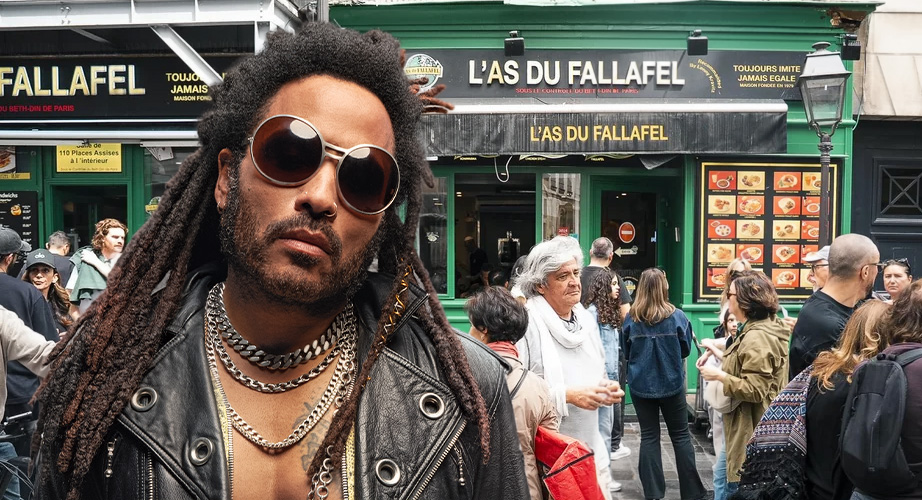
Which brings me to last week, when Lenny Kravitz got filmed taking pictures with the staff at a falafel restaurant in Paris and the internet did the thing it does. Hen Mazzig posted the video with the caption that Kravitz had been seen at an Israeli falafel store in Paris, and that Kravitz’s father Sy was Jewish, and that it brought him joy to see Kravitz supporting the community. Which, fine. Nice sentiment. No notes on the sentiment.
Lenny Kravitz was seen taking pictures at an Israeli 🇮🇱 falafel store in Paris 🇫🇷.
Lenny's father, Sy, is Jewish. It brings me a lot of joy to see him supporting the community. 💙 pic.twitter.com/3OSS3SV5RE
— Hen Mazzig (@HenMazzig) August 28, 2026
Here is my note. An Israeli falafel store.
Bro. It has a name.
Let me walk you through the chain, because the chain is the story. Yomi Peretz, who runs the restaurant, posted the video to his own Instagram on August 20. On August 23 a peace account reposted it. On August 27 Creative Community for Peace posted it with a nice little explainer about Kravitz’s Jewish father and his Bahamian and African-American Christian mother, the actress Roxie Roker, and how Kravitz has talked openly about being both Black and Jewish. Also no restaurant name. Hen posted later that same day. A fourth account got in on August 28 and, to be fair, actually did name the joint.
Nobody did anything wrong here. Nothing illegal, nothing malicious, nobody owes anybody a lawsuit. It is just so annoying. Six days, four accounts with serious reach, and the amount of research required to not do this was typing “Lenny Kravitz falafel Paris” into a search bar one single time. It is giving (olds: it has the energy of) a group project where everyone assumed someone else read the book.
And what got lost is the part that is actually good. Because the story is not “famous man eats sandwich.” The story is that Yomi has said, on the record, that the restaurant’s international reputation came from the artists who started showing up, and that Lenny Kravitz was the first one. The first one. This man is not a tourist who wandered in. He is load-bearing.
The place opened in 1979 as a kosher grocery store run by Yomi’s parents, Isaac, an Israeli from Tel Aviv, and Daisy, a Tunisian-born French Jew who grew up in the Marais. Daisy did the cooking in the back and there was one small falafel corner. The falafel corner ate the grocery store. They went full restaurant in 1997. Daisy has since passed away and Yomi runs it now with his wife, his sister and his brother-in-law, and if you have ever been you have probably been yelled at affectionately by a man in sunglasses working the line outside. That is him. He is a landmark. He is also the guy in the video with Kravitz and no, despite what a truly upsetting number of commenters said, he is not Andrew Tate.
And the person who brought Kravitz? Vanessa Paradis. They were together for about five years in the early nineties, he wrote and produced her 1992 album, and she was living in the Marais at the time. Regulars in the mid-nineties remember the walls being covered in photos of Kravitz with the staff and with his band, plus one of him and Paradis together at a table. A whole shrine. Thirty years ago.

None of that made it into any of the posts. The drip was right there (olds: the good material was available) and everyone left it on the floor because being first beat being interesting. That is the algorithm working exactly as designed and I hate it here.
Then the replies showed up, and it stopped being about sourcing.
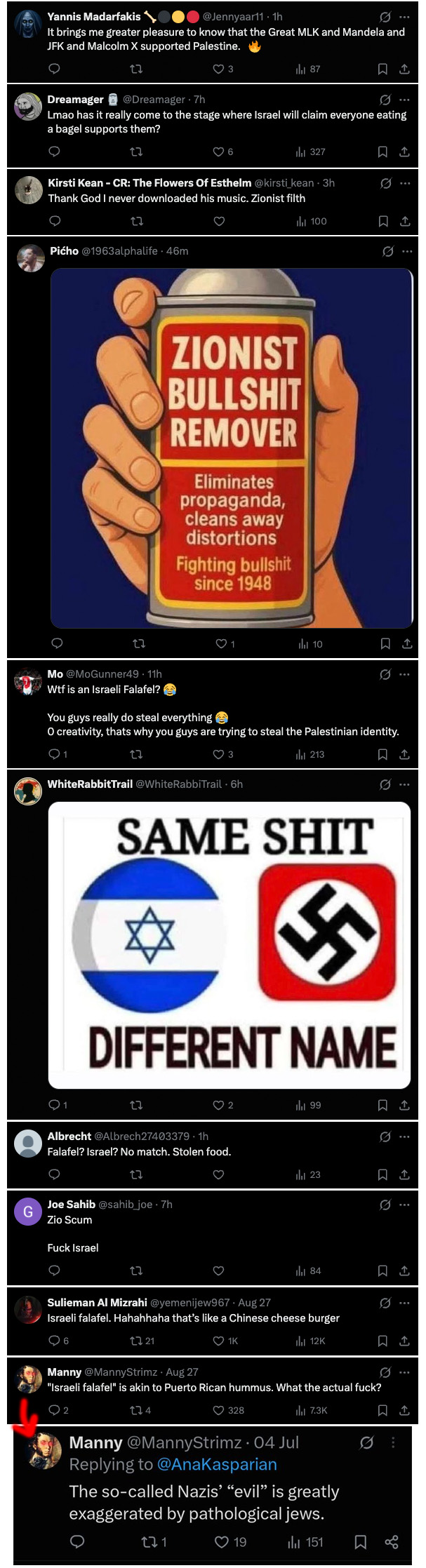
What is an Israeli falafel. You people steal everything. No creativity, that is why you are trying to steal the Palestinian identity. Falafel? Israel? No match, stolen food. Israeli falafel, that is like a Chinese cheese burger. One guy just posted “Zio Scum” and then, on a separate line, in case the nuance was lost, an instruction regarding Israel.
Okay. Story time. Let us do the food history, quickly, because it actually goes hard (olds: it is genuinely good) and because approximately none of these people have done it.
Falafel is Egyptian. Not Israeli, not Palestinian, Egyptian, no cap (olds: I am not exaggerating). The original is called ta’amiya, it is made from fava beans and not chickpeas, it is bright green inside from all the herbs, and the most commonly repeated theory is that Coptic Christians invented it as a protein source during Lent. Meaning the ur-falafel, the OG, the patient zero of the entire genre, is a Christian Egyptian Lent food. Chickpeas were not invited. It travelled north into the Levant, meaning modern Syria, Lebanon, Jordan and Palestine, and somewhere along that road the fava beans got subbed for chickpeas and the version everyone is currently fighting about was born.
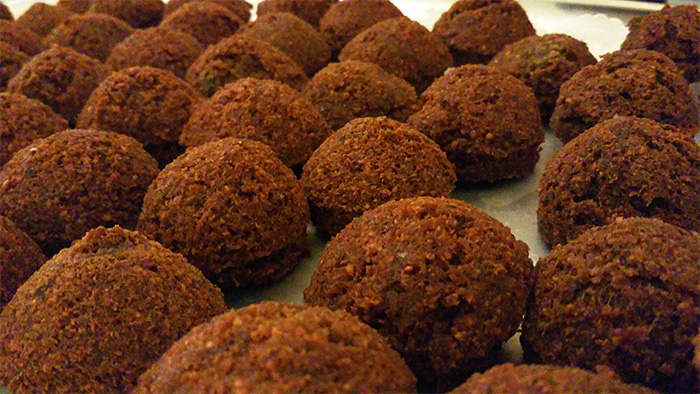
Which means that when someone tells you falafel is uniquely Palestinian, clock what they have just done (olds: notice it). They have applied a rule about culinary origin that, if you actually run it, means Palestinian falafel is Egyptian. Every single account currently posting about theft owes Cairo an apology and a fruit basket. They will not send one, because the rule is not a rule, bestie. It only switches on when the person eating is a Jew.
Now here is what Israelis actually contributed, and it is not the fritter, and nobody serious has ever claimed it was the fritter.
The earliest known written mention of falafel served inside a pocket of pita comes from a 1939 article in The Palestine Post, which is, and I love this, the same newspaper that is now called The Jerusalem Post. At that point the street food scene in Mandate Palestine was overwhelmingly Arab vendors. Fine. Conceded. Not the Jews.
What happened next is that Israel was established, and then something like 48,000 Yemenite Jews were airlifted into a brand new country that was rationing food and had nowhere to put them. Broke, displaced, unemployable. A lot of them opened falafel stands, because the barrier to entry was a fryer.
And what they built was not the falafel ball. It was the delivery system. They took the pita and made it thicker and fluffier, closer to saluf, the thick Yemenite flatbread their grandmothers made by slapping wet dough onto the inside wall of a clay taboun oven, because a thin Levantine flatbread structurally cannot hold eight falafel balls and a liter of tahini without failing at the bottom. They engineered a sandwich that does not leak. That is real design. That is understanding the assignment (olds: doing exactly what the job required). Then they loaded it with everything, including zhug, the murderous green chili paste they brought from Yemen, and eventually amba, the pickled mango sauce Iraqi Jews brought from Baghdad. The drip is immaculate (olds: the whole assembly is beautiful) and every single component has a passport. The food historian Gil Marks dates the popularization of the pita falafel sandwich to exactly this period.
Which puts the actual accusation on the table, which is that Jewish refugees from Yemen, Iraq and Egypt stole their own grandmothers’ cooking. That they committed appropriation against themselves. That a Mizrahi kid whose family had been eating a version of this dish for six or eight generations in Sana’a is a thief for frying it in Jerusalem.
That is not a food argument. That is not even a bad food argument. It is just the other thing wearing a food argument like a hat.
And you can prove it from the timeline, which brings me to Manny.
Manny is an account that posted, on August 27, that “Israeli falafel” is akin to Puerto Rican hummus, what the actual something. Cute. Got 328 likes. The kind of post that reads as a normal person being normal-annoying about cultural authenticity.
On July 4, the same account, replying to Ana Kasparian, wrote that the so-called Nazis’ evil is greatly exaggerated by pathological Jews.
Seven weeks. Same guy. In July he is doing Holocaust denial with the quotation marks around “evil” and everything, and in August he is a concerned defender of Levantine culinary heritage. He did not develop a sudden passion for chickpea provenance. He found a thread where his actual position was welcome as long as he swapped one noun for another.
The falafel is a costume. It is a really convenient costume, too, because it lets a person be openly disgusting about Jews while sounding like they are defending a dispossessed people’s cuisine, and it gets them a friendly reply section instead of a suspension. Scroll the same thread and you will find a Nazi flag meme, a cartoon of a spray can labelled Zionist Bullshit Remover, fighting bullshit since 1948, which is a date doing an enormous amount of work, and a person thanking God she never downloaded Lenny Kravitz’s music because he is now, and I quote, filth.
He took a picture with a falafel guy.
Here is the part that made me put my phone down, though, and it goes back to Vanessa Paradis.
In January 2011, Paradis was scheduled to play Tel Aviv on February 10. Her first show ever in Israel. She was due to arrive with her partner Johnny Depp, who she never married despite fourteen years and everyone on earth assuming otherwise, and their two kids, Lily-Rose, then 11, and John Christopher, then 8. Isabelle Adjani was coming. Karl Lagerfeld was coming, and not as a plus one. Lagerfeld ran Chanel. He was its creative director from 1983 until he died in 2019, he made it what it is, and he had personally chosen Paradis as the face of the house in 1991. The head of Chanel was getting on a plane to Tel Aviv to watch his muse sing.
BDS France sent her a letter. Worth reading the register on it. They came at her as a mother, as the patron of a children’s wish charity, and asked her to think about Palestinian children who cannot dream. On January 15 the promoters announced the cancellation, and her manager David Stern told AFP it was purely for professional reasons and nothing else.
Tel Aviv was the only date she cancelled on the entire tour. Every other show went ahead. Haaretz reported that the concert’s own organizers said she had given in to the campaign, that activists had been sending letters and waiting outside her other shows threatening to boycott her too, and that what drew the campaign’s attention in the first place was Depp coming along.
I am not here to drag Vanessa Paradis. I am here to point out that neither she nor Lily-Rose has ever, as far as I can find anywhere, said a single public word about Israel or Palestine. Not one. She is a French pop star who has been the face of a handbag company since before I existed and who is now married to a Jewish director, Samuel Benchetrit, and who once dated a Jewish rock star and took him for falafel. That is the whole file.
She got conscripted anyway. So did Kravitz, last week, for the crime of a photograph.
Which brings us to the address, and I need you to be holding something.
L’As is at 34 rue des Rosiers. The street is 380 metres long, which is about a four minute walk end to end, and at the other end of it, at number 7, there is a storefront that used to be Chez Jo Goldenberg, the most famous Jewish deli in Paris. On August 9, 1982, at about 1:15 in the afternoon, men walked up to it, threw a grenade into a dining room holding around fifty people, and then came in with submachine guns and kept firing into the crowd as they ran back through the Marais. The whole thing took three minutes. Six dead. Twenty-two wounded. It is still the deadliest Antisemitic attack in France since the Shoah, and it was carried out by the Abu Nidal Organization, a Palestinian group that had split off from Fatah.
Now there is a ceremony outside number 7 every August and the names get read out loud. This year it was on Friday August 7, the forty-fourth anniversary, two weeks before Lenny Kravitz showed up down the block. But get this. Yohann Taïeb, who leads the collective of victims’ families, told CNews that the annual commemorations only started after the 2015 Paris attacks. Before that, nothing. Thirty-three years of nobody standing on that pavement in August.
The names. André Hezkia Niego. Mohamed Bennemou. Grace Cutler. Anne Van Zanten. Denise Guerche Rossignol. Georges Demeter.
Read those again. One of the six people murdered in the deadliest Antisemitic attack in postwar France was a Muslim man. And André Niego, whose sister Jacqueline read the names at the last commemoration, had survived the Shoah. He got out of that, came to Paris, and was killed eating lunch thirty-seven years later on a street where Jews had lived for a hundred years.
That case sat unsolved for four decades. Then in September 2025 the Palestinian Authority arrested a man named Hicham Harb, real name Mahmoud Khader Abed Adra, accused of leading the commando and firing on the diners himself. In April of this year he was extradited to France. In July the Paris appeals court threw out his challenge. He and five other men have been referred to trial. It is the oldest open terrorism case in the French justice system and it is finally, actually moving.
That is the street. That is the actual context of the photograph.
At one end of it, a family business that has been feeding people since 1979, run by the son of a man from Tel Aviv and a woman from Tunis, whose international fame started because a Black Jewish rock star from Brooklyn kept coming in thirty years ago with his French girlfriend. At the other end, four minutes away, the site of a massacre whose alleged ringleader is sitting in French custody right now waiting for a jury.
Lenny Kravitz stood on that pavement on a Wednesday in August and took a picture with the guy who makes the sandwiches.
And thousands of people looked at that, at all of that, and concluded that the crime being committed was chickpeas.
The restaurant has a name. It is L’As du Fallafel, it is at 34 rue des Rosiers, and it is kosher, which is why it shuts Friday at sundown and stays shut all day Saturday while the rest of the Marais is doing its busiest tourist trade of the week. Go before noon to avoid the insane linesss. Falafel and shawarma are perfectly acceptable brunch foods and I will not be taking questions on that. Take the takeout window rather than the sit-down line, because the takeout line moves and the other one does not. Then take your enormous sandwich into the alley and eat it leaning against a wall like a raccoon. Again, not taking questions.
Get the shawarma one too. Tell Yomi that Lenny sent you. Apparently he did.

- The Restaurant Has a Name, Besties! - 8/29/2026
- Everyone in the Clavicular Israel Story Is a Little Bit Awful, Actually - 7/13/2026
- JVP Isn’t After My $20. It’s After Us. - 7/3/2026