
A narrative history, 1948–1985
A Note on Why This Piece Exists
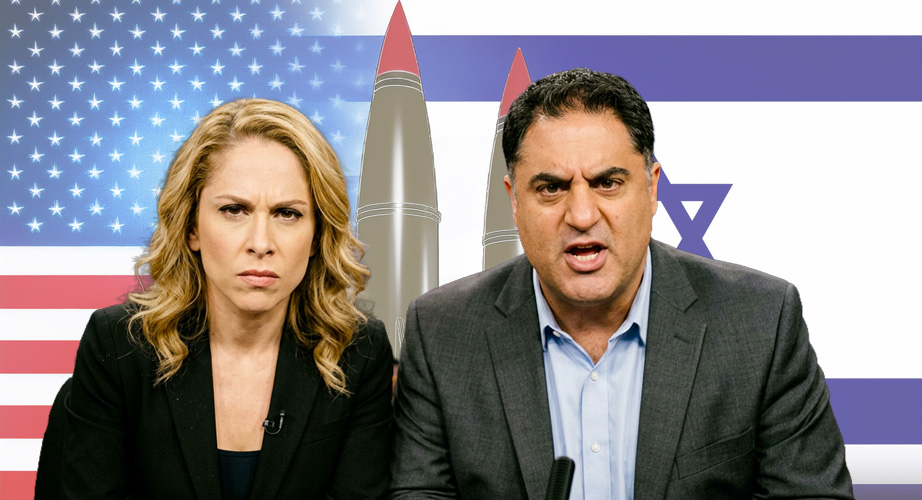
Cenk Uygur, founder of The Young Turks, is one of the most predictable voices in media today. Whether on his own show or as a frequent guest on Piers Morgan Uncensored, the destination is always the same: Israel is wrong. To get there he relies on a rotating set of tropes, repeated with such confidence that they start to sound like established fact. They aren’t.
The tropes don’t emerge from nowhere. They are created and amplified by an entire ecosystem of anti-Israel voices whose primary goal is not to help Palestinians but to use the Israel-Palestine conflict as a wedge, driving division between Israel and the Western countries that support it. Cenk is one of that ecosystem’s most effective distributors, reaching millions of subscribers who hear the same claims enough times to absorb them as truth.
One of the most persistent of those claims is that Israel stole nuclear materials and technology from the United States, robbing its closest ally of bomb-grade uranium and classified secrets to build its nuclear arsenal. In this video, Cenk states it plainly: “Israel stole our uranium. And our nuclear secrets. And the triggers. And we didn’t do anything. We just gave them more money.”
It makes for a compelling talking point. The problem is that it fundamentally misrepresents what actually happened. The full historical record, which Cenk either hasn’t read or has chosen to ignore, tells a very different story.
The record we are going to lay out does not whitewash Israel’s nuclear program. Israel acquired fissile material through channels that were covert, sometimes illegal under existing agreements, and deliberately obscured from public view. Uranium almost certainly was diverted from an American processing plant in Pennsylvania. A ship carrying 200 tons of yellowcake vanished in the Mediterranean in one of the most audacious covert operations of the Cold War. French reactor technology and Norwegian heavy water were obtained under cover of civilian energy programs. None of that is in dispute.
What is in dispute, what the full record demolishes, is the framing of these events as theft from an unwitting victim. The United States government, at the highest levels and across multiple administrations, knew what Israel was doing. The CIA tracked it. American presidents were briefed on it. Inspectors were sent to Dimona with instructions designed to produce reassuring rather than accurate reports. Western intelligence agencies were formally called in to investigate the missing yellowcake and chose to do nothing. And in September 1969, President Nixon and Prime Minister Golda Meir reached a private understanding (no notes, no witnesses) that formalized what had been an informal policy for more than a decade: the United States would tolerate a nuclear-armed Israel, and neither side would ever say so publicly.
This was not naivety. It was strategy. Israel was providing the United States with intelligence on Soviet weapons systems, military doctrine, and nuclear capabilities that no other ally could supply, intelligence that directly shaped American nuclear strategy and arms control positions throughout the Cold War. The relationship was reciprocal, deliberately maintained, and structured to ensure that neither side ever had to formally acknowledge what both sides clearly understood.
Two former officials of the US Nuclear Regulatory Commission, writing in the Bulletin of the Atomic Scientists, have concluded that the evidence supports the conclusion that uranium was diverted from NUMEC and ended up in Israeli bombs. Their technical analysis deserves respect. But their regulatory vantage point did not give them visibility into the policy and intelligence framework surrounding NUMEC: the CIA’s institutional choice not to pursue the investigation, the AEC’s active suppression of the FBI inquiry, the Nixon-Meir understanding that had already been reached, the broader architecture of American complicity that transformed what looks like theft in isolation into something far more complicated in context. The tree was real. They just couldn’t see the forest.
When Cenk Uygur says Israel stole uranium and nuclear secrets from the United States, he is not drawing on this full picture. He is presenting one thread of a very complicated story as if it were the whole cloth, while omitting the documented record of American institutional complicity that surrounds every single one of those episodes. That omission is not a minor oversight. It is the difference between a fact and a smear.
What follows is the full record. Judge for yourself.
Prologue: The Shadow of the Ovens
David Ben-Gurion was not a sentimental man. He was a pragmatist, a street fighter, a political animal who had willed a state into existence through sheer tenacity. But he had one overwhelming, almost cellular conviction, forged in the fires of the Holocaust: the Jewish people could never again depend on anyone else for their survival. Not the British. Not the Americans. Not the United Nations. No one.
By 1948, the new State of Israel had beaten back five Arab armies with a combination of desperation, improvised weapons, smuggled Czech rifles, and tactics that bordered on madness. They had won. But Ben-Gurion understood, more clearly than his generals, that they had barely won, and that the next war, and the one after that, might not go the same way. Israel was a country the size of New Jersey, surrounded by enemies who publicly promised its annihilation and outnumbered its population by a factor of forty to one.
He reached a conclusion that would reshape the Middle East for the next seventy years: Israel needed the ultimate weapon. The one that made conventional arithmetic irrelevant. The one that transformed a small, besieged nation into something no rational enemy would risk destroying.
He needed the bomb.
What followed was one of the most audacious and consequential covert programs of the Cold War era, built on French technology, Norwegian heavy water, Argentine yellowcake, and American-sourced bomb-grade uranium. It was sustained not primarily by deception but by something more sophisticated: a system of mutually maintained ambiguity, in which Israel provided just enough formal deniability for Western governments to avoid confrontations none of them ultimately wanted to have. It succeeded because Israel was determined, because the Cold War created a geopolitical logic that made a nuclear-armed Israel quietly convenient, and because the powers that could have stopped it, above all the United States, had strong reasons of their own to look the other way.
Part One: Einstein’s Children (1948–1956)
Ben-Gurion began recruiting even before the 1948 war ended. His model was the Manhattan Project, proof that a concentrated group of brilliant scientists could accomplish the impossible in a short time. He was fond of reminding people that Einstein, Oppenheimer, and Teller were all Jewish. What they had built for America, Jewish scientists could build for Israel.
The instrument for this ambition was Ernst David Bergmann, a German-born chemist and head of the Weizmann Institute‘s science division. Bergmann became the scientific patron of the Israeli bomb project almost from the day of independence. He also became, for two decades, one of the most quietly influential men in the country, a figure who operated largely in the shadows, cultivating relationships with foreign scientists and institutions, and building the intellectual infrastructure Israel would need.
In 1949, a unit of the Israel Defense Forces called HEMED GIMMEL, the Hebrew acronym for the Science Corps, began a two-year geological survey of the Negev Desert, ostensibly looking for oil. Among other objectives: finding uranium deposits. They found some, in the phosphate deposits of the region, though not nearly enough to fuel a weapons program.
Meanwhile, the French connection was forming.
France in the early 1950s was a country with deep insecurities and grand ambitions. Humiliated by the Nazi occupation, overshadowed by the Anglo-American alliance, and watching its empire fracture in Vietnam and North Africa, France was determined to become a great power again. It had decided that nuclear weapons were the key. The French Commissariat à l’Énergie Atomique (CEA) was building expertise and infrastructure, but operating largely outside the Anglo-American nuclear sharing arrangements established under the wartime McMahon Act. France had to build its program largely alone, and it needed partners.
Israel was a natural fit. Both countries felt excluded and threatened. Both had deep institutional networks connecting their scientific and defense establishments. Israeli scientists had been invited to participate in the French nuclear program as early as 1949. Friendships formed at conferences and laboratories in Paris. Trust was established the way trust usually is in intelligence circles, slowly, personally, and outside of formal channels.
The man who turned these informal bonds into a formal alliance was Shimon Peres, then a 28-year-old official in Israel’s Defense Ministry, impossibly young for what he was attempting and arguably the most consequential arms dealer in Israeli history. Peres spoke French, loved Paris, moved easily in French political circles, and possessed a gift for building relationships that would pay off years later. He began laying the groundwork for a nuclear partnership with France in the early 1950s, weaving together commercial, military, and scientific threads into what would eventually become a full strategic alliance.
The pivot moment came in 1956.
Part Two: Suez, and the Shadow of Soviet Missiles (1956–1958)
In October 1956, Israel, France, and Britain launched a joint military operation against Egypt. The ostensible cause was Nasser’s nationalization of the Suez Canal; the real motivations were more complex. France wanted to punish Nasser for supporting Algerian rebels, Britain wanted to reassert imperial prerogative, and Israel wanted to destroy the Egyptian military before it could absorb the Soviet weapons pouring into Cairo.
The operation worked militarily and was a catastrophe diplomatically. Eisenhower was furious. The attack had blindsided Washington and complicated American Cold War positioning. He threatened economic sanctions against Britain and effectively forced all three countries to withdraw. The episode was a profound humiliation, particularly for Britain and France, and it demonstrated with crystal clarity how dependent on American goodwill the Western powers actually were.
But something else happened during Suez that is less well remembered: the Soviets issued nuclear threats.
As Israeli, French, and British forces advanced, Soviet Premier Bulganin sent letters to the three governments warning of possible Soviet intervention, including the barely veiled implication of nuclear missiles. The threats were mostly bluster, but they landed. For France and Israel, both of whom were already pursuing nuclear programs, the Suez crisis hardened a conclusion they had been approaching for some time: in the nuclear age, great powers could bully and threaten middle powers with impunity unless the middle powers had nuclear deterrents of their own.
In the immediate aftermath of Suez, that same autumn, France agreed to help Israel build not a small research reactor, but a real plutonium-producing facility. The scale of the commitment was extraordinary: France would provide a 24-megawatt reactor, the technical expertise to build it, and, in protocols that were deliberately not written down, a chemical reprocessing plant capable of separating weapons-grade plutonium from spent reactor fuel.
Shimon Peres signed the Dimona package in Paris on October 3, 1957. The reactor would be built in the Negev Desert, far from prying eyes, at a site officially designated as a textile factory.
France also provided something beyond hardware: access to its nuclear weapons design data. When France conducted its first nuclear tests in 1960, Israeli scientists were present alongside their French counterparts, with access to all test results. The knowledge transfer was as significant as the machinery.
Hundreds of French engineers and technicians began arriving in the Beersheba and Dimona area in late 1957 and 1958. The construction effort was massive, secretive, and mostly successful at remaining hidden. The Israelis even built a fake control room, a sanitized version of the facility that inspectors could be shown without seeing anything sensitive. The real heart of Dimona was underground: a six-story plutonium reprocessing facility, hidden beneath the desert floor, which almost no one outside a tiny circle of Israeli and French officials even knew existed.
Part Three: Eisenhower’s “Atoms for Peace” and the Architecture of Deniability (1955–1960)
There was a parallel track, running simultaneously and openly, which provided both governments with something they found useful: a publicly defensible story.
In 1953, President Eisenhower had launched “Atoms for Peace,” a program to share civilian nuclear technology with friendly nations, in the hope that doing so openly would reduce the pressure for secret weapons programs. Israel was the second country in the world to sign on, in July 1955.
The result was a small, legitimate research reactor at Nachal Soreq, built with American assistance and subject to International Atomic Energy Agency (IAEA) safeguards. It gave Israel’s nuclear program a respectable public face and gave American officials something they could point to when asked about Israeli nuclear ambitions. The real program at Dimona, three hundred kilometers to the south in the Negev, continued in deliberate obscurity, and that obscurity served Washington’s purposes nearly as well as Jerusalem’s.
The arrangement became harder to sustain in December 1960. American U-2 reconnaissance aircraft had been flying over the Middle East for years, and analysts poring over photographs of the Negev finally had to confront what they were looking at: the unmistakable profile of a large nuclear facility under construction. The Eisenhower administration, in its final weeks, could no longer claim not to know. The question now was what to do about it.
Ben-Gurion went to the Knesset in December 1960 and acknowledged that a reactor existed at Dimona, but insisted it was for peaceful purposes. A desalination project, he suggested. An “agricultural paradise” for the Negev. The claim was transparently implausible to anyone who had seen the U-2 photographs, but it gave everyone the formulation they needed: Israel had spoken, however unconvincingly, and the question was now officially answered. Six of the seven members of Israel’s own Atomic Energy Commission promptly resigned in protest, warning that the program represented “political adventurism which will unite the world against us.”
Ben-Gurion brushed them aside. He had work to do.
Part Four: Kennedy’s Contradiction (1961–1963)
John F. Kennedy arrived in the White House in January 1961 convinced that nuclear proliferation was among the gravest threats to humanity. His position was not idealistic posturing. He had read the intelligence, he understood what the spread of nuclear weapons meant for stability, and he spoke about it with genuine urgency. He was determined that no new state would join the club on his watch if he could prevent it.
But Kennedy also had another commitment, running directly against the first: a deep political investment in the American Jewish community, whose support he considered essential to his re-election in 1964. And these two commitments were about to collide directly over a reactor in the Negev Desert.
The man Kennedy chose to manage that collision tells you almost everything you need to know about how he actually intended to handle it. His point man on Israel, the person he delegated to manage all sensitive bilateral dialogue on Dimona, was Myer “Mike” Feldman), his Deputy Special Counsel and informal White House liaison to the Jewish community. When Feldman told Kennedy he might not be the right person for the job because of his open bias in favor of Israel, Kennedy replied that was precisely why he wanted him. Kennedy then delegated the two most sensitive issues in the relationship, Palestinian refugees and the nuclear program, directly to Feldman, bypassing the State Department professionals who resented the arrangement bitterly.
This was not a bureaucratic accident. It was a choice. And it shaped everything that followed.
Kennedy pressed Ben-Gurion for American scientists to visit Dimona, with regular, thorough, twice-yearly inspections covering all parts of the facility. Ben-Gurion’s instinct was delay: domestic political crises, Jewish holidays, anything to push the date back. He was helped by the genuine chaos of the period: the Bay of Pigs disaster in April 1961, Kennedy’s humiliation by Khrushchev in Vienna) that June, the Berlin crisis that consumed the summer. But by late March 1961, Ben-Gurion’s diary records that he had been persuaded by Feldman and Kennedy’s informal ally Abraham Feinberg, an American Jewish fundraiser who had been involved in financing Dimona itself, that allowing an inspection, in exchange for a coveted personal meeting with Kennedy, was the price of keeping the nuclear project alive. The inspection was not extracted from Israel as a hard-won concession. It was brokered by men who were invested in the program’s survival, as a deal that served Israel’s interests.
The inspection took place on Saturday, May 20, 1961, the Jewish Sabbath, when most Dimona staff were conveniently absent. The American scientists were not permitted to bring measuring instruments. Their Israeli hosts lectured them at length, limiting actual inspection time. The underground plutonium reprocessing facility, the entire operational heart of the weapons program, was never mentioned, let alone shown. And the two scientists who made the visit had been, as Feldman later confirmed in an oral history interview, handpicked after considering who would be acceptable to Israel.
The report the scientists brought back concluded that Dimona appeared to be of “peaceful character.” Kennedy used it to have a relaxed, amicable meeting with Ben-Gurion in New York ten days later. And in that meeting, Kennedy told Ben-Gurion something remarkable, not “you must stop,” but something closer to a shared acknowledgment of what the exercise had actually been for. A woman, Kennedy said, should not only be virtuous but should also have the appearance of virtue. It was in both their interests, he continued, that no one think Israel was involved in nuclear proliferation. He asked Ben-Gurion for permission to share the inspection findings with Arab states, to use the report as diplomatic cover.
Ben-Gurion agreed readily. He could afford to.
In that same meeting, Ben-Gurion also said something that should have stopped Kennedy cold, and it didn’t. Israel’s purpose at Dimona was peaceful, he said, for the time being. After three or four years, Israel might want to develop a pilot plant for plutonium separation. But there was no intention to develop weapons capacity now. It was not a renunciation. It was a timeline, spoken aloud to the President of the United States, in the Oval Office equivalent of a hotel suite in New York. Kennedy let it pass. Ben-Gurion later noted privately that a future shift in policy could always be traced back to this candid senior meeting; he had been honest enough that no one could later accuse him of pure deception.
The CIA, meanwhile, was drawing its own conclusions. A National Intelligence Estimate issued in October 1961 assessed that the Israeli nuclear project was weapons-oriented, contradicting what Ben-Gurion had been telling American officials was false. The intelligence community was not confused. It knew. The inspections were not generating new knowledge; they were generating political cover for knowledge that already existed.
Then came October 1962, and something shifted.
The Cuban Missile Crisis lasted thirteen days and brought the world closer to nuclear annihilation than it had ever been. Soviet ships carrying missiles steamed toward a US naval blockade. Kennedy and Khrushchev exchanged messages that would determine the fate of millions. It was resolved through a combination of diplomatic skill, back-channel communication, and extraordinary luck. But it crystallized, viscerally and permanently, just how catastrophically dangerous proliferation was. If the Soviets could bring the world to the brink by placing missiles ninety miles from Florida, what happened when a dozen regional powers had weapons and the superpower framework of mutual deterrence no longer applied?
After the Missile Crisis, something in Kennedy hardened. Beginning in April 1963, he demanded genuine semi-annual inspections of Dimona: full access, qualified scientists, no stage management. His letters to Ben-Gurion and then to his successor Levi Eshkol carried an unmistakable ultimatum: Washington’s commitment to Israel could be “seriously jeopardized” if reliable information about Dimona was not forthcoming. For the first time, an American president was explicitly linking the entire bilateral relationship to nuclear transparency.
Ben-Gurion fought back with the only tool available to him: changing the subject. Egypt, Syria, and Iraq had just signed an Arab Federation proclamation calling for the liberation of Palestine. Ben-Gurion seized on it as an existential threat, writing to Kennedy about Arab military encirclement while deflecting every question about Dimona. Kennedy dismissed the Arab Federation as largely rhetorical and refused to be moved. The confrontation was reaching a genuine peak, the most direct clash between an American president and an Israeli prime minister that has ever been documented.
In June 1963, Kennedy sent what historians call his ultimatum letter. It was scheduled to be delivered on June 16.
On June 16, Ben-Gurion resigned.
Whether the timing was coincidental remains debated. His governing coalition was under pressure from several directions, including a long-running political scandal. But the effect was to reset the clock, forcing Kennedy to begin the confrontation anew with Eshkol, a less domineering personality, more conciliatory in tone if not in practice.
Then, on November 22, 1963, Kennedy was shot dead in Dallas.
Israel invited American scientists to inspect Dimona in December, notably and pointedly only once Kennedy was gone.
That timing has fed a persistent conspiracy theory: that Israel had a hand in Kennedy’s assassination, motivated by his pressure on Dimona. The theory deserves a direct answer, because the documented record makes it not just unproven but logically incoherent. The theory rests on the premise that Israel needed Kennedy dead to protect the nuclear program. But everything we now know about the actual state of that program in late 1963 demolishes the premise. Israel didn’t need Kennedy assassinated. It needed him to keep doing exactly what he was already doing. The inspection regime was theatrical. The man running Israel policy from inside the White House was openly pro-Israel. Ben-Gurion had delivered a veiled nuclear timeline to Kennedy’s face and Kennedy had let it pass. The ultimatum letters were real, but the institutional machinery underneath them was not. Israel’s strategy of delay, managed ambiguity, and back-channel diplomacy was working. Ben-Gurion had already escaped the immediate pressure by resigning in June, five months before Dallas, calculating, correctly, that Eshkol would face less personal heat and that the confrontation could be reset and defused. There was no rational basis, from the Israeli side, to conclude that Kennedy’s death was necessary when his political constraints were already doing the work. Conspiracy theories about Dimona and Dallas say more about how shocking Kennedy’s assassination was, and how badly people want a tidy explanation for it, than about anything Israel actually did. The record is damning enough without inventing crimes that the evidence doesn’t support.
The honest verdict on Kennedy and Dimona is uncomfortable. He had three genuine but incompatible commitments: nonproliferation as a global principle, the need to keep Soviet influence in check as an existential necessity, and Israel’s security and the domestic relationship with American Jewry. When those commitments collided, he didn’t resolve the contradiction. He managed it, by placing a self-declared pro-Israel fixer in charge of the most sensitive nuclear question in the bilateral relationship, by accepting inspection arrangements he knew were theatrical, and by listening to Ben-Gurion essentially describe a weapons timeline without pressing the point. The ultimatum letters of 1963 were real, and it is possible, historians still debate it, that Kennedy would have forced a genuine reckoning had he lived. But the record of what he actually did, rather than what he wrote, suggests a president whose institutional choices made it easier, not harder, for Israel to cross the threshold. His complicity was not cynical, like Nixon’s. It was the complicity of a man who could not bring himself to make his stated convictions cost him something.
Part Five: The Bargain Takes Shape, and the Uranium Disappears (1963–1969)
Lyndon Johnson was a more complicated figure on this question than Kennedy. He was opposed to Israel having the bomb, in principle. He continued to press for inspections. But he was also a man who worked in the currency of relationships, who had deep personal and political ties to the American Jewish community, who was increasingly consumed by Vietnam, and who was far more comfortable than Kennedy with the idea that some problems are better managed than solved.
By the mid-1960s, the tacit bargain had settled into a stable routine. American inspectors visited Dimona periodically, but the visits were understood by both sides for what they were: exercises in managed ambiguity rather than genuine verification. The Israelis showed visitors a carefully curated version of the facility. The real work, the plutonium reprocessing in the underground chambers, the weapons design calculations, the assembly of components, happened in spaces the inspectors were never taken to. The underground reprocessing plant remained invisible to American scientists for years.
The inspectors returned to Washington with reports that were carefully inconclusive. American officials who read those reports alongside CIA intelligence understood exactly what they were looking at. But understanding and acting are different things, and the political logic consistently favored not acting. A nuclear-armed Israel was becoming a strategic fact; the question was only how explicitly to acknowledge it.
Meanwhile, Israel needed uranium, and lots of it.
France had been supplying uranium fuel for Dimona, but in the early 1960s de Gaulle began restricting the supply, unwilling to be directly implicated in an Israeli weapons program. Israel turned, in characteristic fashion, to multiple simultaneous covert channels.
From Argentina, it purchased yellowcake through opaque commercial arrangements that American and British intelligence tracked but never effectively blocked. From South Africa, it obtained materials through a relationship that would deepen over the following decade into what amounted to mutual nuclear complicity. And from a small nuclear fuel processing plant in Apollo, Pennsylvania, a facility called the Nuclear Materials and Equipment Corporation run by a committed Zionist named Zalman Shapiro, bomb-grade uranium began, the CIA concluded, to disappear.
The NUMEC affair, as it came to be known, was the most brazen piece of the entire story. Between the late 1950s and 1968, somewhere between 200 and 600 pounds of weapons-grade uranium-235 went missing from the Apollo plant, enough potentially for several nuclear weapons. The losses were attributed at the time to sloppy accounting and processing waste. The US Atomic Energy Commission, the federal agency responsible for regulating nuclear materials and entirely distinct from Israel’s own Atomic Energy Commission mentioned earlier, accepted this explanation. NUMEC paid an $834,000 fine to the AEC for the missing material and the matter was administratively closed. The FBI opened a criminal investigation, then was talked out of pursuing it by the AEC itself, which was more concerned about public confidence in civilian nuclear power than about where the uranium had actually gone.
In September 1968, four Israeli intelligence officials visited the NUMEC plant. One of them was Rafi Eitan, the same Mossad operative who had organized the capture of Adolf Eichmann in Buenos Aires eight years earlier, and who would later be caught running Jonathan Pollard as a spy inside the US Navy. His listed purpose at NUMEC was “defense ministry chemist.” By 1976, the CIA’s deputy director for science and technology was telling the Nuclear Regulatory Commission, in a closed briefing, that the agency believed the missing uranium was in Israeli bombs.
No charges were ever filed. No one was ever prosecuted. The AEC had actively discouraged a criminal investigation, less from pro-Israel sympathy than from institutional self-interest: public exposure of the NUMEC losses would have raised devastating questions about the AEC’s oversight of nuclear materials in private hands, at precisely the moment it was trying to build public confidence in civilian nuclear power. The Carter administration, despite Carter’s genuine commitment to nonproliferation, worked to keep the story suppressed. The incentives to not look too hard ran across multiple agencies, multiple administrations, and multiple motivations, and that is precisely why nothing happened.
The same year Eitan visited NUMEC, Mossad executed another audacious acquisition, one so brazen it would eventually inspire a Ken Follett thriller. In November 1968, a small freighter called the Scheersberg A departed Antwerp flying a Liberian flag, its hold packed with 560 drums of yellowcake, 200 tons of uranium oxide mined in the Belgian Congo, and purchased through a web of Mossad front companies. The paperwork described a routine commercial transaction: a German chemical firm selling to an Italian paint company for processing. Euratom, the European nuclear regulatory body, had licensed the shipment on exactly that basis. The drums were labeled “Plumbat,” a harmless lead derivative, and the ship’s original Spanish crew had been quietly replaced with Mossad operatives carrying forged passports.
The Scheersberg A never reached Genoa. Approximately seven days into its voyage, somewhere east of Crete, under cover of darkness and with Israeli gunboats standing watch, it rendezvoused with an Israeli freighter. The 560 drums were transferred in near silence. The Israeli ship set course for Haifa, and eventually for the six-level underground chemical plant at Dimona. The Scheersberg A continued to Turkey, docking empty, several pages torn from its log, its hull bearing fresh scrape marks from the transfer. The Italian paint company was told the cargo had mysteriously disappeared (they assumed piracy) and kept a $12,000 advance payment as compensation.
When the ship reappeared without its cargo, Euratom launched an inquiry. Its investigators quickly hit a wall: the agency had no police powers. After a few months of getting nowhere, Euratom formally called on the security forces of Western nations for help. The CIA, British intelligence, and their European counterparts were all brought in, agencies that had been monitoring Dimona by satellite and U-2 overflight for nearly a decade, that had concluded NUMEC uranium was already in Israeli bombs, and that had been tracking Israel’s covert uranium procurement across multiple continents. The notion that these agencies could not identify what had happened to 200 tons of yellowcake in the Mediterranean, transferred in the dark between two ships, with Israeli naval escort, to a country with exactly one reactor capable of processing it, is not remotely credible. What they could not do, or chose not to do, was make it a formal confrontation. The pattern was by now entirely familiar: know, document, decline to act.
The affair stayed out of public view for nearly a decade. It was not broken open by any intelligence investigation. It was exposed by accident, through one of the more darkly comic episodes in Mossad history.
In July 1973, a fifteen-person Israeli hit team descended on the quiet Norwegian town of Lillehammer as part of Operation Wrath of God, Israel’s campaign to assassinate the architects of the 1972 Munich Olympic massacre. They had been tipped that their target, Black September operations chief Ali Hassan Salameh, was working as a waiter in the town. He wasn’t. The man they shot thirteen times outside his home, in front of his pregnant wife, was Ahmed Bouchiki, an entirely innocent Moroccan waiter who had caught their attention by speaking French with a Palestinian courier at a café. The local police, sixteen officers strong in a town that hadn’t seen a murder in decades, moved with surprising efficiency. Mossad had badly underestimated how conspicuous a team of foreigners with rental cars, walkie-talkies, and foreign passports would be in a small Norwegian city. Six agents were arrested within twenty-four hours. Doh!
Under interrogation, the agents talked, one of them, Dan Aerbel, with particular eagerness, reportedly due to severe claustrophobia that made his cell intolerable. Among the details that emerged were references to a Mossad operation involving a ship called the Scheersberg A, and one agent’s connection to the Liberian shell company used to purchase it. Norwegian investigators pulled the thread. The story of Operation Plumbat began to come into focus, not through any formal intelligence process, but through a murder investigation in a Norwegian resort town.
There is also a detail that has received far less attention than it deserves. According to the book Mange Liv by lawyer Annæus Schjødt, who represented two of the agents and later married one of them, Aerbel also provided the Norwegian government with information about the Israeli nuclear weapons program. The Norwegian government, having received this intelligence from a Mossad operative during a murder trial, chose to remain completely silent about it. Norway, which had sold Israel heavy water without safeguards in the late 1950s, now sat on nuclear intelligence and said nothing. The information about Israel’s nuclear weapons would not become public until Mordechai Vanunu disclosed it in a London newspaper in 1986, thirteen years later.
The Plumbat affair itself was finally made public not by Norway, not by any Western government, and not by any intelligence service, but by a single determined American Jew: Paul Leventhal, a former investigative journalist turned Senate staffer who had spent years accumulating knowledge about exactly these kinds of gaps in nuclear oversight. Leventhal had come to Washington in 1969 as press secretary to Senator Jacob Javits, but quickly gravitated toward nuclear policy, serving as special counsel to the Senate Government Operations Committee and deeply immersing himself in proliferation issues. By the mid-1970s he was a research fellow at Harvard’s Program for Science and International Affairs on a Ford Foundation grant, working specifically on nuclear weapons proliferation, the period during which he pieced together the Plumbat story from the fragments left by the Norwegian investigation, the Euratom inquiry, and his own extensive Capitol Hill sourcing.
In April 1977 Leventhal stood up at a non-proliferation conference in Salzburg, Austria, and disclosed Operation Plumbat publicly for the first time, describing a 200-ton yellowcake heist in the Mediterranean that Western intelligence agencies had known about for nearly a decade. He noted the stolen cargo was sufficient to run a reactor like Dimona for up to ten years. The disclosure landed like a stone in a still pond. European Community officials confirmed it. Israel was silent at first, then issued denials.
Leventhal went on to found the Nuclear Control Institute in 1981, launching it with a full-page ad in the New York Times asking: “Will Tomorrow’s Terrorist Have an Atom Bomb?” He spent the next two decades as one of Washington’s most tenacious advocates for tighter controls on nuclear materials, applying the same standard to plutonium programs in Japan, to the US-India nuclear deal, and in his final years, to Iran. He was Jewish, born in Manhattan to a Leventhal father and a Shapiro mother, trained at Columbia, his career launched working for Jacob Javits, and he was not anti-Israel. He was simply someone who believed the rules had to apply to everyone, including the Jewish state, and who found the alternative intolerable. He died in 2007. His disclosure of Plumbat remains one of the most significant acts of nuclear accountability in the Cold War era, not through official channels but by one former journalist who decided the public record mattered.
Israel officially denied everything. It has never acknowledged Operation Plumbat to this day.
Part Six: The Six-Day War and What It Meant (1967)
In June 1967, Israel launched preemptive strikes against Egypt, Syria, and Jordan, destroying their air forces on the ground in the first hours and conquering the Sinai, the West Bank, Gaza, and the Golan Heights in six days. It was one of the most stunning military victories of the twentieth century.
What is less well known is the nuclear dimension of those weeks.
In the days before the war began, as Egyptian forces massed in the Sinai and the Egyptian and Syrian media broadcast promises of annihilation, Israeli leaders confronted the possibility that they might lose, that the Arab coalition might break through and that the conventional military might not be enough. According to later accounts, Israel assembled at least two nuclear devices during the crisis period, a last-resort option against total defeat.
The devices were not used. Israel’s conventional military performance made them unnecessary. But the episode showed what the bomb was actually for, in Israeli strategic thinking: not for use, but for deterrence, the ultimate guarantee that even in the worst case, even if the armies were defeated and the cities burning, there would be a final weapon. The Samson Option, as it would come to be called.
After the Six-Day War, the strategic logic hardened further. Israel was now occupying vast territories, its enemies were humiliated and seeking to reverse the outcome, and the Soviet Union was rearming Egypt and Syria at an accelerating pace. The Cold War was playing out directly in the Middle East. Soviet advisors and Soviet weapons were flowing into Cairo and Damascus. The US was arming Israel, partly as a counterbalance. Both superpowers were using regional clients to fight proxy conflicts while avoiding direct confrontation. Nuclear weapons, in this context, were not just about the Arab-Israeli conflict. They were about where Israel fit in the Cold War power balance, and about what the Soviets might be willing to risk if they believed they could destroy Israel without triggering American retaliation.
Part Seven: The Secret Deal (1969)
By 1969, the CIA estimated that Israel had probably already assembled nuclear weapons. The program had been underway for more than a decade. The plutonium reprocessing plant at Dimona had been operational long enough to have produced meaningful quantities of fissile material. The weapons design work, informed by access to French nuclear test data and by the intellectual network of Jewish-American scientists who had consulted and shared information over the years, had presumably reached a conclusion.
Richard Nixon entered the White House in January 1969 with a fundamentally different attitude than Kennedy or Johnson. Nixon and Kissinger were realists, not in the casual sense but in the rigorous strategic sense. They evaluated the world in terms of power, interests, and balance, not norms or principles. They were building a new relationship with China, negotiating the Strategic Arms Limitation Treaty (SALT) with the Soviets, and executing a theory of geopolitics in which every piece moved in relation to every other piece.
A nuclear-armed Israel, in this framework, was not primarily a proliferation problem. It was a strategic asset, a regional power with nuclear capability, tied to the United States, capable of deterring Soviet-backed Arab states without requiring direct American military involvement. Under the Nixon Doctrine, regional allies were supposed to bear more of the burden of their own defense. Israel with nuclear weapons fit that doctrine perfectly.
Kissinger laid out the options in a memorandum to Nixon in July 1969. The memo was candid: Israel appeared to have nuclear weapons, or be very close. American policymakers faced choices ranging from confrontation and military leverage to quiet acceptance. Kissinger and Nixon chose acceptance.
In September 1969, Israeli Prime Minister Golda Meir came to Washington. She and Nixon met alone, no aides and no note-takers. What exactly was said in that room has never been definitively established. No formal written agreement was produced. But the understanding they reached was clear enough from what followed: Israel would maintain nuclear opacity: no tests, no public declarations, no formal acknowledgment of what everyone in the relevant capitals already knew. The United States would stop pressing Israel to sign the Nuclear Non-Proliferation Treaty and would look the other way. In exchange, the relationship would be strengthened through conventional military supply: advanced aircraft, weapons systems, intelligence cooperation.
It was, as historian Avner Cohen described it, “enough credible evidence to deter enemies but sufficient ambiguity and lack of acknowledgment to allow friends to look the other way.”
The deal did not need to be written down. Both Nixon and Meir understood that a declared Israeli nuclear arsenal would create intolerable pressure on the Soviet Union to arm Egypt and Syria with nuclear weapons of their own, turning the Middle East into a theater of nuclear confrontation. Opacity served everyone: Israel got the deterrent, the US got a stable nuclear-armed ally, and the Soviets were not publicly forced into a corner.
Every American president since Nixon has honored the arrangement.
Part Eight: The Abyss, and the Proof (1973)
On October 6, 1973, Yom Kippur, the holiest day of the Jewish year, Egypt and Syria launched a coordinated surprise attack on Israel. Egyptian forces crossed the Suez Canal in massive numbers while Syrian armor poured into the Golan Heights. Israeli defenses, caught off-guard, were overwhelmed in the first hours. For the first time since 1948, the outcome of a war was genuinely in doubt.
The early days were catastrophic. Israeli commanders on the Golan described looking through binoculars at Syrian tanks rolling toward the Jordan River and being unable to stop them with what they had. Egyptian forces established bridgeheads across the canal and pushed into the Sinai. Israel’s vaunted armor and air force were suffering losses at a rate that could not be sustained.
On October 8, two days into the Yom Kippur War, Defense Minister Moshe Dayan went to Prime Minister Golda Meir and told her Israel might be facing destruction. He recommended preparing nuclear weapons for possible use, and making the preparations visible enough to send a signal. Meir authorized putting thirteen nuclear-armed aircraft on 24-hour alert at Tel Nof Airbase and readying nuclear missile launchers at Sdot Micha. The initial target list included Egyptian military headquarters near Cairo and Syrian headquarters near Damascus.
The weapons were not used. Israeli conventional forces stabilized the front and then counterattacked. By the time a ceasefire was negotiated, Israeli tanks were 101 kilometers from Cairo. But the nuclear alert had had its effect. American intelligence detected it. Kissinger, who later said that the threat of nuclear exchange convinced him to press for a massive American military resupply of Israel, accelerated the airlift of tanks, aircraft, and ammunition that helped turn the tide. There are also accounts that a Soviet intelligence officer warned the Egyptian chief of staff that he was approaching a line Israel might cross, contributing to Egypt’s decision not to push for total victory in the early days.
The Yom Kippur War was the moment when Israel’s nuclear weapons passed from theoretical to operationally real, when they existed not just as technical objects but as instruments of strategy that shaped actual battlefield decisions by multiple parties. The bomb, built in secret over fifteen years, had done exactly what Ben-Gurion had always said it would do: transformed the strategic calculus, made annihilation unthinkable, and kept Israel alive.
Part Nine: The Krytron Run (1979–1985)
There is one episode in this story that Cenk Uygur actually gets closer to right than he realizes, and it is the one his own retelling garbles the worst. “Israel stole our uranium. And our nuclear secrets. And the triggers.” He says it as one sentence, one theft, one conspiracy. It was three. The uranium is NUMEC, 1957 to 1968. The secrets, in the sense of design data and reprocessing technology, came from France, not from an American vault. The triggers are their own story entirely, a decade later, run through a Hollywood producer, and they are the one piece of this history where a Netanyahu shows up by name.
By the late 1970s, Dimona had plutonium. What Israel still needed was a reliable way to detonate it: a triggering mechanism precise enough to produce the symmetric implosion shockwave a plutonium weapon requires. The device that does that job is called a krytron, a small, extraordinarily fast gas-discharge switch, originally developed for flash photography, that happens to be one of the purest dual-use technologies in existence. It is also, for exactly that reason, tightly export-controlled. Krytrons require a State Department munitions license precisely because a handful of them, wired correctly, can set off a nuclear core. Israel had tried to buy them through normal channels. It had been refused.
So it built a pipeline instead.
The architect was Arnon Milchan, a young Israeli who would later become one of Hollywood’s most successful producers, credits ranging from Pretty Woman to 12 Years a Slave. Before any of that, Milchan was recruited in his twenties into LAKAM, Israel’s Ministry of Defense unit for scientific and technical acquisition abroad, the same shadowy office whose operatives would later run Jonathan Pollard. Milchan set up a network of front companies, Heli Trading in Israel and, through an American engineer named Richard Kelly Smyth, a California outfit called MILCO International. Between 1979 and 1985, MILCO illegally exported roughly 800 krytrons to Heli Trading, paid for by Israel’s Ministry of Defense, shipped without the export licenses the law required. The operation had a code name, assigned by the Israeli side and later confirmed in Smyth’s own FBI debriefing: Project Pinto.
Working alongside Milchan at Heli Trading, according to that same debriefing, was a young Israeli embassy official named Benjamin Netanyahu. Smyth told the FBI he met with Netanyahu frequently to execute the operation, and that Netanyahu’s diplomatic posting gave the network a layer of official cover it would not otherwise have had. This is not a rumor manufactured decades later by people who dislike Netanyahu. It is a claim made under FBI questioning by one of the network’s own operators, documented in files the Bureau itself eventually declassified.
The operation held together for years, in part because the law itself was porous. Krytron exports were barely regulated at the time; the rules tightening the controls that would have made this smuggling obviously illegal weren’t published until September 1985, after the scandal broke, not before. It is worth noting, too, that Israel was not the only country trying to route around that gap. A parallel Pakistani attempt to acquire krytrons around the same period was caught and stopped before any devices left the United States. Israel’s operation ran for years without the same intervention.
It ended the way these things often do, by accident rather than design, and caught by people with no idea what they’d stumbled into. In January 1983, someone, probably a local meth head, broke into MILCO’s Huntington Beach office. If you knew Huntington Beach in the 80s, with its skin heads and biker gangs and meth addicts, you know exactly what I am talking about. The burglary brought in the FBI, and in the course of investigating it, an agent stumbled onto references to smuggled “tubes.” Smyth, questioned, admitted to the agent that he was, in his words, bending the law. Part of what finally caught up with him was Operation Exodus, a Reagan-era Customs Service program built to choke off technology smuggling to the Soviet bloc. It wasn’t watching Israel. It was watching everyone, and Smyth’s shipments happened to trip the same wire built for a different enemy entirely. A search warrant in May 1983 surfaced the full outline of the scheme and its name. Two years later, in May 1985, Smyth was indicted on thirty counts of smuggling and false statements, the first genuine criminal case, unlike NUMEC, unlike Plumbat, that this history actually produced.
And then it did what the earlier episodes had also done, just later in the process. Two days before he was due in court that August, Smyth sailed his boat to Catalina Island and vanished, forfeiting $100,000 in bail. He surfaced, sixteen years later, arrested by Interpol in Málaga, Spain, extradited, and finally convicted in 2001. Some American intelligence officials at the time believed he had been killed rather than sheltered; the more mundane and better-supported explanation is that Israel could not afford to have him testify in open court and made sure he never did, for as long as it could help it. Milchan, who by every account ran the operation and outranked Smyth in it, was never indicted at all, and the statute of limitations on the underlying export-control charges had long since expired by the time the FBI files documenting his role became public. He would go on to build one of the great careers in American film, producing Pretty Woman, L.A. Confidential, Fight Club, and 12 Years a Slave, living in Los Angeles for decades on a US visa, while the case that could have implicated him sat unresolved.
What happened to that visa is its own instructive footnote. When Milchan confirmed on Israeli television in 2013 that he had done intelligence work for the state, he declined to discuss Project Pinto specifically, but the acknowledgment alone was enough: US authorities responded by cutting his standard ten-year visa down to a one-year renewal, a downgrade Netanyahu himself later said was a direct response to what had “been published in the press about what he did in the past on behalf of Israel.” That is about as close as this story gets to documented institutional wariness, an actual American visa office deciding, on the record, that Milchan’s history made him a harder case. It did not last. Netanyahu personally lobbied Secretary of State John Kerry three separate times in 2014 to restore the ten-year visa, and the State Department reversed itself and granted it. The reversal later became a central count in Netanyahu’s own Israeli corruption trial, where prosecutors argued the visa help was compensation for the champagne, cigars, and jewelry Milchan had spent a decade supplying the Netanyahu household. Whatever the truth of that exchange, one thing in the public record isn’t disputed: the same US government arm that briefly balked at Milchan’s nuclear-smuggling past folded once a head of state asked twice more.
Netanyahu himself has never been charged. He has never, as far as the public record shows, even been formally questioned by American authorities about his time at Heli Trading. What exists is Smyth’s account, given under FBI questioning, and Netanyahu’s documented employment at the company during the years the smuggling was active. That is a serious, well-sourced allegation. It is not, and should not be presented as, a proven criminal conviction. The distinction matters, and so does the fact that it has never been tested in a courtroom, because Israel made certain the one man who could have testified to it never sat in one.
This episode does not fit the pattern of the rest of this history in quite the same shape, and the reason is who found it. Dimona and NUMEC were known from the start to the people managing the relationship: the CIA, the Atomic Energy Commission, the President himself, the same small circle that had made a deliberate strategic bet on a nuclear-armed Israel and had every incentive to keep quiet about it. Pinto wasn’t found by that circle at all. It was found by a meth-fueled (probably) burglary report, an FBI field office, and a Customs program built to catch Soviet-bloc smugglers that had no idea it had caught an Israeli one instead. None of those institutions were party to whatever understanding existed between Washington and Jerusalem. They did their jobs, and a real grand jury handed down a real indictment. The accommodation only showed up once the case surfaced and the people who did have that institutional memory finally had to deal with it, an unproven flight-risk call, an untouchable foreign national, a diplomat’s immunity, pieces that are individually explainable but that add up to the same destination every other episode in this history reaches: nobody with the most direct connection to the operation ever answered for it in an American courtroom. And when the one lever the US government still held over that circle, Milchan’s residency, briefly tightened after his own public admission in 2013, it took a sitting head of state three phone calls to loosen it again. Whether that is institutional forbearance operating the same way it did at Dimona, or simply what happens when an ally’s leader personally leans on a friendly Secretary of State, is a matter of interpretation. What isn’t a matter of interpretation is that the agencies who caught this one weren’t the agencies who eventually let it go, and that the pressure applied by the second group worked.
So when Cenk Uygur says Israel stole “the triggers,” he is, for once, gesturing at something real. But the actual story is more specific, better documented, and more interesting than his one-line version. It’s a story about American law enforcement getting most of the way there and then running into the edges of what an ally relationship can absorb, again and again, at the extradition stage, at the statute of limitations, at the visa office. Both things can be true about the same alliance: that the system tried, and that it didn’t matter. This history does not require you to choose a single, tidy villain. It never has.
Part Ten: The Price of Admission: What America Got in Return (1973-1985)
To understand why elements of the American intelligence community not only tolerated but actively facilitated Israeli access to the most sensitive nuclear facilities in the United States, you have to understand what Israel was providing in return, and why it was irreplaceable.
The CIA’s fundamental problem throughout the Cold War was the Soviet Union’s opacity. Technical collection, U-2 overflights, satellites, signals intelligence, could photograph missile silos and intercept radio traffic, but it could not reliably penetrate the human interior of the Soviet defense establishment. Israel could. Its network of Russian-speaking immigrants, its relationships with Eastern European governments cultivated through trade and diaspora connections, and above all its repeated battlefield capture and exploitation of Soviet weapons systems gave Washington things no amount of satellite imagery could provide.
The payoff was concrete and consequential. After the Six-Day War in 1967, Israel handed the United States an intact Soviet MiG-21, the frontline fighter of the Soviet air force, captured from an Iraqi defector. American engineers tore it apart and redesigned US air combat doctrine around what they found. After the Yom Kippur War, Israel provided Washington with captured Soviet anti-aircraft missile systems, electronic warfare equipment, and tank armor that transformed American understanding of what a land war in Europe would actually look like. These were not minor contributions. They were, in the assessment of senior CIA officials, among the most valuable intelligence windfalls of the entire Cold War.
But perhaps the most significant Israeli intelligence contribution was the one least discussed. In the late 1970s and early 1980s, Israel made a unique and particularly valuable contribution by shedding fresh light on Moscow’s nuclear-equipped intercontinental ballistic missiles threatening the US. According to a senior CIA official, the information Israel provided indicated that Soviet strategic missile technology was of inferior quality than the CIA had believed. The implications were enormous: the CIA had feared the Soviets had already developed the capability to equip their intercontinental missiles with multiple independently targetable warheads, a development that would have fundamentally altered the nuclear balance. Israel’s intelligence showed those fears were premature. American nuclear strategy, targeting doctrine, and arms control positions were all recalibrated accordingly.
This is the essential context for everything that preceded it. The relationship was never one-directional. Israel was not simply a recipient of American tolerance. It was a strategic partner paying in the only currency it had, and paying generously.
The PROMIS software affair of the early 1980s is the clearest illustration of how this reciprocity actually worked in practice, and why the framing of theft is not merely inaccurate but precisely backwards. When Rafi Eitan, the same Mossad operations chief who had visited NUMEC in 1968 and who was simultaneously running Jonathan Pollard inside the US Navy, arrived at the Department of Justice in 1982 and obtained a copy of the PROMIS case management software, he was not conducting a covert penetration of an unwitting adversary. He was operating within a relationship. The DOJ provided the software. What happened next was a joint operation: Israel modified PROMIS with a hidden backdoor, then distributed it to intelligence agencies and institutions across the world, the KGB, agencies across Africa, Latin America, and Asia, while both the Mossad and American intelligence shared the surveillance take. The arrangement was documented in Inslaw’s own summary of evidence, which revealed that the Justice Department had been misappropriating PROMIS simultaneously for NSA financial surveillance, for Israeli foreign intelligence operations, and for CIA internal use. Three agencies. One software package. A shared operational architecture.
Robert Maxwell, Czech-born British media baron, Labour Member of Parliament, and by this point a confirmed Mossad asset, was the distribution vehicle. It was Maxwell who brokered PROMIS installations worth hundreds of millions of dollars to governments worldwide, and who, according to the most credible accounts, facilitated the software’s penetration of Sandia National Laboratories and Los Alamos, two of the most sensitive nuclear research facilities in the United States. That penetration gave Israeli intelligence access to American nuclear weapons design data: triggering systems, delivery mechanisms, the technical interior of the American bomb.
This sounds, on its face, like the most serious security breach in the piece. In a narrow sense it was. But the broader context is indispensable: it happened within a framework in which American intelligence agencies were co-participants in the same operation, sharing the product and knowingly tolerating the access. The logic was identical to the logic that had governed every previous accommodation, from the theatrical Dimona inspections to the Nixon-Meir understanding. Both sides got something they needed. Neither side could acknowledge the arrangement publicly. And the Cold War provided the justification that made the calculus, however uncomfortable, feel rational to the men making it.
US Ambassador to Israel Walworth Barbour captured the operating principle with unintentional precision when he was given an intelligence briefing on the Israeli nuclear weapons program and announced he did not believe it. When his briefers pressed him, Barbour explained: “If I acknowledge this, then I have to go to the President. And if he admitted it, he’d have to do something about it.” That was not a failure of intelligence. It was the system working exactly as designed, at the ambassadorial level, at the agency level, at the presidential level. Knowledge created obligations. The deliberate choice not to formally know was what allowed the relationship to function.
What Cenk Uygur and commentators like him describe as Israeli theft was in reality something far more complex: a Cold War intelligence partnership in which Israel provided the United States with human intelligence, battlefield intelligence, and signals intelligence that no other ally could supply, and in which the United States provided Israel, not always explicitly, not always through official channels, but consistently and knowingly, with the tolerance, the materials, and ultimately the access that allowed the Israeli nuclear program to reach fruition. Both sides understood the arrangement. Both sides benefited from it. And both sides had every reason to ensure it was never written down.
Epilogue: The World That Was Made
The story of how Israel got the bomb is not the story of a rogue state defying the international order. It is the story of how the international order, or at least the Western part of it, quietly accommodated a small, vulnerable, strategically important ally while maintaining enough plausible deniability to preserve the formal architecture of nonproliferation.
France provided the reactor, the reprocessing technology, and nuclear test data, motivated by Suez, by shared anti-Soviet strategic interests, and by the personal bonds forged between French and Israeli scientists and officials over a decade of collaboration.
Norway sold heavy water without safeguards. Britain made hundreds of secret shipments of restricted nuclear materials. Argentina sold yellowcake. South Africa cooperated so deeply that it likely benefited from Israeli weapons design knowledge in building its own apartheid-era bomb, six gun-type nuclear devices assembled in secret through the 1970s and 1980s. When F.W. de Klerk became president in 1989 and moved to dismantle apartheid, he ordered all six destroyed, making South Africa the only country in history to have built nuclear weapons and voluntarily given them up. The weapons-grade uranium extracted from those bombs remains locked in a vault at the Pelindaba research center outside Pretoria to this day, still there, still weapons-grade, and by the assessment of senior American officials, among the most vulnerable nuclear stockpiles in the world.
The United States, its uranium possibly diverted from a Pennsylvania plant, its inspectors sent to Dimona with instructions that guaranteed inconclusive results, its presidents one by one declining to apply decisive pressure, ultimately formalized its acceptance of Israeli nuclear weapons in a private room in the White House in September 1969. No notes were taken. No one was told. No one needed to be.
It was not theft. That word implies a victim, a United States government that was deceived, outmaneuvered, and robbed by a duplicitous ally. The documented record shows something entirely different. American intelligence knew what was happening at Dimona from almost the beginning. The CIA concluded the missing NUMEC uranium was in Israeli bombs. Western intelligence agencies were formally called in to investigate the Plumbat affair and chose to do nothing. American presidents from Eisenhower to Nixon were briefed, pressed, accommodated, and ultimately accepted a nuclear-armed Israel as a strategic fact. Nixon formalized that acceptance in a private meeting with Golda Meir in 1969 and never looked back.
When commentators insist that Israel stole nuclear secrets and materials from the United States and use that framing to portray Israel as a dangerous or ungrateful ally, they are not following the evidence. They are projecting a conclusion the evidence does not support. What actually happened was a covert acquisition program conducted with the quiet tolerance, and in some cases the active facilitation, of Western governments who found a nuclear-armed Israel more convenient than the alternative. That is a more complicated story than theft. It implicates Washington as much as Jerusalem. And it says something important about how the international order actually works, not through the rules states publicly espouse, but through the accommodations they privately make when those rules collide with their interests.
What is clear is that it worked. Israel has nuclear weapons. It has never used them. It has never officially acknowledged them. And no American president has ever forced a confrontation over them, because the Cold War logic that made a nuclear-armed Israel convenient in 1969 has never entirely dissolved, and because the Nixon-Meir bargain, never written down, has proven to be one of the most durable agreements in the history of American foreign policy.
Ben-Gurion, the man who set it all in motion, died in 1973, the same year his creation made its silent debut on the world stage. He would have considered the outcome exactly right.
Which brings us back to Cenk Uygur, Ana Kasparian, Nick Fuentes, and the rest of the talking-point industrial complex. These are people who have read none of the above, or if they have, found it inconvenient. The story of Israel’s nuclear program is genuinely fascinating: Cold War realpolitik, covert operations, a Norwegian murder that accidentally blew open a Mediterranean uranium heist, a Jewish American journalist who dragged it all into the light, a secret deal struck in a room with no witnesses. It has everything. What it does not have is a simple villain, a clear victim, or a clean moral that fits in a tweet. And that, more than anything else, is why Cenk and his ilk don’t tell it. The Rageoisie (as I like to call them) business model requires that Israel be monstrous and America be naive. The documented record makes America complicit and Israel strategic. That doesn’t get clicks. It doesn’t get shares. It doesn’t get the dopamine hit that comes from an audience that already agrees with you pumping its fist at a screen. So instead you get “Israel stole our uranium. And our nuclear secrets. And the triggers.” Delivered with the confidence of a man who has done approximately no research and the indignation of someone who has decided the conclusion in advance and is working backwards to the evidence. Cenk has built a career doing this. Ana has followed him into it. Nick Fuentes arrived at the same destination from a different direction, which tells you a great deal about the destination. None of them are stupid. All of them know exactly what they’re doing. They’re not informing their audiences. They’re feeding them. There’s a difference, and it matters, and they’ve decided it doesn’t.
Ben-Gurion would have had no patience for any of them. He was many things, some of them not admirable. But he operated in the real world, where decisions have consequences and complexity is not optional. The people repeating this talking point operate in a different world entirely, one where the algorithm rewards certainty, nuance is a ratings killer, and the truth is whatever your audience most wants to hear.
The record is there. It has always been there. And you my friend, you just read it.
Principal sources: Avner Cohen, “Israel and the Bomb” (1998) and “The Worst-Kept Secret” (2010); Seymour Hersh, “The Samson Option” (1991); National Security Archive nuclear vault documents; Wilson Center digital archive; Bulletin of the Atomic Scientists: Revisiting the NUMEC Affair; BESA Center: Israel’s Intelligence Contribution to US Security; declassified CIA, FBI, NSC, and State Department records.

― Tom Robbins