

Photo of Yonah Bookstein in Poland in 1992 doing fieldwork.
Join Our Kickstarter Today!
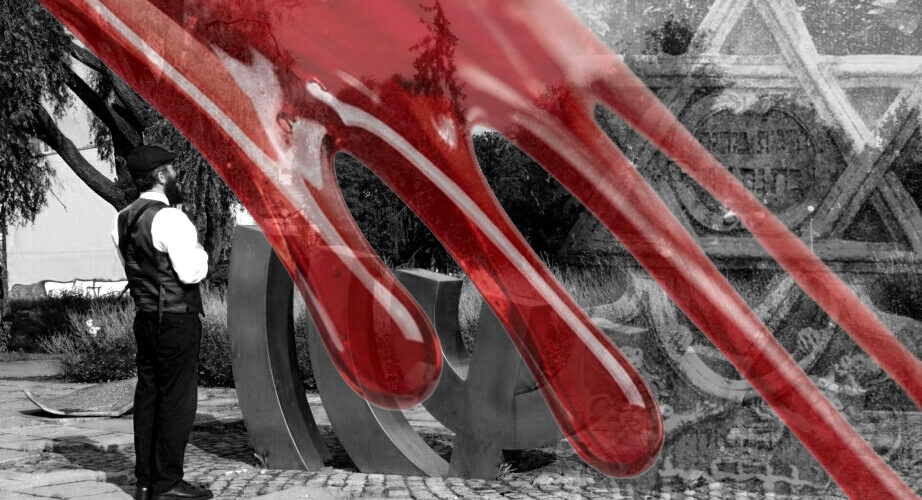
No one would talk to me about what they saw on July 4, 1946. That was when local townspeople attacked and killed Jewish Holocaust survivors in a pogrom sparked by a blood libel. This took place more than a year after World War II. On that hot summer day, nearly 50 survivors were murdered, and 150 were injured.
No one would say anything about what happened that day. People told me they were “out of town that day.” There was a secret, and no one wanted to talk about it.
I didn’t know then that those quiet streets would change the course of my life.
A Fulbright Fellowship brought me back to Poland to learn more. Graduate studies at Oxford helped me deepen my thinking and improve my skills. My search took me to archives in five countries.
During that time, I accessed secret NKVD files in Moscow when they were briefly open to outside researchers. At Yad Vashem I reviewed unpublished survivor testimonies recorded in displaced persons camps right after the war.
I interviewed pogrom survivors, residents of Kielce, journalists, historians, and filmmakers.
I also spent years in Warsaw. There, with my wife Rachel, we helped rebuild Jewish community life in a country that had almost forgotten its Jewish roots. Over time, my research materials kept piling up.
Returning to My Research
Then COVID happened. I tried learning the banjo and baking sourdough, but neither worked out. Meanwhile, boxes of research files, interview tapes, and books waited for me in my garage. With my family’s encouragement, I started writing. Over the past five years, I began traveling back and forth to Poland again.
Denial is a River in Poland: The Aftermath of Europe’s Last Pogrom is the result of that journey. It was more than 30 years in the making.
Dr. Michael Berenbaum, Holocaust scholar, former project director of the United States Holocaust Memorial Museum, and one of the most important voices in Holocaust remembrance today, is writing the Forward.
Denial tells the story of what happened on July 4, 1946. It also reveals what followed over the next 80 years. The authorities quickly covered up the Kielce pogrom. In place of facts, all that people had were Myths about what happened. Scholars published investigations, including official state inquiries. These were intended to deflect Polish responsibility rather than face it.
Some brave Poles pushed back. A few memorials and an exhibit were built.
Denial also examines how a town lives with a crime for 80 years. How is a story of murderous betrayal transmitted from one generation to the next? Kielce processes its unwanted heritage mostly through silence and denial, but also through a small museum, the theater, monuments, and ceremonies.
Finding Answers
I came to Kielce to find out how, even after the Holocaust, a blood libel could still be used as a reason for murder. What I didn’t understand while walking along Planty Street in 1992, I can now see clearly.
The clarity is bitter.
The Denial Kickstarter launches June 1st. This will help us cover the final costs of publishing the book in Poland with our partners at Austeria Publishing. All campaign funds go toward publication costs.
Additional funds raised will also support an online living memorial for the victims and a searchable archive we are building.
Please check out this Kickstarter campaign to be part of it. The victims of the Kielce pogrom wait for justice.
________
This post is crossposted from my Substack. Please check it out.