
In January 1942, fifteen men sat around a table at a villa on the Wannsee, a lake in the southwest of Berlin, and spent about ninety minutes scheduling the murder of every Jew in Europe. The conference, convened by Reinhard Heydrich, was not the beginning of the Holocaust. By that point, the Einsatzgruppen had already shot hundreds of thousands of Jews in open fields across the Soviet Union. But Wannsee was the bureaucratization of it, the moment the Final Solution became a logistics problem to be managed across government departments, with agendas and minutes and a catered lunch. Fifteen men. Ninety minutes. Eleven million Jews on the list.
It did not start there, of course. It started earlier and smaller, the way these things always do. With laws that made Jews less visible in public life. With signs in windows telling customers who was not welcome. With Jewish-owned shops that became difficult, then impossible, to operate. With the incremental removal of Jewish people from the fabric of German daily life, dressed in the language of grievance and politics, until one day the fabric looked completely different and almost nobody who remained could remember what it had looked like before.
I think about that when I think about what just happened in Friedenau.
Friedenau, for those who have not had the pleasure, is one of Berlin’s quietest and most civilized neighborhoods: Art Nouveau villas, tree-lined streets, the kind of bourgeois residential calm that Nobel laureates apparently find conducive to writing. Günter Grass lived there for over twelve years. The Niedstrasse is known as the literature mile. Marlene Dietrich and Helmut Newton are buried in the local cemetery, because even in death Friedenau maintains its standards. It is not Kreuzberg. It is not Prenzlauer Berg with its stroller traffic and artisanal everything. It is the part of Berlin where professors live, where the cafes have good coffee and nobody is performing their personality too loudly, where a sunlit corner bakery with a small outdoor terrace feels completely and exactly right.
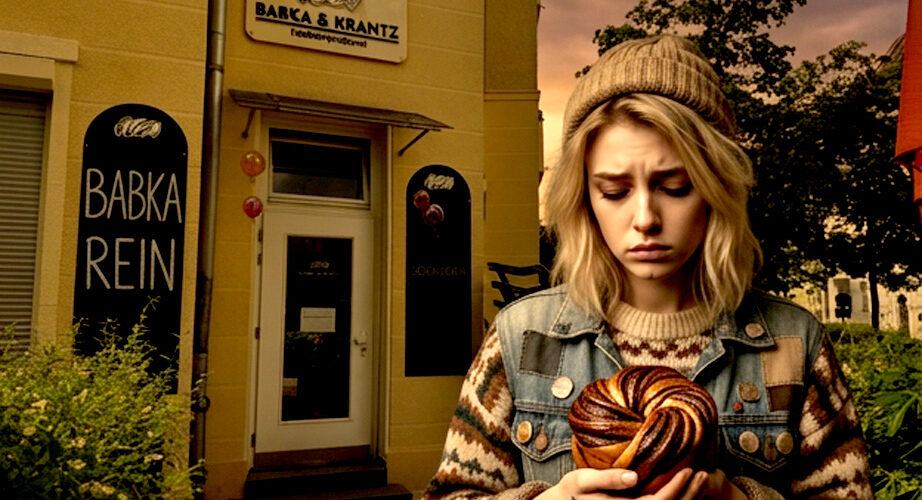
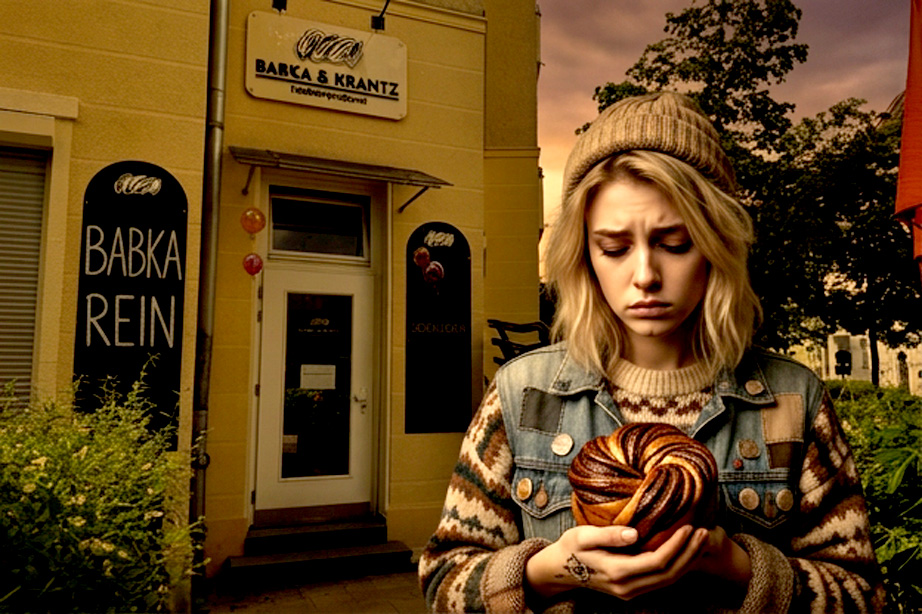
That bakery was Babka & Krantz. And it is gone.
Owners Shahar Elkin, originally from Haifa, and Marcin Liera-Elkin, born in Poznań and raised in Berlin, opened the place in November 2022 after two years of searching for exactly the right location in exactly the right neighborhood. It was the first Jewish bakery to be inducted into the Berlin Bakers’ Guild in the guild’s 750-year history. Shahar had moved to Berlin in 2012 and spent seven years earning his master baker’s certificate to make that happen. They opened a second location in December 2024, at the House of the Wannsee Conference. That is the building. That specific building, where the catered lunch happened. They opened a Jewish bakery there, brought Jewish life back to that address, and the memorial issued a statement welcoming the collaboration and expressing its full support.
Then October 7 happened, and the hatred, as Shahar and Marcin put it in their farewell note, reached Berlin as well.
Their car was vandalized. Hate mail arrived. The phone calls came. They sent their daughter to stay elsewhere for a time. The Wannsee location closed first, last November, amid what the memorial’s own statement described as verbal abuse so severe it made the collaboration untenable. Now the Friedenau original is closed too. Shahar and Marcin told the Berliner Morgenpost: “We really don’t know if Berlin is still the right place for us.”
Nobody is calling this the Holocaust. But nobody should have to clarify that it isn’t, either. The project of making Jewish life in Germany untenable, one business at a time, one family at a time, dressed up in political language, is not a new project. It is very old. And Berlin, of all cities, has the commemorative plaques, the stumbling stones, the catered-lunch minutes to know exactly what it looks like in its early stages.
Now: what, precisely, have we lost
I have been to Babka & Krantz more than once. I have sat at one of those small outdoor tables on a grey Berlin afternoon and eaten things that made me briefly rethink my life choices in the best possible way. I need you to understand the specific quality of the loss.
Babka is a sweet, enriched yeast bread of Eastern European Jewish origin, and it is what happens when challah dough is handed a better destiny. You take a rich, eggy, slightly sweet dough and roll it thin. You cover it in something magnificent: chocolate, cinnamon, poppy seed, hazelnut, marzipan. You roll it up tight, slice it lengthwise, twist the two halves around each other so the filling spirals through in a dark, gorgeous ribbon, and bake it until it is golden and glossy and makes everyone in the building come to the kitchen. Challah, for reference, is the braided Shabbat bread baked every Friday for the Sabbath table, traditional, beautiful, faintly sweet. The leftover challah on Saturday night goes into the babka dough. It is a circle of life situation for carbohydrates.
If you need a cultural reference point: Season 5 of Seinfeld, “The Dinner Party,” written by Larry David, original airdate February 3, 1994. Jerry and Elaine are going to a dinner party and stop at the Royal Bakery on West 72nd Street, based on the real Royale Pastry Shop at 237 West 72nd, now closed and replaced, I am not making this up, by a Jenny Craig. They want a chocolate babka. The last one is taken by another customer. They are forced to settle for cinnamon. Jerry’s verdict: “Cinnamon takes a back seat to no babka.” He then clarifies: “Chocolate. Chocolate is the superior babka.” He is not wrong. He has never been more right about anything. If you have not seen this episode, stop reading, go watch it, and come back when you are a more complete person.
In New York the current gold standard is Breads Bakery, with locations in Union Square, Rockefeller Center, Lincoln Square, the Upper East Side, and Bryant Park. Their chocolate babka is laminated, dark, glossy, structurally magnificent, and will make you briefly forget every problem you have. Martha Stewart has collaborated with them on a babka. This is the correct use of Martha Stewart.
Babka & Krantz’s version was something else again, because Shahar and Marcin split the difference between two family traditions. The babka came from Marcin’s Polish grandmother’s recipe. The krantz, the Israeli version, is wound tighter, more compressed, the filling denser. And then there were the flavors that existed nowhere else: the Zhug Kräntzchen filled with Yemeni green chili paste and coriander. The Safta Tamal with tahini and medjool dates. The Groyse Metsye with poppy seed and marzipan. A Sabich bagel with za’atar and aubergine and hummus. Over 90 percent of ingredients were organic, the house dough rested up to 48 hours, and the whole place smelled like something a reasonable person would convert for. A neighbor told the Times of Israel she had been going every day once she found out they were closing. She said she was trying not to cry. I understand her completely.
The “anti-Zionists” and their extraordinary record of achievement
Here is where I need to be direct, because someone is already drafting the comment.
Someone is going to explain that Shahar is Israeli, and that people who oppose Israeli government policy have the right to express that, and that this is all very complicated, and perhaps if Israel would only end the occupation then Jewish bakeries in Berlin would not face harassment, and we must consider the nuance and the layers and the.
No.
Shahar Elkin is a baker. He makes bread. He did not deploy a single tank or authorize a single settlement or design a single policy. He moved from Haifa to Berlin in 2012 and spent seven years becoming a master baker so he could make Jewish pastries in a city rebuilding its Jewish life. The people who harassed him are not engaged in principled political resistance. They are people who looked at a Jewish baker and decided he was a valid target because of his ethnicity and national origin, and they dressed that decision in political language because “I harass Jewish bakers” does not poll as well as “I oppose genocide.” These are not the same thing.
And Germany’s numbers will not let anyone argue otherwise. Berlin police recorded a record 2,267 antisemitic crimes in 2025, up sharply from 1,825 in 2024, 900 in 2023, and just 381 in 2022. Nationally, Germany registered 8,627 antisemitic incidents in 2024, nearly double the 4,886 from 2023. The head of Germany’s Federal Research and Information Point for Antisemitism was not subtle: the objective risk of being persecuted as a Jew in Germany has increased since October 7, 2023.
The European picture is worse. According to the ADL’s one-year impact report, in the Netherlands antisemitic incidents shot up 818 percent in the month following October 7 compared to the prior three-year monthly average. In Austria, incidents were up 500 percent. France went from 436 antisemitic incidents in 2022 to 1,676 in 2023. If this is about Israeli government policy, please explain the math. Israeli government policy did not change 818 percent in thirty days. What changed is that Jews became acceptable targets, and the acceptability was dressed up in political language so the people doing it could feel righteous, which is the one feature antisemitism has maintained across every era and iteration.
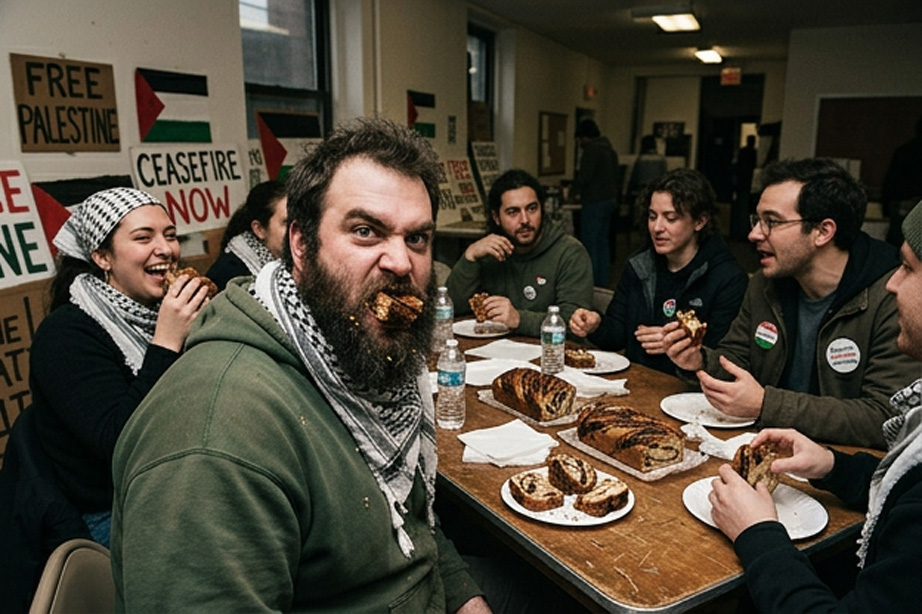
Now here is the part that I find genuinely clarifying. The Palestinian liberation movement has been active in various forms since 1948. In those seventy-five-plus years, it has not liberated a single acre of land through this kind of action. Not one. Gaza is a mess. The West Bank is a mess. The two-state solution gets further away every year. Boycotts, protests, harassment campaigns directed at Jewish and Israeli businesses have produced: no Palestinian state, no right of return, no sovereignty, no Palestinian Authority elections since 2006.
But they closed a babka bakery in Friedenau. They chased out Kanaan, a Berlin hummus bar jointly owned by an Israeli and a Palestinian, which closed in March after experiencing protests. An Israeli restaurant in Portugal. An Ethiopian-Israeli restaurant in New York. A chain of Israeli restaurants in Washington, D.C. All gone. Every one of those businesses was doing more concrete, measurable good for the cause of human coexistence than anything the protest movement has produced, and every one has been destroyed by people who claim to act in the name of human coexistence.
The Elkins wrote in their farewell note that their bakery was a place where “different people can eat together at one table and speak to each other,” where non-Jewish Berliners learned about Jewish culture, where the neighborhood found something to share. Shahar won a Craftsmanship Award from the German Federal Ministry for Economic Affairs last year. The memorial at the House of the Wannsee Conference called the partnership a source of genuine meaning.
All of it is gone. And the people who destroyed it have not freed one inch of anything.
Where to take your grief in Berlin now
You will need somewhere to go. Some options.
Fine Bagels on Warschauer Strasse in Friedrichshain is your best bet for Jewish-American style baking, including babkas, challahs, and rye loaves. Founder Laurel Kratochvila is an American master baker who moved to Europe, found no good bagels, and refused to accept this. The bagels are excellent. Do not skip the rye.
Bäckerei Kädtler in Prenzlauer Berg has been kosher-certified since 2000 at the Jewish community’s request and bakes challah every Friday. It is a traditional German bakery doing Jewish baking with institutional seriousness, which is not nothing.
None of these are Babka & Krantz. None of them will be. That is the point.
On the miracle of Berlin
In their goodbye note, Shahar and Marcin wrote: “Our families come from cities with a vibrant Jewish life and a formative culture of debate. Today, few or no Jews live in these places anymore. That’s why Berlin is such a miracle.”
That is the sentence. Berlin had become, genuinely and against all odds, a place where Jews were returning, where 200,000 now live including tens of thousands of Israelis, where a Jewish bakery could open in a quiet neighborhood full of Nobel laureates and be embraced by its non-Jewish neighbors, where a couple could open a second location at the site of the Wannsee Conference and turn it into something warm and alive and smelling of chocolate and tahini.
That miracle is under pressure. It is being dismantled, slowly, one business at a time, by people who call themselves opponents of Zionism and are in fact opponents of the same thing opponents of Jews have always opposed, which is the presence of Jews.
Look to the babka, Elaine. The babka is gone.