
Jewish law does not bless settler vigilantism, not loosely, not by analogy, not through Pinchas, not through anyone. This isn’t a technicality for people who enjoy Talmud on the side. Vigilante violence dressed up as religious zeal is dangerous to Palestinians first and most directly, but it doesn’t stop there. Once a private citizen decides he gets to identify the enemy and hand out the punishment himself, nobody is safe from that decision, including other Jews: a soldier who intervenes, a leftist, a peace activist, an Arab citizen of Israel with full citizenship, you, me, anyone a mob decides is insufficiently loyal in the moment. Lawlessness like this threatens the state and the rule of law itself, not just whoever it happens to be aimed at this week.
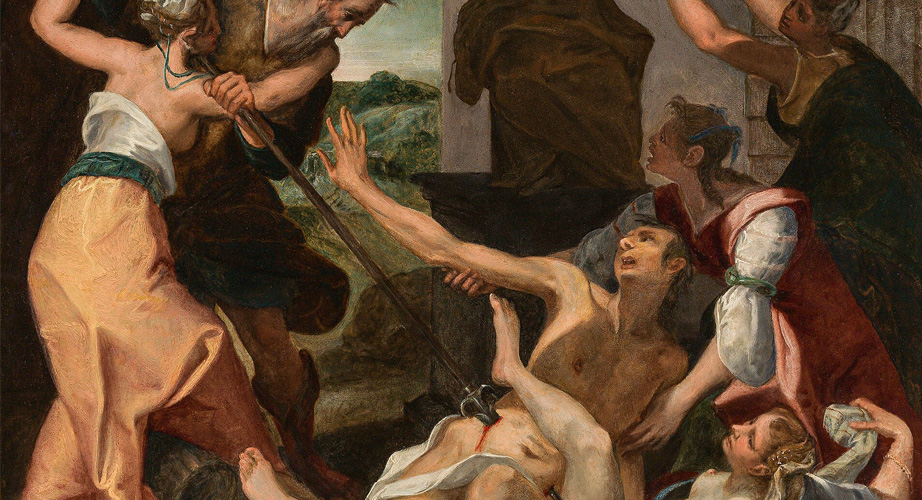
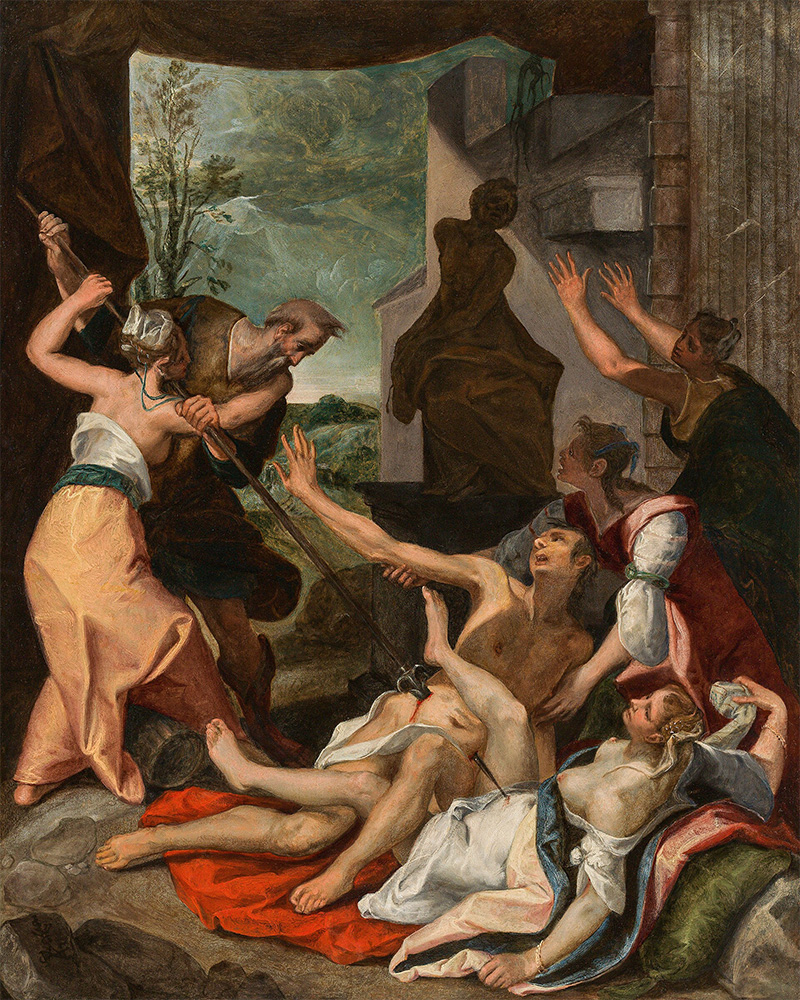
Quick recap for anyone who slept through the end of last week’s parsha. Israelite men had started getting it going on with Moabite and Midianite women and worshipping their gods at a place called Baal Peor, and God sent a plague through the camp in response. In the middle of all this, a tribal prince named Zimri brought a Midianite woman named Cozbi into a tent in full view of Moses and the entire community and had full on, no holds barred, public sex with her there, an open middle finger to the plague and the leadership alike. Pinchas, a grandson of Aaron the high priest, father of the entire Kohen line, grabbed a spear, followed them in, and killed them both mid act, in flagrante delicto as they say, with a single thrust. The plague stopped right after. No trial, no warning. One spear, two bodies, killed mid act in front of a watching crowd. That’s the entire incident people are working from usually when they invoke his name.
Every year around this parsha, somebody trots out Pinchas as the patron saint of Jewish vigilantism. Grab a spear, skip the courtroom, let God sort it out. It’s a seductive read if you’re the kind of guy who thinks torching an olive grove is a mitzvah. It’s also wrong, and not by a little. The rabbis who canonized this story spent centuries making sure nobody could use it that way.
Start with the law itself. The Mishnah in Sanhedrin permits Pinchas-style action in one narrow case: a Jew publicly cohabiting with a non-Jew, witnessed in the act.[1] Then it does something the tradition rarely does. It attaches a warning to its own ruling: halacha ve-ein morin ken, “it is the law, but it should not be taught.”[2] Translation: this is technically permitted and you should never, ever tell anyone that. A law you’re forbidden to teach isn’t a precedent. It’s a trapdoor the rabbis nailed shut on their way out.
It gets stricter. Had Zimri turned and killed Pinchas first, the sages ruled Zimri would walk free on self-defense. Kill your target one second after the act instead of during it, you’re a murderer, full stop. Ask a rabbinic court for permission in advance, and the answer is no. The only legal window is the act itself, not a moment before, not a moment after, and you can never ask first because asking forfeits the right to act. It’s a law built to exist on paper and nowhere else.
And the sages weren’t done narrowing it. The Gemara adds that the zealot’s motives have to be perfectly pure, no anger, no grudge, no ulterior motive, or the whole thing collapses into ordinary murder. Commentators go further still. Some ask why the Torah bothers reminding us Pinchas was Aaron’s grandson, and answer that people were already gossiping about the other side of his family. His father Elazar had married into a lineage with a history of idol worship, and Pinchas killed a Midianite woman, his own mother’s people.[3] Maybe, the whisper went, this wasn’t pure zeal at all. Maybe a man with that pedigree had something to prove, and killing a Midianite woman in public was less about God and more about distancing himself from his own ancestry. If a plausible motive that petty can contaminate the act, the bar for “purely for the sake of Heaven” isn’t high. It’s basically unreachable by design.
One more detail nobody quotes, because it wrecks the vigilante reading completely. Before Pinchas did anything, he went to Moses and got confirmation that kana’im pog’im bo, the same narrow zealotry law from Sanhedrin, applied to Zimri and Cozbi specifically. He checked. The guy the tradition holds up as the model zealot didn’t act on his own authority. He consulted leadership first.[4]

So hold that up against the hilltop outposts. The Duma attack,[5] the burning of homes and fields in Turmus Aiya,[6] the mob that hit an IDF base at Kafr Malik, torching equipment and attacking Israeli soldiers, fellow Jews, because they got in the way.[7] These aren’t isolated flare ups either. The UN’s humanitarian office documented more than 1,600 settler attacks across the West Bank in 2025 alone, roughly five a day, with October logging the highest monthly total since anyone started counting in 2006.[8] The IDF’s own numbers back this up. Military and Shin Bet data logged a 27% rise in settler attacks in 2025 over 2024, with severe incidents up more than 50 percent, and Central Command officers reportedly told Netanyahu directly that up to 80 percent of the incidents troops record in the West Bank are Jewish attacks on Palestinians, pulling resources away from actual counterterrorism.[9] No consultation with anyone, no verified facts on the ground, no rabbinic sign off, no single instant of pure motive. Just anger, dressed up in religious language, at scale.
Worth being precise here, because tarring all half a million West Bank settlers with the hilltop brush is its own kind of dishonesty. Most people living in Ma’ale Adumim, Efrat, and the other large blocs did not move there to hasten the messiah. Researchers estimate roughly two-thirds of settlers cite quality of life, not ideology, as their actual reason for being there, and a majority of recognized settlements were established explicitly on those grounds.[10] Some settlers are even Arab residents, a few dozen of them in Ma’ale Adumim alone, drawn by the same cheaper housing and shorter commute as everyone else.[11] None of that erases Duma, or the 2025 numbers. It just means the guy driving to his sales job in Jerusalem from a three bedroom apartment isn’t who Sanhedrin is worried about, and pretending otherwise doesn’t help anyone’s argument.
The rabbis of Judea and Samaria have said as much themselves, including ones nobody would call doves. Rabbi Eliezer Melamed of Har Brakha, a settler rabbi by any definition, wrote that Jews should not aspire to private vengeance, only state vengeance carried out through the IDF and the institutions of government.[12] Melamed isn’t some outlier on the left. He’s a mainstream religious Zionist rabbi telling his own community exactly what Sanhedrin says: this isn’t yours to take. IDF commanders in the field have said it in blunter language. Col. Ariel Gonen, who commands the brigade covering much of the northern West Bank, told his own troops the recent wave of settler attacks is carried out by “a fringe group of criminals and anarchists… taking the law into its own hands,” and called the violence “unjustifiable and intolerable.”[13]
And the “settler violence isn’t real” crowd doesn’t actually help their own case here, because it doesn’t matter.[14] Even in the framing most favorable to the settlement movement, where you strip out clashes with security forces and dispute the UN’s numbers, nobody disputes that Duma happened, that Turmus Aiya happened, that people have died. The theological question isn’t whether the count is inflated. It’s whether Jewish law would bless any of it if the count were exactly one. It wouldn’t.
Pinchas got a covenant of peace for it, God’s promise, delivered right at the start of this week’s parsha, that the plague would end and that priesthood would run through his line forever. That’s the reward for an act our own tradition immediately fenced off, hedged, and warned against repeating, not ambiguity. The rabbis saw a story with obvious appeal to hotheads and spent two thousand years making sure nobody could point to Pinchas and say “he started it.”
Pinchas earned that covenant by checking with Moses first, acting in a single instant with a motive nobody could fully impugn, and never once claiming the authority for himself. Skip any one of those steps and you’re not reenacting Pinchas. You’re just a guy with a spear, and spears in the hands of people who’ve appointed themselves judge, jury, and executioner don’t stay pointed at one group for long. Ask the soldiers at Kafr Malik.
Notes
- The full line from the Mishnah is “ha-bo’el aramit, kana’im pog’im bo,” one who has relations with a gentile woman, zealots may strike him. It’s a single, extremely narrow carve-out, not a general license. ↩
- This phrase shows up elsewhere in the Talmud for rulings the sages considered too dangerous to state as normal, applicable law, even when technically true. Think of it as the rabbinic version of “this is real but do not try this at home.” ↩
- Pinchas’s father Elazar married a daughter of a man the Torah calls Putiel. Rabbinic tradition reads that name two ways at once, one tying him to Yisro, Moses’s father in law and a former Midianite priest who had once fattened calves for idol worship before breaking with it and joining the Israelites, the other tying him to Joseph. The gossip about Pinchas wasn’t that leftover idolatry was somehow driving him to kill. It was more cynical than that: given his mixed pedigree, and given that Cozbi was herself Midianite, maybe the killing wasn’t pure zeal for God at all, maybe it was personal, ethnic anxiety or a grudge wearing the costume of piety. That’s the kind of ordinary human motive the sages worried might be hiding under any act of zealotry, even this one. It’s also why the Torah immediately restates his priestly lineage through Aaron right after the killing, functioning almost like a character witness answering the whispers before they could stick. ↩
- Some traditional sources draw the same point from Jacob’s anger at Shimon and Levi after they killed the men of Shechem to avenge their sister Dina. Jacob’s problem wasn’t that they defended her. It was that they never asked him first. ↩
- Duma is a Palestinian village in the West Bank where, in July 2015, settlers firebombed a home, killing an 18 month old baby and, later, both his parents. It remains the reference point for what “price tag” ideology looks like when it goes all the way. ↩
- Turmus Aiya is a Palestinian town near Ramallah that has been hit repeatedly by organized settler attacks, including a June 2023 incident in which hundreds of assailants burned homes, cars, and fields and killed a resident. ↩
- In June 2025, more than a hundred settlers stormed Kafr Malik, a Palestinian village near Ramallah, burning homes and vehicles. Israeli forces killed three Palestinians in the ensuing unrest. Days later, dozens of settlers, some linked to the Hilltop Youth movement, rioted at a nearby IDF base, torching security equipment and attacking soldiers. Even Netanyahu and Ben Gvir condemned that second incident, which tells you something about how far outside the norm it was. ↩
- Per OCHA’s West Bank humanitarian updates, 2025 saw more than 1,600 documented settler attacks affecting over 270 Palestinian communities, and October 2025 alone logged over 260 attacks, the highest monthly figure since OCHA began tracking in 2006. Palestinians injured in settler attacks in 2025 also ran more than double the 2024 total. ↩
- Per the IDF and Shin Bet’s own year end data, reported by the Times of Israel in January 2026, “nationalistic crime” incidents rose from 682 in 2024 to 867 in 2025, a 27 percent increase, with severe incidents like shootings and arson climbing from 83 to 128. By May 2026, officers were telling the prime minister directly that up to 80 percent of recorded West Bank incidents were Jewish attacks on Palestinians, and that this was forcing units to cut back on Palestinian terror suspect arrests. This is the Israeli security establishment’s own accounting, not an outside advocacy figure. ↩
- Israel Policy Forum’s breakdown, drawing on Israeli demographic and settlement records, found roughly one third of Jews in the West Bank cite religious ideology as their motivation, with the rest drawn by quality of life. Of the recognized settlements, 63 of 127 were established explicitly for quality of life reasons rather than religious ones. ↩
- Same source, citing researcher Shaul Arieli: 33 settlements have registered Arab residents. Ariel has the largest population, about 573, mostly students at Ariel University. Ma’ale Adumim, Kfar Etzion, and Giv’at Ze’ev each have a few dozen. ↩
- Melamed made this argument in his column in the newspaper Besheva, explicitly rejecting private “price tag” vengeance in favor of action through the state and the IDF. Worth noting because he is not a centrist voice by any stretch. ↩
- Gonen’s message to troops came in November 2025, after a spate of settler attacks in his sector. Field commanders condemning settler violence in these terms, rather than the softer “friction” language some officials use, has become more common as the numbers have climbed. ↩
- Groups like Regavim have published reports arguing that “settler violence” statistics, particularly from UN sources, blur together clashes with Israeli security forces and genuine attacks on Palestinian civilians. Even granting the strongest version of that argument, named, documented, fatal incidents like Duma are not in dispute, and neither OCHA’s nor the IDF’s own 2025 figures can be explained away by a dataset dispute, since the IDF’s numbers are the security establishment counting its own incidents. ↩

― Tom Robbins