

On Monday, eJewishPhilanthropy, the trade paper of the Jewish nonprofit world, ran a long, careful, very polite article about the newest plan to fight Antisemitism from the Jewish Federations of North America. JFNA is the national umbrella for the local Jewish federations, the big community charities that raise and hand out most of the organized Jewish community’s money. If you’ve ever gotten a call asking you to pledge to “the annual campaign,” that was them.
I read it twice. I’m going to be a lot less polite.
What JFNA is buying
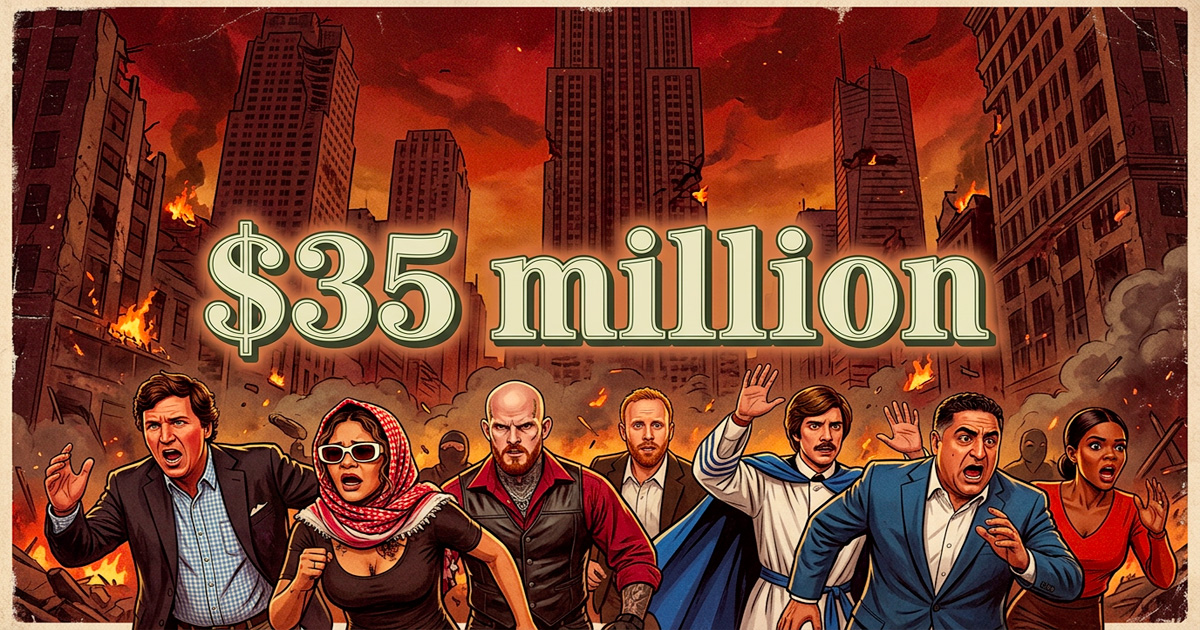
The plan is called Frontline. It’s $35 million to put 100 new staffers into local federations to advocate against Antisemitism and build community relations. JFNA pays each new hire’s salary for two years, and the local federation has to promise to keep the job going for at least three. More than 25 donors chipped in. JFNA says it’s going after concrete wins: state security bills, school policies on how Israel gets discussed in class, and actual discipline when someone paints a swastika on a school.
Some of that is fine. Here’s the problem. Nobody has said how anyone will know whether it worked. The eJP piece reports no plan to evaluate it. And it isn’t filling an empty field. Of the 141 federations in North America, 73 already have staff working on community building or Antisemitism, and 44 have a JCRC, a Jewish Community Relations Council, whose entire job is relations with other communities. So the plan is 100 more of a thing we already have a lot of, with no way to tell if any of it does anything.
One of the programs JFNA lists alongside Frontline is Project Halo, its messaging project to improve Israel’s image. UCLA’s Dov Waxman, who studies American Jews and Israel, told eJP he worries Frontline is mostly Israel advocacy with an Antisemitism label slapped on it.
We already know most of this money is wasted
This isn’t me being cranky. The establishment has been saying it out loud.
Last year the Jewish Funders Network, the umbrella group for Jewish philanthropists, had Tufts political scientist Eitan Hersh study 160 organizations and 25 funders that all claim to fight Antisemitism. The study, called Fight Smarter, found a crowded field full of redundant programs that couldn’t show they had any effect. JFN’s president, Andrés Spokoiny, said two new funders contact him every single day wanting to start a new Antisemitism initiative. His answer to them: “When people come and say, ‘Nobody is doing X,’ I can tell you they are.” He has also written that plenty of groups just rebranded their old programs as Antisemitism work because that’s where the donors are.
In February, New York Times columnist Bret Stephens gave the annual State of World Jewry talk at the 92nd Street Y in Manhattan and said that if it were up to him he would dismantle the ADL, the Anti-Defamation League, the biggest Jewish group fighting Antisemitism. He called the fight against Antisemitism, which eats tens of millions of dollars in Jewish philanthropy every year, a mostly wasted effort, and said the money should go toward raising young Jews who actually know what being Jewish means. ADL CEO Jonathan Greenblatt was sitting in the audience and called the talk misguided. Of course he did.
And sometimes this stuff backfires. Cynthia Miller-Idriss, who runs PERIL, an extremism research lab at American University, told eJP her lab had to pull one of its own videos after testing showed it made conspiracy-minded viewers more Antisemitic, not less. That’s what you find out when you actually test things. Her advice was to test before you scale. Frontline is going straight to 100 hires.
Yes, this is about Israel
You can’t talk about Antisemitism in 2026 without talking about Israel, and the organized community keeps trying.
The ADL’s own audit counted a record 9,354 Antisemitic incidents in the U.S. in 2024. That year, for the first time since the ADL started counting in 1979, more than half of them (58%) were tied to Israel or Zionism. Incidents dropped by a third in 2025, but physical assaults hit a record high.
Gallup’s February poll found that for the first time since it started asking in 2001, more Americans sympathize with the Palestinians (41%) than with the Israelis (36%). Among Americans aged 18 to 34 it was 53% to 23%.
And our own kids? A Washington Post poll of American Jews last fall found that half of Jews aged 18 to 34 say Israel is committing genocide in Gaza. Only 36% of them said they feel an emotional connection to Israel, compared to 68% of Jews 65 and older.
Let me be really clear about one thing. None of this excuses a single Antisemite. A Jewish kid in Montreal or a synagogue in Michigan is not responsible for anything the Israeli government does, and blaming them for it is Antisemitism, full stop. Jew hatred didn’t start with Gaza either. The Tree of Life massacre in Pittsburgh was in 2018. The Colleyville hostage crisis was in 2022.
But pretending the war, and the government running it, had nothing to do with the spike is stupid. Benjamin Netanyahu was literally asleep at 6:29 on the morning of October 7 when his military secretary woke him, and he has spent three years blocking a state commission of inquiry that would look at what he and everyone else got wrong. His government gave us Itamar Ben-Gvir, convicted in 2007 of incitement to racism and supporting a terror group, and Bezalel Smotrich, who said in 2023 that the Palestinian village of Huwara should be wiped out (he later walked it back). Last week, after Bibi’s bloc lost its majority in the election, his Likud party claimed the Arab parties stole it.
The organized community’s answer to all of that has mostly been to defend whatever the government does as if the government were the country, and to buy messaging. That’s what Project Halo is. Eran Shayshon of the Israeli think tank Atchalta told eJP that hasbara, the Hebrew term for Israel’s public diplomacy (PR, basically), won’t work. He’s right. You can’t message your way out of a finance minister saying a village should be wiped out. Normal people saw it. Our kids saw it. No talking points from a federation office were ever going to fix that.
We should have seen it coming
Here’s the part that makes me angriest. None of this snuck up on anyone.
In December 2023, two months after October 7 and before most of the destruction in Gaza, a Harvard CAPS/Harris poll found that 60% of Americans aged 18 to 24 said the October 7 massacre could be justified by Palestinian grievances. In the same poll, 51% of them said the conflict should end with Israel handed over to Hamas. Two months in. You don’t get numbers like that from two months of news. You get them from years of social media, campus politics and nobody from our side showing up with anything worth listening to.
Gallup has tracked Democrats drifting toward the Palestinians since around 2017 and young Americans since around 2020. The Pew survey of American Jews released in 2021 found that 41% of Jews under 30 don’t identify with any Jewish denomination, compared to 22% of those over 65. Israel’s own top strategic think tank, INSS, published a paper this April titled “Israel is losing America’s youth.” The warning signs were all there, in public data anyone could read.
We are a people who have won something like a fifth of all the Nobel Prizes ever handed out. We can read a poll. What we did, mostly, was wait for disaster and then raise money. Credit where it’s due: after October 7 the Federations raised $908 million for Israel and pushed it out through more than 4,200 grants to 877 organizations. That’s a real accomplishment. It also proves the money was always there. It just shows up after the catastrophe, not before.
Jewlicious has been telling the organized Jewish community to be proactive instead of reactive since we started this site in 2004. This is what reactive looks like.
Meanwhile, somebody’s getting rich
While the organized community was busy being reactive, a whole industry figured out that demonizing Israel, and in some cases Jews, pays very well. I want to be careful here, because there are two different groups, and lumping them together is exactly the kind of lazy argument I’m complaining about.
The anti-Zionists
The first group is anti-Zionists, a lot of them Jewish. Opposing Zionism is not automatically Antisemitic, and I’m not calling these guys Antisemites. I am saying they’ve built careers and businesses on this, and some of them have crossed lines that have nothing to do with criticizing a government.
Benjamin Moser won a Pulitzer for his biography of Susan Sontag. His new book, Anti-Zionism: A Jewish History, came out from Doubleday on September 22 at $35 a copy and is being published in half a dozen languages. He is everywhere. He’s been back at Brown, and on Mehdi Hasan’s Zeteo under the headline “Zionists Are the Enemies of the Jews.” His publisher’s page carries a blurb from Hannah Einbinder, whose Jewish politics we’ve covered before. The book got a rough reception from the New York Times and the New Yorker, and even Shaul Magid, a sympathetic reviewer in the LA Review of Books, called its selection of figures a major weakness. But look at who it’s for. One review said Moser is writing for young Jews who are rediscovering this history. That’s the market. We built it by leaving those kids with nothing better to read.
Norman Finkelstein, the son of Holocaust survivors, compared October 7 to the Warsaw Ghetto Uprising on the day it happened and wrote that it “warms every fiber of my soul,” according to Jewish Insider. This year he sat down with Peter Beinart for an interview that included why he won’t condemn the attacks. He has also questioned whether sexual violence happened that day, even though a UN team led by Pramila Patten found reasonable grounds to believe that rape and gang rape did.
Max Blumenthal runs The Grayzone, a site Wikipedia’s own editors deprecated as a source. Within three weeks of October 7 he was arguing that the Israeli army killed a big share of the victims, and he took that argument on a podcast tour. His team later released a documentary, Atrocity Inc., that treats reports of Hamas atrocities, systematic rape included, as hoaxes. To be fair, Israel did kill some of its own people that day. The army invoked the Hannibal Directive, the doctrine of stopping a kidnapping even at the risk of the hostage’s life, in at least some places, and that’s real and it’s ugly. Turning it into the claim that Israel was responsible for much of its own massacre is something else, and it sells.
Aaron Maté is Blumenthal’s partner at The Grayzone. He hosts its show Pushback, which has featured Finkelstein and, last December, a Hamas negotiator, and the two of them do live shows that run two and three hours.
Glenn Greenwald is a different case. He won a Pulitzer for the Snowden reporting and he is not a Grayzone guy. But Gaza became a staple of the subscription business he built on Substack and then on Rumble, where by his own account his nightly show ran out of a Rio de Janeiro studio with 15 employees. This year he moved his operation back to Substack. Israel and Gaza remain a regular subject of the show his subscribers pay for. And he got to Nick Fuentes, the white nationalist and Holocaust denier you’ll meet below, a month before Tucker Carlson did. On September 29, 2025, his show, System Update, aired a congenial, wide-ranging interview with Fuentes. According to Media Matters, Fuentes floated “voluntary segregation” on the show and said he’d undo America’s demographic change if he had a time machine. They did argue about censorship. But Greenwald also told Fuentes that his authenticity made it easy for critics to pull quotes that can sound “very almost Nazi-like” and use them against him. As if the problem with Nick Fuentes is the quotes. Later, on his show, Greenwald called Fuentes very impressive, while conceding that his rhetoric can be offensive. The Fuentes interview pulled at least 196,000 views on Rumble. Free speech is a fine principle. It also happens to be good content.
The ones who don’t bother with the distinction
The second group doesn’t pretend it’s only about Zionism.
Candace Owens has engaged in what the American Jewish Committee documents as repeated Holocaust denial and minimization. She has 5.7 million YouTube subscribers. A Jewish People Policy Institute study found that in the second half of 2025, three quarters of her videos that mentioned Jews were Antisemitic, up from 45% in the first half. The Daily Wire dumped her in 2024, citing Antisemitism, and her podcast now ranks about thirty spots ahead of Ben Shapiro’s on Spotify. Jew hatred turned out to be a better business model than the job she lost over it.
Tucker Carlson sat down in October 2025 with Nick Fuentes, a white nationalist and Holocaust denier, for a friendly two-hour interview. The Heritage Foundation’s president defended him, and the think tank melted down. President Trump shrugged and said people have to decide. Carlson’s network charges subscribers $9 a month, and Ynet reported estimates of $12 million to $30 million a year in revenue. The same JPPI study found Israel became one of the main topics on his YouTube channel in 2025.
On the left, Cenk Uygur, who founded The Young Turks, and his nephew Hasan Piker had their permission to travel to the UK revoked this year on the grounds that their presence wasn’t conducive to the public good. British reports said the concern was their rhetoric since October 7 exacerbating Antisemitism. Uygur says he was banned for criticizing Israel, and plenty of people, Piers Morgan included, thought the ban was ridiculous. Piker’s numbers are public because of a 2021 data leak: Twitch paid him $2.8 million in 26 months, not counting sponsors, merch or YouTube, and that year he bought a $2.74 million house in Los Angeles. This election cycle the ADL reports he hosted or campaigned with several DSA-backed candidates, and says he has a history of rhetoric that denigrates Jews.
The platforms are in on it too. When CyberWell, an Israeli nonprofit that tracks online Antisemitism, studied Antisemitic videos on YouTube, it found that 24% of the English ones were running ads, even though YouTube’s own rules say hate content can’t make money. Researchers who study this point out that the algorithms push whatever gets engagement, and outrage gets the most.
Left and right, Jewish and not, it all ends up in the same place: a business that makes money off making people angry at Jews and Israel. And this is where our kids actually learn about both. Not at a JCRC meeting. Carlson’s network claims 56.8 million views per episode across platforms. Piker streams for hours every day to an audience in the millions. Moser is on every podcast that will have him. The organized community’s answer is 100 new staffers and a messaging hub. You don’t beat Hasan Piker with a JCRC. You beat him with people who are smarter, funnier and more honest, honest enough to say so when the Israeli government is wrong, making stuff young people actually want to watch. Which brings me back to schools, and to the last time the establishment tried to be cool.
Fewer Holocaust museums, more Jewish schools
We’ve said it here for twenty years: build fewer Holocaust museums and more fully funded Jewish schools. Some people hear that as disrespect for the dead. It isn’t. It’s a question about what we think the money is buying.
I’m from Montreal. The new Montreal Holocaust Museum on Saint-Laurent is a C$120 million project. Boston is building one for around $100 million. Holocaust Museum LA did a $50 million expansion. Survivors founded many of these places and they do real educational work. But we have to be honest about what they accomplish against Antisemitism.
The US Holocaust Memorial Museum opened in Washington in 1993. In 2020, a Claims Conference survey found that 63% of American millennials and Gen Z didn’t know six million Jews were murdered, and 11% said the Jews caused the Holocaust. This year a Monash University report in Australia, based on interviews with educators and museum professionals in Australia, Britain and the U.S., found that Holocaust awareness has gone up with no matching drop in Antisemitism. The researchers also warned that students mostly meet Jews as victims from the past instead of as living people. The lead researcher, David Slucki, said Holocaust education is badly inadequate if you treat it as the main defense against Jew hatred.
To be fair, there’s data on the other side. A RealityCheck Research study found a correlation between Holocaust education and fewer hate crimes, though its own authors say a correlation doesn’t prove cause. Fine. Keep the museums. Just stop treating them as the strategy.
Now look at what has actual evidence behind it. The Camp Works study found that adults who went to Jewish overnight camp are 55% more likely to feel very emotionally attached to Israel and 45% more likely to go to synagogue than Jews who didn’t. Brandeis researchers found that non-Orthodox Birthright alumni were 57% more likely to be married to a Jew, and later follow-ups found the effect lasting up to two decades. Birthright paid for the original study, so take that into account, but outside experts say the findings hold up.
The pattern is simple. Immersive Jewish experiences work. The most immersive one is a Jewish school, and most families can’t afford it. San Diego Jewish Academy charges $39,550 in high school tuition before $4,215 in fees. A Samis Foundation report found that a 400-student day school would need to cut its cost per student to $30,000 and raise a $177.7 million endowment to bring tuition down to what Catholic schools charge. Catholic schools manage tuition under $10,000 a year in every major American city.
It can be done. In Seattle, the Samis Foundation caps tuition at 15% of income or $15,000 per child, whichever is lower, for families earning up to $350,000. UJA-Federation of New York, to its credit, says it has put more than $400 million into day schools over 45 years, and it just launched a $15 million, three-year tuition pilot, though it only covers Jewish communal professionals. So a federation can do the right thing. It’s just tiny next to everything else.
Put the numbers side by side:
| What | Cost | Notes |
|---|---|---|
| Israel Emergency Campaign (after October 7) | $908 million | Raised in a crisis, spent on relief in Israel |
| LiveSecure community security | $130 million | The one program here with results you can point to |
| New Montreal Holocaust Museum | C$120 million | Includes a $25 million endowment |
| Holocaust Museum Boston | About $100 million | Construction costs |
| Holocaust Museum LA expansion | $50 million | Doubles the campus |
| JFNA Frontline (100 new staffers) | $35 million | No evaluation plan reported |
| UJA-Federation NY day school tuition pilot | $15 million over 3 years | Communal professionals only |
| Endowment one 400-student day school needs to match Catholic school tuition | $177.7 million | Samis Foundation estimate |
The last time they tried to be cool
None of this is new. In the early 2000s the organized Jewish world had its last big panic about young Jews drifting away, and it responded by trying to be cool.
The vehicle was a crop of edgy startups. The Joshua Venture, a fellowship funded by Steven Spielberg’s Righteous Persons Foundation, the Nathan Cummings Foundation and the Walter and Elise Haas Fund, handed out seed money to young Jewish “social entrepreneurs.” A $60,000 Joshua Venture grant launched Heeb, a glossy magazine its founder pitched as being about “cool Jews,” and another helped start JDub Records, the label that broke Matisyahu, with UJA-Federation of New York chipping in too. Charles Bronfman’s philanthropies and Spielberg’s foundation founded Reboot, a network for young creatives, most of whom considered themselves on the outskirts of Judaism. The Bronfman people also created Slingshot, a Zagat-style guide to “Jewish innovation” ranked by foundation professionals. And UJA-Federation put up $1 million for the Six Points Fellowship for emerging Jewish artists, the largest grant it had ever given to individual artists.
The whole idea was to come at Jewish identity sideways. Heeb’s founder, Jennifer Bleyer, described her magazine as Jewish by side-glance rather than head on, and she later said she wanted a Jewish identity built on more than the Holocaust and Israel. When JDub folded, the Forward summed up the whole movement as a shift away from traditional Jewish education toward the social and cultural cues of young adults. Day school, camp, Hebrew, actual Jewish learning, anything that looked too Jewy: that’s not what this money was for.
And almost none of it was measured. Looking back last year, eJP noted that the Joshua Venture deliberately backed projects whose impact couldn’t be measured in traditional ways. Of the 15 organizations it launched between 2001 and 2005, only a handful survived on their own. The Joshua Venture itself shut down in 2005 after a $200,000 deficit turned up, and one of the people involved summed it up as an entrepreneurial venture without an entrepreneur. Heeb stopped printing in 2010 and had more or less closed by 2019. JDub shut down in 2011. When UJA-Federation dropped Six Points in 2013 and moved the money to Israel education, an official stressed that the decision wasn’t a reflection of the fellowship’s performance. Read that again. They didn’t measure it when they funded it, and they didn’t measure it when they killed it.
Heeb, by the way, was rebooted last year as a nonprofit called Heeb Media. It’s led by Mik Moore, a political strategist who sits on the steering committee of The Jewish Vote, the electoral arm of the left-wing Jews for Racial and Economic Justice, and JFREJ’s website now reposts Heeb stories.
I watched this from the inside
Jewlicious was part of that scene, so let me tell you what it looked like up close.
In 2008 the Jewish Community Foundation of Los Angeles gave JDub a $250,000 Cutting Edge grant to engage young Jews in LA through music, running from August 2008 to July 2011. According to a tally a reader posted in the comments here at the time, based on numbers itemized on eJP, JDub put on 21 concerts in LA in that period, and only nine of them were credited as made possible by the foundation’s support. Four of those nine were by the Sway Machinery and three were by Girls in Trouble, all three within a single month. That works out to more than $25,000 a show, for good bands that were touring anyway.
Jewlicious got one grant in that era: just over $200,000 from the Jewish Community Foundation of Los Angeles, for the festival, after five years of packed festivals for Jewish college students. None of it went to the website, which, as I wrote back in 2010, has never received a penny of grant money. And the knock on us, made often enough that it ended up in our Wikipedia entry, was that Jewlicious was a kiruv operation. Kiruv is Orthodox outreach, the business of bringing secular Jews closer to religious observance. Some Hillel directors told me to my face they wouldn’t send their students to the festival because of it. We had sessions on legalized marijuana and LGBTQ issues, women singing on stage and mixed dancing. Show me the kiruv outfit that does that. In other words, we were too Jewy. A New York label booking club shows was cooler than a homegrown LA festival that was openly, unapologetically Jewish.
So yes, I have an axe to grind, and you should weigh that. But my point isn’t that we deserved JDub’s money. It’s that nobody on either side of those decisions was asked to prove anything, before or after. That I know of!
Here’s the contrast that should embarrass everybody. Charles Bronfman’s money also built Birthright, which Brandeis researchers have tracked for two decades and which has now brought 900,000 young Jews to Israel. Same philanthropist, same era. The bet that got measured is the one that worked and grew. Frontline is the cool-startup era all over again, with Antisemitism instead of irony as the pitch.
The fair part
JFNA’s executive vice president Shira Hutt told eJP this work goes back decades, that federations were overwhelmed after October 7, and that small communities need dedicated people. She’s right about that. If you’re one of a handful of Jewish families in a small city and your kid comes home after a swastika shows up at school, you want someone to call. She also says choosing between fighting Antisemitism and building Jewish identity is a false choice. In theory, sure. In practice, every dollar spent on one is a dollar not spent on the other.
Some of this stuff works. JFNA’s $130 million LiveSecure security campaign is the one thing here I can defend with a straight face. Rabbi Charlie Cytron-Walker credited his security training with saving his life in Colleyville. And some Frontline money is going to things like rebuilding a bridge-building JCRC in Santa Barbara, which is the kind of face-to-face contact between communities that the research actually supports. Social scientists call it contact theory.
Great. Then measure it and publish the results.
What we’re asking for
- Independent evaluations. Every major Antisemitism and Jewish engagement program funded in the last ten years should be evaluated by people who don’t work for it, and the results should be published in full. Including the embarrassing ones.
- Money follows results. Camp, immersive Israel trips and Jewish schools have evidence behind them. Fund them first.
- A real tuition plan. The Samis model exists. The math exists. Do it in more than one city, and for more than communal professionals.
- No more money for vibes. Every new project, edgy or establishment, gets a clear goal and an evaluation plan before the first check is written, and the results get published whether they’re good or bad. That includes Frontline.
- Stop running Israel advocacy under the Antisemitism label. Fighting Jew hatred and defending the policies of the current Israeli government are not the same job, and pretending they are makes both harder.
- Fund creators, not just staffers. The fight for young people is happening on YouTube, Twitch, TikTok and podcasts. Put real money behind Jewish creators who can compete there, give them room to be edgy and to criticize Israel when it deserves it, and hold them to the same rule: show us the numbers.
- Ask the tuition question. The next time someone pitches a nine-figure Holocaust museum, ask what that money would do for Jewish school tuition.
The organized Jewish community didn’t cause Antisemitism. Antisemites did. But we were warned, we had the money, and we spent too much of it on the wrong things. On the third anniversary of October 7, I wrote that Israel needs a real state commission of inquiry. American Jewry needs one too, into itself. Another $35 million of the same isn’t a plan. It’s a press release.

― Tom Robbins