
Last Tuesday, American voters handed Democrats both houses of Congress, and the war with Iran was a big reason why. In NBC’s exit poll, 74% of voters called the war a crucial or major factor in their vote, and 63% said attacking Iran was the wrong decision. Gas costs about 40% more than it did a year ago. People are pissed, and I get it.
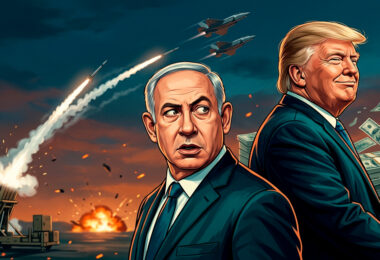
A story is riding along with those numbers. It says this is Israel’s war, that Bibi dragged America into it, and that Americans are paying for Israel’s security at the pump. A poll from the IMEU, a pro-Palestinian advocacy group, found 56% of voters think the war benefits Israel more than America. That story has fans on the left and on the America First right. The day after the election, the conservative Federalist ran a piece titled “Iran Nuked Us After All.”
I think that story is wrong. Israel benefits, sure. But the case for checking the Islamic Republic of Iran is an American case, and it would exist if Israel had never been founded. Left alone to do what it has spent 47 years trying to do, the regime would cost Americans far more, in money and in lives, than anything they’ve paid this year. Containing it isn’t a favor to Israel. It’s about as America First as foreign policy gets.
Full disclosure: I live in Jerusalem, in a country Iran has been firing missiles at all year, and you’re entitled to factor that in. So I’m going to make this case almost entirely with American dead, American infrastructure and American wallets.
Iran’s war on America started in 1979
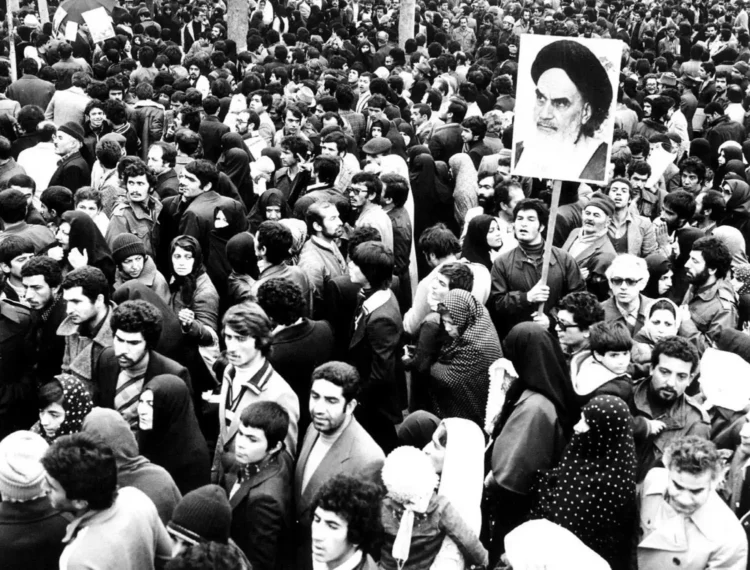
The Islamic Republic didn’t start out hating America because of Israel. It started out hating America, period.
In November 1979, months after the revolution that brought Ayatollah Ruhollah Khomeini to power, student militants stormed the US embassy in Tehran and held 52 Americans hostage for 444 days. Khomeini called America the “Great Satan.” Israel got the junior title, “Little Satan.” In the regime’s own vocabulary, we Israelis are the sideshow. You are the main event.
Then came the body count. Every one of these attacks targeted Americans, and none had anything to do with Israel:
- Beirut, 1983. A suicide truck bomb killed 241 US service members at the Marine barracks in Lebanon. The people behind it became Hezbollah, Iran’s Lebanese militia, and a US federal court later held Iran responsible.
- Saudi Arabia, 1996. The Khobar Towers truck bombing killed 19 US airmen. A US court held Iran responsible for that one too.
- Iraq, 2003 to 2011. Iranian-supplied roadside bombs called EFPs (explosively formed penetrators, which punch through armor) killed American soldiers for years. In 2019 the Pentagon confirmed that Iran was responsible for 603 US troop deaths in Iraq, about 17% of all Americans killed there. Those deaths came from EFPs, other roadside bombs, rockets, mortars and sniper fire.
- Washington, 2011. Iranian agents plotted to blow up a DC restaurant to kill the Saudi ambassador. The middleman, a used-car salesman from Texas named Manssor Arbabsiar, got 25 years.
This isn’t ancient history. In 2022 the Justice Department charged an IRGC member with trying to arrange a $300,000 hit on former National Security Adviser John Bolton, as revenge for the 2020 US strike that killed IRGC commander Qasem Soleimani. In 2024 it charged Farhad Shakeri, an IRGC asset living in Tehran, who prosecutors say was tasked with drawing up a plan to assassinate Donald Trump. In a separate case, Asif Merchant, an IRGC-trained Pakistani national, was convicted this March of a murder-for-hire plot aimed at Trump and other US officials. And in 2025, two Eastern European mobsters got 25 years each for a $500,000, Tehran-backed contract to kill Iranian-American journalist Masih Alinejad at her home in Brooklyn.
(The IRGC is the Islamic Revolutionary Guard Corps, the regime’s ideological army. It runs the missile program, the proxy militias and most of the dirty work abroad.)
None of those victims were Israeli. This is what the regime does to Americans when it can.
Your wallet
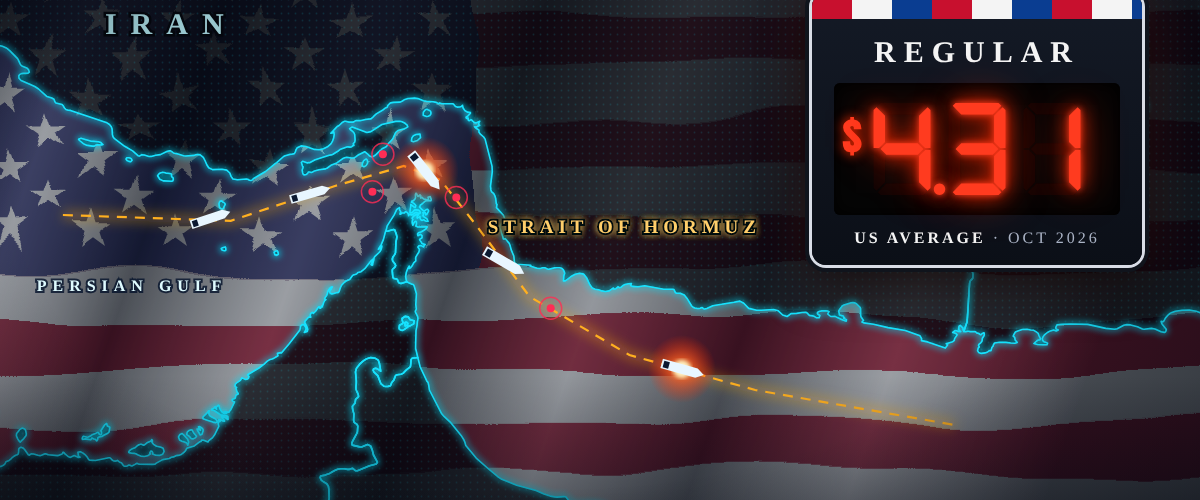
Every American voter already knows this part, because they paid for it. Before the war, GasBuddy forecast that 2026 would be the first year since the pandemic with gas averaging under $3 a gallon. Instead, regular averaged $4.31 in October, up 40.8% from a year earlier, according to the federal Bureau of Transportation Statistics. Diesel, which moves every truck carrying your groceries, hit $6.25, up almost 70%.
Iran pulled that off in two ways.
First, it shut the Strait of Hormuz, the narrow mouth of the Persian Gulf that about a fifth of the world’s traded oil and gas normally passes through. As of this week, ship traffic is running at about 3% of prewar levels, according to the Iran SITREP tracker.
Second, it attacked its neighbors’ oil and gas plants. On March 2, Iranian strikes hit Saudi Aramco’s Ras Tanura refinery and forced Qatar to shut Ras Laffan, the world’s largest liquefied natural gas plant. After Israel hit Iran’s South Pars gas field in mid-March, Iran went after refineries across the Gulf, including in Kuwait, and Brent crude hit $118 a barrel. On July 27 it hit Saudi Arabia’s giant Abqaiq oil processing plant. A Reuters investigation found the damage to Gulf water plants, power stations and refineries wasn’t stray debris. Hurting civilians was the point.
Honesty requires me to say the obvious: Iran did this because it was attacked. Before February 28 the strait was open and gas was cheap. I’ll deal with that below. But look at what this year proved. A regime with a dead Supreme Leader and its air defenses smashed still managed to raise the price of everything in America for eight months. Now imagine that regime when it isn’t flat on its back.

Your safety
The war didn’t stay in the Gulf. It came to American water plants.
On April 7, six federal agencies issued a joint warning: the FBI, the Cybersecurity and Infrastructure Security Agency (CISA), the NSA, the EPA, the Department of Energy and US Cyber Command. Since at least March, hackers tied to the IRGC had been breaking into programmable logic controllers across US critical infrastructure. Those are the small industrial computers that run pumps, valves and power equipment. Some organizations found the data on their control screens had been manipulated. In September, NBC reported that Iranian hackers had gone after US water, telecom and energy systems again.
This isn’t new either. In 2012 an Iranian virus called Shamoon wiped about 30,000 computers at Saudi Aramco. In 2016 the Justice Department indicted seven Iranians for cyberattacks that knocked 46 US financial institutions offline, and charged one of them with breaking into the control system of the Bowman Avenue Dam in Rye Brook, New York.
Then there are the hit squads. In June the United States and 22 other countries condemned Iran’s intelligence services for hiring local criminal gangs to plot attacks in Europe, North America and Australia. British Prime Minister Keir Starmer said Iran backed 20 potentially lethal plots on British soil in 2025 alone. Hiring criminals is the whole idea. It gives Tehran deniability and turns any street gang into a potential contractor.
None of this requires a nuclear weapon. Which brings me to the scary part.
Hormuz is the trailer, not the movie
Everything above happened while America could still hit back. Iran says tankers hit its mines in the strait this week, and the US struck Qeshm Island. Iran hit Abqaiq, and Trump threatened to flatten its power plants. That ability to punch back is the only real limit on how far Tehran goes.
A nuclear bomb takes that limit away, and Iran is openly talking about it. Since March its parliament has been debating leaving the Nuclear Non-Proliferation Treaty (NPT), the agreement Iran ratified in 1970 promising never to build nuclear weapons. Some Iranian experts now argue Iran should only quit the treaty after it has a bomb, so it can’t be punished for leaving.
Here’s what a nuclear-armed Islamic Republic looks like for Americans:
- A permanent toll booth on the world’s oil. Iran is already choosing which ships get through Hormuz. In March it started letting through ships from friendly countries, and one of its conditions for ending the war was US recognition of Iranian sovereignty over the strait. With a bomb, nobody could challenge that. China gets its oil, and your gas price becomes a decision made in Tehran.
- Nuclear cover for everything else. Hackers in water plants, hit men in Brooklyn, militias firing at US bases. Today the US can answer all of that. With an Iranian bomb, every answer comes with a risk of nuclear escalation.
- An arms race in the worst neighborhood on earth. Saudi Crown Prince Mohammed bin Salman told CBS’s 60 Minutes in 2018 that if Iran developed a nuclear bomb, “we will follow suit as soon as possible,” and he has repeated it since. Turkey and Egypt would think hard about it too. That’s a handful of nuclear powers sitting on top of the world’s energy supply.
- A stronger anti-American bloc. Iran designed the Shahed drones Russia has been sending into Ukrainian cities, and the Financial Times reports Russia is now secretly helping Iran with supersonic cruise missiles. China buys most of Iran’s oil. A nuclear Iran is a nuclear partner for both.
Eight months of a closed strait cost Americans plenty. A nuclear Iran could make it permanent, and wouldn’t need to fire a shot.
The regime’s first victims are Iranians
Let me be very clear about something, because it gets lost. I have nothing against Iranians, and neither does Israel. This isn’t a fight with Islam either. Iran is a country of about 90 million people, most of them born after the revolution, and the Islamic Republic has been killing them for 47 years.
In January, Iranians poured into the streets, first over prices and then to demand an end to clerical rule. On January 8 and 9 security forces opened fire, and the regime cut the internet so nobody could count the dead. By late January the US-based Human Rights Activists News Agency (HRANA) had verified at least 6,126 deaths, with more than 17,000 more under investigation. An Iranian official put the government’s own count at 5,000, including 500 security personnel. A network of more than 80 Iranian doctors across 12 provinces told the Guardian the real toll could top 30,000. They described bodies moved in ice-cream and meat trucks and pressure on graveyard staff to bury the dead in mass graves. Even Ali Khamenei admitted “several thousand” were killed.
Then came the gallows. Amnesty International counted at least 2,159 executions in Iran in 2025, the most since 1981 and more than double the year before. This year, the Norway-based group Iran Human Rights had recorded at least 532 by the end of August. Dozens were people convicted over the January protests, many after trials Amnesty calls torture-tainted. In July the regime built a stage in a public square in Isfahan and hanged young men convicted over the protests at dawn. Rights groups say the noose falls hardest on minorities: Kurds, Baluch and Arabs.
The regime will also kill you for a post. In September a court in Mashhad sentenced Najmeh Amini, a 23-year-old accounting student, to death for “insulting the Prophet” in a social media post. Cyber police had been watching her account, and she was arrested in February. Her lawyers argued she wrote the post while high on mushrooms, and the judge rejected it. From Vakilabad Prison she has smuggled out audio messages asking the world to be her voice. Her sentence is still under appeal.
On November 4, a Revolutionary Court in Tehran sentenced Amirhossein Mousavi, 40, to death for “corruption on earth” over the anonymous X and Instagram accounts he ran as “James B. Dean.” He had been held for almost two years. In 2025 state TV aired his “confession” to being an Israeli agent who stirred up the 2022 protests. He later retracted it, and rights groups say it was extracted by torture. That’s a pattern worth noticing: the regime often brands its critics Israeli agents before it tries to hang them.
And it has gone through with it before. In May 2023 the regime hanged Yousef Mehrad and Sadrollah Fazeli Zare for running a Telegram channel that criticized religion. Amnesty said they were hanged solely for their posts.
So when I say contain the regime, I mean the people running Iran, not the people living in it. The Iranians filling those prisons are the best proof that the Islamic Republic doesn’t speak for Iran. Most of them are Muslims, and the regime hangs them anyway.
So what about Israel?
Israel benefits from all of this. I’m not going to pretend otherwise, and I’m not going to apologize for it. Israel is a democracy that shares intelligence with the US and develops missile defense systems with it. It’s also been absorbing Iranian missiles that would otherwise be aimed at American bases.
But the order of events matters. The regime took American hostages before it fought a single proxy war against Israel. It killed Marines in Beirut, airmen in Saudi Arabia and soldiers in Iraq for reasons that had nothing to do with Jerusalem. Iran’s leaders have spent decades promising that Israel will disappear. If it did, the IRGC would still want US forces out of the Gulf, a hand on the world’s oil and its hackers and hit men in business. Israel is the “Little Satan.” Guess who the big one is.
So no, this isn’t Israel’s war that America got roped into. Israel just happens to be on the front line of America’s.
The objections, and they aren’t stupid
“The war caused all of this.” This is the strongest objection, and I’m not going to dodge it. Saudi Arabia restored relations with Iran in 2023 and condemned Israel’s strikes in 2025. Iran hit Aramco because it was attacked. Fair enough. But that’s an argument about whether this war was the smart way to contain Iran, not about whether Iran needs containing. When Iran came under pressure, its first move was to wreck civilian energy and water across the Gulf. That’s exactly why you don’t want to find out what it does under pressure with a bomb.
“America makes its own oil. Let Asia worry about Hormuz.” The US is a huge oil producer, and Americans still paid $4.31 a gallon in October. Oil is priced globally. When Gulf supply disappears, Texas crude gets more expensive too.
“It costs too much.” The Pentagon asked Congress for $200 billion in March. That’s real money. But containment and all-out war are different things. Sanctions, naval patrols, cyber defense and backing Gulf allies cost a fraction of that, and every president since Jimmy Carter has paid for them, Democrat and Republican.
“Pressure just convinces Iran it needs a bomb.” Maybe. Libya gave up its nuclear program and Muammar Gaddafi was killed by rebels eight years later. North Korea kept its bomb and nobody touches it. Tehran has learned that lesson, so the job is to make sure it can’t act on it, not to shrug and hope for the best.
“Regime change is a fantasy.” Probably, at least from the air. The Islamic Republic replaced Ali Khamenei with his son Mojtaba about a week and a half after he was killed. So the realistic goal is containment: a regime that can’t get a bomb, can’t close the strait and can’t reach Brooklyn.
What the midterms actually said
Voters didn’t vote to let Iran have a bomb. They voted against eight months of $4 gas, a war that was supposed to be quick and an administration that never clearly explained why Americans were fighting it. USA Today found Republicans who had voted for Trump three times who weren’t buying the administration’s shifting rationale for the war. In CBS’s exit poll, about a quarter of Republicans called it a mistake. That failure to persuade is on the administration, not the voters.
Democrats take over both chambers in January. As of November 7, the AP count has them at 54 Senate seats, a net gain of seven. That includes independents who caucus with them and two races where they’re still leading. In the House, they had won more than 250 seats by Thursday, with dozens of races still uncalled. That’s their biggest majority since 2008. Good. Now Iran is their problem too, and they have a track record here. The Obama administration built the sanctions that brought Iran to the negotiating table in 2015, and Democrats have backed containing Iran for 40 years. The test for the new Congress is whether it can tell the difference between ending this war and walking away from the job.
For the America First crowd, the test is simpler. America First means putting American lives, American wallets and American infrastructure first. The Islamic Republic has gone after all three for 47 years. Checking it isn’t a favor to Israel. It’s the most America First thing on the menu.

― Tom Robbins