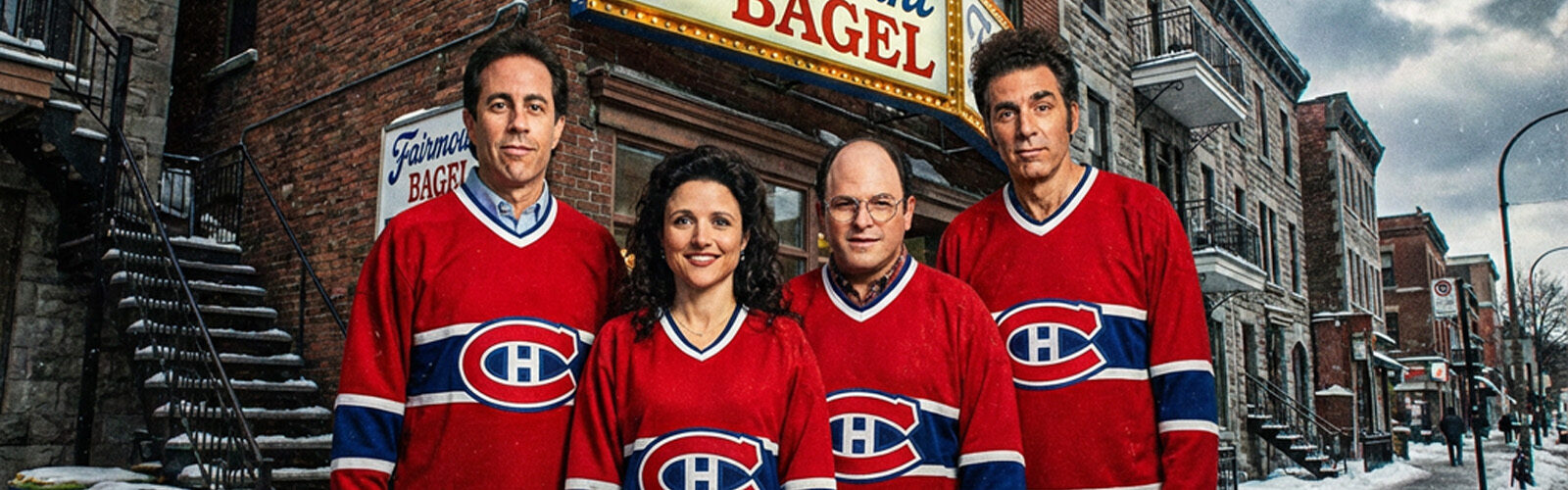

Let me be upfront: I am not a hockey person. I could not tell you what icing is, and I remain emotionally unavailable to any sport played on frozen water. But I am a Jewish person, and right now the Montreal Canadiens are pulling off something I can only describe as deeply, cosmically Jewlicious. The Habs are leading the Tampa Bay Lightning 2-1 in their first-round playoff series, with Game 4 going tomorrow at 2 PM in Tampa. Les Canadiens sont là! And the more you look at this team and this city, the more Jewish the whole thing gets.
It starts, as so many things do, with Seinfeld.
Martin St. Louis, Hall of Famer and head coach of the Canadiens, a man who got cut from every level of hockey before becoming one of the best players of his generation, has revealed that his postgame wind-down ritual is watching Seinfeld. He told reporters after a recent game that the show is his complete disconnect from playoff pressure:
“To me, Seinfeld is the show that can let me disconnect from everything. It’s a show about nothing. So you can just think about nothing. And you don’t even have to actually watch it, you can just listen to it because you know the characters, so it’s easy to fall asleep. For me, Seinfeld makes me disconnect.” (NHL.com)
He added that he has watched all nine seasons at least four times through, and that George Costanza is his favorite character. Now, whatever George’s technical ethnicity might be on paper, we all know that George Costanza is Jewish. He is neurotic, self-sabotaging, magnificently petty, and lives with his parents on Long Island. He is one of the great Jewish characters in the history of American television, created by two of the great Jewish comedy writers of the 20th century: Jerry Seinfeld and Larry David. That Martin St. Louis’s comfort character, the person he falls asleep thinking about after high-stakes playoff games, is George Costanza is not nothing. It is, if anything, very something. The NHL, to their credit, opened their write-up of the story with “Now here’s a story about nothing.” They deserve points for that.
But if a coach falling asleep to the most Jewish sitcom ever made were the only data point, you would chalk it up to coincidence. There is more. Much more.
Allow me to introduce @MontrealRabbi, the unofficial spiritual director of the Montreal Canadiens on X. During this playoff run, Rabbi Yisroel Bernath, spiritual director at Chabad of NDG and Jewish Chaplain at Concordia University, has been posting prayers and blessings for the Habs with the kind of devotion that would make any Chabad emissary proud. You may know him as the Love Rabbi, a title coined by the Montreal Gazette, and as the founder of JMatchmaking International, through which he has made over 200 successful matches. He is the subject of two CBC documentaries. He is also, apparently, a hockey person.
Before Game 2, as Shabbat approached, he posted this. The challah in the photo was baked by Carole B. Zuckerman in the shape of the Canadiens logo. C’est magnifique.

Shabbat Shalom Go Habs Go – challah shaped as the Canadiens logo with Shabbat candles, Via @montrealrabbi
I am not ashamed to say I teared up a little. “You take simple dough… you twist it, turn it, stretch it… and somehow out of all that pressure you create something beautiful.” He is talking about challah and he is talking about the Montreal Canadiens and he is also, unmistakably, talking about the entire Jewish experience. This is the most Jewish thing I have ever seen, and I grew up going to shul.
He also posted a formal prayer for the team, which deserves to be read in full:

Rabbi Bernath, suited up. Via @montrealrabbi
“May their names be erased.” The Tampa Bay Lightning, Anthony Corelli and Brandon Hagel specifically, cursed in the same liturgical register as Haman and Amalek. Nick Suzuki and Lane Hutson compared to a rabbi announcing the page for the Amida. “Hiding Joe Veleno’s iniquities.” This is not a hockey post. This is a theological document. The man is writing Siddur content for a playoff run, and it is extraordinary.
The Habs won Game 3 in overtime. Correlation is not causation. But I am not ruling anything out.
This is also worth noting alongside AFP’s report that fans in a Catholic cathedral outside Montreal have been watching playoff games on a projection screen strung across the sanctuary, bleu-blanc-rouge candles lit in the pews. “Hockey is a religion in Quebec,” one organizer told AFP. Yes, obviously. But the Canadiens now have both a cathedral watch party and a Chabad rabbi posting Tehillim on X. They have achieved full interfaith status. Ecumenical playoff hockey. Only in Montreal.
But the Jewish roots of this franchise go much deeper than this playoff run, back to the very beginning of the team, and to one of the most remarkable families in the history of this city.
The first Jewish name ever inscribed on the Stanley Cup belongs to Cecil Hart, who coached the Canadiens to three championships, in 1924, 1930, and 1931. Hart is credited with signing Howie Morenz, arguably the greatest player of the early NHL era, the “Stratford Streak,” a Hall of Famer whose death in 1937 sent all of Montreal into mourning. As the Forward has noted, Cecil’s father, Dr. David Hart, donated the Hart Trophy, given annually to the NHL’s most valuable player, in 1924. The redesigned trophy now commemorates both father and son. The Hart family did not merely participate in the history of the Canadiens. They helped build the architecture of the sport itself.
But the Harts’ significance to Montreal goes much deeper than hockey. Cecil’s ancestor Ezekiel Hart was elected to the Legislative Assembly of Lower Canada in 1807, making him the first Jew elected to political office in the British Empire. His election day fell on a Saturday, so Hart, being Hart, refused to take his oath on Shabbat and waited until January to be sworn in. When he finally appeared before the assembly, he swore on a Hebrew Bible with his head covered, replacing “on the true faith of a Christian” with his own formulation. The assembly voted 35-5 to expel him, ruling that “Ezekiel Hart, Esquire, professing the Jewish religion cannot take a seat, nor sit, nor vote, in this House.” New elections were called. Trois-Rivières returned him anyway. He was expelled again. The people re-elected him a third time. The Hart family, it turns out, has always had more staying power than the people trying to keep them out. Ezekiel’s decades of activism eventually produced the 1832 Emancipation Act, which granted full civil and political rights to Jews in Lower Canada, a full 27 years before anywhere else in the British Empire. On ne lâche pas. We do not let go. It applies to hockey and it applies to history.
So: the Hart Trophy. Three Stanley Cups. Jewish political emancipation in Canada. Not bad for one family.
In 1979, Irving Grundman became the Canadiens’ general manager, the second Jewish GM to have his name on the Cup. Defenseman Mathieu Schneider won the Cup with the 1992-93 Canadiens and is now enshrined in the International Jewish Sports Hall of Fame in Israel, which is a real thing and a wonderful thing.
While we are doing a full accounting, the two most important Jewish literary figures in Canadian history are also Montreal’s own. Leonard Cohen was born in 1934 into an Orthodox Jewish family in Westmount. His grandfather and great-grandfather were both presidents of Congregation Shaar Hashomayim, Montreal’s oldest Ashkenazi synagogue, where Cohen had his bar mitzvah. He once wrote that he had to keep coming back to Montreal “to renew my neurotic affiliations,” which is the most Jewish sentence ever written. He ate St-Viateur bagels at all hours, lived for decades in a duplex on the Plateau just off the Main, and when he died in 2016, he was buried in the Shaar Hashomayim cemetery on Mount Royal, in a simple pine casket, in a family plot that goes back generations. His final album, You Want It Darker, was recorded with the synagogue’s cantor and choir and won a Grammy posthumously. As his cantor wrote in the Globe and Mail, Cohen “remembered his roots and remained proud of his heritage as a Jew, a Montrealer and as a member of Congregation Shaar Hashomayim.” There is a towering mural of him on Crescent Street. He was a Jewish Montrealer till his last breath.
Mordecai Richler grew up on St. Urbain Street in the Mile End, grandson of a rabbi, and spent his career writing the Jewish Montreal neighborhood into the permanent record of world literature. The Apprenticeship of Duddy Kravitz. St. Urbain’s Horseman. Barney’s Version. Readers of his novels will note that hockey appears throughout, because in Montreal, the Habs and Jewish life were simply part of the same city, the same streets, the same argument. He felt, as he once wrote, “forever rooted in Montreal’s St. Urbain Street.” That rootedness, Jewish and urban and hockey-adjacent, is exactly what we are talking about.
Then there is the food, which is in some ways the whole point. You cannot talk about Jewish Montreal without talking about the food. It would be like talking about Jewish New York without pastrami. Structurally impossible.
Fairmount Bagel, open 24 hours a day, 365 days a year, has been in the Mile End since 1949. Denser than a New York bagel, sweeter, boiled in honey water, baked in a wood-fired oven, it is an object of genuine theological dispute among Montrealers divided between Fairmount loyalists and the St-Viateur Bagel faction. As Tourisme Montréal notes, both bakeries trace their ancestry to a single Montreal Bagel Bakery opened in 1919 by Jewish immigrants from Eastern Europe, and the split between them is essentially the Montreal bagel version of the great Ashkenazi/Sephardi divide: passionate, identity-defining, and ultimately resolved only by eating both. Le bagel, c’est sacré.
Schwartz’s Hebrew Delicatessen, founded in 1928 by a Romanian Jewish immigrant on Saint-Laurent Boulevard, is the unofficial godfather of Montreal’s smoked meat tradition. The line is always out the door, even in winter. (Céline Dion owns a stake in it now, which is not a Jewish fact per se, but feels cosmically appropriate.) Smoked meat on rye with mustard and a pickle is not just food. It is an argument for the existence of G-d. And then there is Cheskie’s, the beloved kosher bakery responsible for rugelach and babka of a quality that makes you feel like you are visiting a grandmother you never had. The Museum of Jewish Montreal runs a food tour, “Beyond the Bagel,” that weaves through the Mile End hitting all of the above. If you have not done this tour, please go to Montreal and do it. The Canadiens are in the playoffs. You have an excuse.
It is, as one food historian has observed, as if Montreal’s culinary heritage corresponds almost exclusively to Jewish specialties, which seems improbable given that Jews have historically made up about 2-3% of the city’s population. But that is the thing about Jewish food: it punches above its weight. Much like the Canadiens, who are once again making noise in the playoffs after years of disappointment.
None of this makes the Canadiens technically Jewish. Martin St. Louis is not Jewish. Lane Hutson, who scored the overtime winner in Game 3, is not, to my knowledge, Jewish. This is not the point. The point is that the Montreal Canadiens exist inside a city that Jewish immigrants helped build, in a sport that Jewish minds helped shape, coached by a man who falls asleep to the most Jewish sitcom ever made, cheered on by the Love Rabbi of NDG posting Tehillim on X and wearing a Canadiens jersey in his profile photo. The Hart family gave us the Hart Trophy and Canadian Jewish political emancipation. Leonard Cohen ate the bagels and wrote the songs and was buried on the mountain. Mordecai Richler walked the same streets and put them in the books. Schwartz’s has been slicing smoked meat since 1928. Fairmount has been pulling challah out of that oven since 1949.
Montreal is Jewish the way New York is Jewish: not exclusively, but essentially. And the Canadiens, whether they know it or not, carry that with them onto the ice. Vas-y les Glorieux.
So tomorrow, when Game 4 drops at 2 PM in Tampa, I will be doing something I do not normally do: rooting for a hockey team. Because apparently what it takes to get me invested in the NHL playoffs is Seinfeld references, a Chabad rabbi petitioning the Almighty to move Noah Dobson’s slapshot one inch to the left, the legacy of Ezekiel Hart, and the knowledge that somewhere in the Mile End, Fairmount Bagel is open, the wood-fired oven is going, and the bagels are hot.
Shavuah Tov and Go Habs Go.