


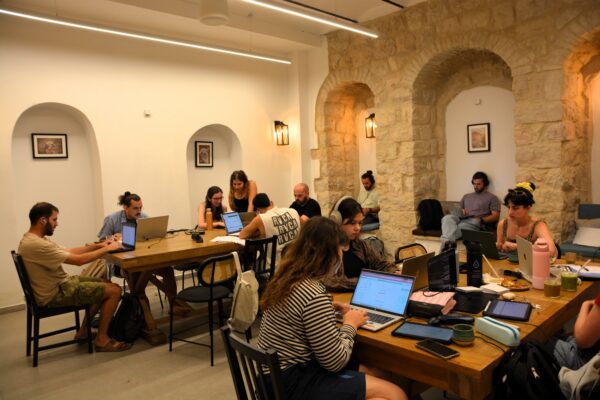
Come for the Macchiato. Stay for the Messiah. (photo by Gil Tanenbaum)
Jerusalem was rocked over the past two weekends by Haredim (Ultra-Orthodox) Jews protesting on Shabbat afternoons against a recently opened new café located in the downtown area, Café Basimta (in the alley), that operates on Shabbat, the Sabbath. The protestors see any such activity on Shabbat as a religious desecration, since all forms of commerce are strictly prohibited on the Sabbath. But this story has a twist. Something that the author of this article was unaware of before he sat down with the café’s manager for an interview.
The Café is owned and operated by the Jews for Jesus organization, which is run by Christian missionaries who use it as a front for converting Jews to Christianity. The organization does so by telling people they can still be Jews, even if they believe in Jesus. This is seen by Jews as nothing more than a deception and yet another example of Christians trying to stamp out the very existence of the Jewish religion itself.
But first the story of the protests and why the ultra-orthodox are focusing on the new café, when there are many other businesses open on Shabbat nearby.
Shouts of “Shabbos, Shabbos” (Shabbat in Yiddish) can be heard from far away on Saturday afternoons as Hasidim and others come over from other neighborhoods to protest the café being open on the Sabbath. There is nothing new here. For Jerusalem this is about as out of the ordinary as seeing a priest and a Hasid sitting side by side on the bus.
Café Basimta is located in a beautiful fully renovated space that was part of a building dating back to before the British mandate. Several years ago, what were small buildings with shops on the front side on Agrippas and Jaffa, were shuttered for renovations and expanded into new seven story apartment buildings with fancy shops and cafés lining their front sides on the street.
But to find Café Basimta you need to know where it is. Small alleys built more than a century ago cross between the buildings, connecting Agripas to the main thoroughfare of Jaffa St, where the light rail runs through town.
The café has outdoor seating in an open space that can barely be seen from the alleyway. The space is a small quad with the new apartment buildings on three sides.
Inside there is a new anterior with the kitchen area and coffee machine, where you can see the old stones that make up the original façade of the ground floor exterior of what was once a small home. There are arches where windows would have been. Behind this is the main seating area with small tables and chairs and a few loungers, behind which is a back room with large tables and chairs that was packed with people working on notebook computers.
The areas are usually packed, even on weekdays.
It should be noted here that, as mentioned above, when one walks through downtown Jerusalem on a Friday night or Saturday afternoon one sees plenty of cafés, bars and restaurants that are open for business and that sell non-kosher food.
So why are the Ultra-orthodox people so angry about this café? And no, it is not because of its affiliation with Jews for Jesus, something about which most of the Haredim do not know.
Simply put, as the saying goes: location, location, location.
The alleyway where Café Basimta is located abuts the largely religious Nachlaot neighborhood, and is just two blocks away from where an Orthodox neighborhood lies. The Haredim acquiesce to the non-kosher businesses in the downtown area that are open on Shabbat, as well as those on a side street on the other side of Nachlaot. But they feel that this new café is just a little too close for comfort and, in their minds, it violates an unwritten agreement on the secular/religious status quo in the city.
But why open another such business on Shabbat, and specifically in this location?
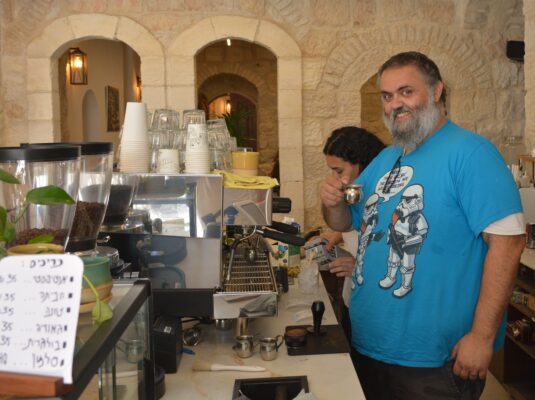
Yoel Ben David at Café Ba Simta (photo by Gil Tanenbaum)
Café Basimta is operated by Yoel Ben David, son of a Scottish father and a Moroccan mother, who was born in Israel, but grew up abroad. He returned to Israel at the age of 19 and served in the army rabbinate.
Yoel explained that they started another café open on Shabbat in an effort to “create a sense of community, a place where people can have coffee but it can be a little different, trying to answer some of the needs in the area.”
“This is about us being Israelis living in cities and wanting to do something for the city that we believe is really going to contribute,” he added.
They already had a lot of support even before the protests, but the demonstrators brought in even more business. They even have some religious customers who come in on weekdays and offer their support.
Yoel also takes pride in his policy of letting people spend all day there saying, “most coffee shops kick people out or give them only a certain amount of time with a laptop, for us we were able to find we have enough space and it works out OK.”
He said that this is part of the purpose of the café, which only sells coffee and some pastries.
However, the fact that Café Basimta is owned and operated by Jews for Jesus, an evangelical Christian missionary group whose purpose is to “back door” conversions of Jews to Christianity, adds a completely different dimension to this story. All major Jewish organizations reject them and exclude them from the Jewish community.
Even Israeli law denies messianic Jews, the name they give themselves, the right to become citizens under its “Law of Return,” which grants all Jews from around the world the right to come and live in Israel.
The anti-missionary organization Yad L’Achim says the owners only hire messianics, and use their coffee shops as a platform for their missionary activities. The organization sees the coffee shop as a threat and an example of expanding missionary activity in Israel, and they are more concerned with this issue than that of a business operating on Shabbat.
As for Yoel, he said that he converted later in life after reading the New Testament and has worked for the Jews for Jesus organization for 20 years.
Jews for Jesus now operates four coffee shops throughout Israel. Interestingly, its Tel Aviv café is not open on Saturdays because, as Yoel explained, they see no need for more such places to be open on Shabbat there. He also denied that their purpose is to proselytize to Jews.
However, the Jews for Jesus’ own website has videos boasting about how their Tel Aviv Café has succeeded in preaching to Israelis. It also has YouTube videos in which the organization brags that it uses its coffee shops to convert Jews.
On the matter of Café Basimta being owned by Jews for Jesus, Yoel said, “We’re messianic jews so we are a messianic organization.”
As to criticisms that they only employ messianics, Yoel said this is only because non-messianics will not work for them.
He also denied that they exist to convert people or for missionary activities.
(It should be noted that Yoel did not hide his beliefs and said he was a messianic at the very start of the interview.)
Yoel dismissed the videos on the organization’s website as something that the people in America do that for their own reasons.
He said that “maybe a few people here and there may have heard more about Jesus because they came to our coffee shops,” but denied any concerted effort to use them for missionary activities.
Regardless of Yoel’s personal feelings on the matter, one reason for such widespread hostility from Jews against messianics is that the Jews for Jesus missionaries engage in deceptive campaigns, hide what they really are, and prey on Jews who have little or no Jewish education or much knowledge about Judaism.
The messianic issue is so controversial that one prominent orthodox rabbi, who supports the right of some to have such cafés to go out to on Shabbat, retracted his comments and declined to be named once he heard of the messianics’ involvement in Café Basimta. This rabbi already heard of the protests, but said he could not speak out in the café’s defense since that could be construed as also giving his support for the activities of missionaries.
Responses from local politicians, however, both on the matter of a coffee shop being open on Shabbat and the messianic issue varied.
Rabbi Aaron Leibowitz, an orthodox rabbi, local community leader and former member of the Jerusalem City Council said that he supports the right of secular Jerusalemites to have their own places to gather together, even on Shabbat.
“If we close all coffee shops in Jerusalem on shabbat it means telling the secular community that the city is not for them and they will leave,” he said.
Leibowitz even compared coffee shops to synagogues saying that they serve a social function, as a place for people to gather together as a community, and so the coffee shops are like a synagogue for the secular in that respect. Both the word synagogue and its corresponding Hebrew word literally mean “a place of assembly.”
As far as its being owned by missionaries, Rabbi Leibowitz feels that they should be transparent about this, saying, “if I’m going in to buy a cup of coffee and you are trying to sell me something else that’s not OK and whatever the agenda, even a Jewish one, they should be open about it.”
Hagit Moshe, Deputy Mayor of Jerusalem for Education from the Religious Zionism Party said, “Of course, I am not in favor of this personally because I am religious, but the protestors were wrong and only brought them publicity. No one from another area would have even known about it otherwise. Maybe this was good for them because of the attention they got.”
As for the demonstrators, Moshe said they actually, “caused damage to the city.”
Regarding the coffee shop’s affiliation with messianics, she also feels that people need to be informed about this.
Adir Schwarz, Deputy Mayor of Jerusalem for Youth and Leader of the secular oriented Hitorerut (Awakening) Party in Jerusalem, had a different take entirely.
“There should be a place for people to go to on shabbat for coffee and there is a reason why you see 1,000 people waiting in line there, there should be a place for people to go to synagogue on shabbat and a place to buy coffee,” he said.
Schwarz described the people protesting against the café as “extremists who want to dictate how we spend our shabbat and we won’t allow it,” and added that, “there was never a better advertisement for a coffee shop than those people trying to tell us what to do.”
He is also concerned that the ultra-orthodox are taking control of the city, saying, “The trajectory in Jerusalem is very clear; it is becoming a place where there will be no place for secular people.”
On the messianic issue, Schwarz said he feels that “nobody came there to support the coffee shop because of the background of its ownership, they come there to support it regardless of its ownership which is simply not relevant to the issue of having places on shabbat that are open.”
As for the City of Jerusalem, it released a rather diplomatic official statement on the matter, in which it described the city as “diverse” and “home to people of different faiths, communities, and backgrounds,” and added that, “mutual respect and peaceful coexistence are essential to the city’s unique character.”
It also explained that the city government does not intervene in “matters of personal religious observance or individual choice,” and that it will, “continue to uphold the rule of law, preserve the city’s longstanding status quo, and ensure that all residents and visitors can live, work, conduct their business, and practice their faith in safety, dignity, and mutual respect.”
Jerusalem being a center of conflict between religious and secular Jews dates back to the times of the Old Testament. And there seems to be no chance of this changing any time soon. Café Basimta is just the latest battle ground in a never-ending war.
But the café’s association with missionaries makes the issue much more complex this time.
Jews the world over see the existence of this organization as a statement by Christian fundamentalists that they do not really respect Jews, or Judaism, that they use any means to convert Jews to Christianity and will not rest until the last Jew has converted.
The Jewish world has placed a very thick wall between itself and the messianics for a reason: Once someone adopts a belief in Jesus he has taken himself out of the Jewish people and is no longer practicing Judaism, no matter how many Jewish traditions he might observe.
The radio personality Howard Stern probably says it best whenever anyone mentions Jews for Jesus. He says there is another name for Jews for Jesus – Christianity.






I read your entire article. However, if I were you, I wouldn’t quote Howard Stern as if he has anything of value to add.
The man is an example of a moral degenerate and using him in your article as a closing statement reflects poorly on you as an author.
Have you seen his show? And you want to mention him as a voice of moral clarity and authoritative criticism? It hurts your point.
Many others have said the same thing, find someone else to quote who didn’t make such a gross example out of themselves.
That’s what you got from this? Your biggest concern? Howard Stern as a moral exemplar?
What’s wrong with Howard Stern?
Nothing – these people are idiots – it’s a joke, and they just don’t get it – they read the whole article, and all they get out of it is the Howard Stern quote