


New York is finally being forced to confront what the rest of the world figured out decades ago: that the secret to their legendary bagels wasn’t the water. It was a carcinogen.
Albany just passed the Food Safety and Chemical Disclosure Act, which bans potassium bromate from commercial baked goods sold in the state. The EU banned it in 1990. Canada in 1994. California got around to it last year. New York is just now catching up, which tells you something about New York’s relationship to self-awareness in general.
Jesse Spellman, the second-generation owner of Utopia Bagels in Queens, is already warning anyone who will listen that the transition to unbromated flour will be difficult, expensive, and time-consuming. “You could achieve that same bagel texture,” he told the AP, “but it’s a lot more work and it’s going to be a lot more expensive.” He’s also currently experimenting with yeast concentrations and rise times to adapt.
Here is the thing: what he’s describing as an emergency is what bakers everywhere else on earth just call baking.
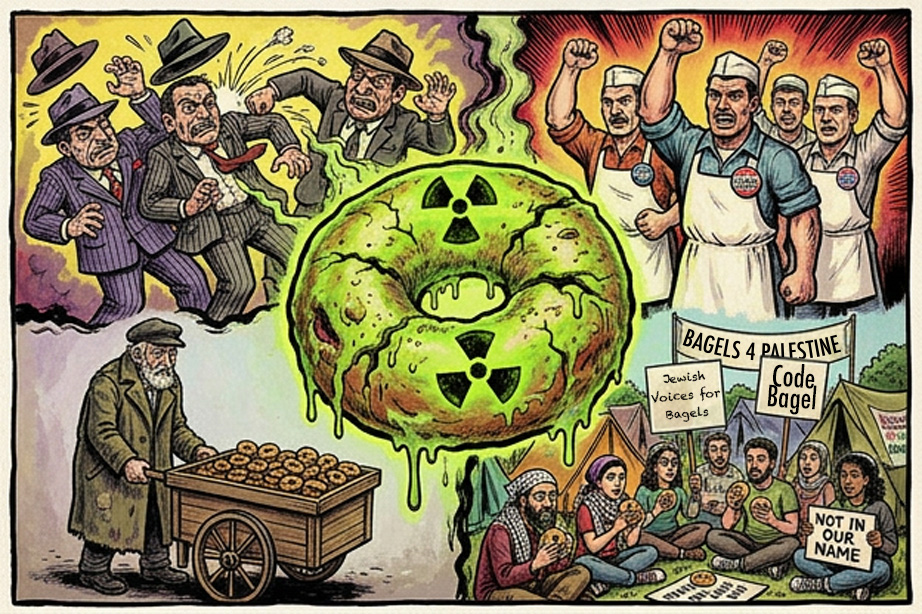
The inflated, pillowy, palm-sized New York bagel wasn’t always the New York bagel. Before the late 1960s, it was small, dense, hand-rolled, and made by skilled artisans who organized through Bagel Bakers Local 338, a union so formidable that when Johnny Dio and the Lucchese family tried to muscle into the bagel business in the 1950s, the bakers beat them back. Strategy meetings conducted entirely in Yiddish tend to stymie even determined wiseguys. (That story deserves its own post and it will get one.)
Where the mob failed, the automated bagel machine succeeded. Factory owners used it specifically to crush Local 338 and eliminate skilled labor from the equation entirely. The machines couldn’t handle traditional stiff dough, so the recipe changed: more yeast, more sugar, potassium bromate to chemically force weak gluten into something big and impressive-looking. The result was a product that required less skill to produce, could be manufactured at volume, and tasted like it.
Meanwhile, two blocks apart in the Mile End neighborhood of Montreal, real bakeries were boiling dough in honey water and loading it into wood-fired brick ovens and not thinking about it very hard because that’s just how you make a bagel. Fairmount Bagel, open since 1919, is the older of the two Mile End institutions. St-Viateur is a block and a half east and opened in 1957, which is why it became the go-to for fancy Westmount Jews who didn’t want to make the full trek. Both are legitimately excellent. Neither uses potassium bromate because neither ever needed to.
If you actually keep kosher, or if you just live on the West Island and can’t be bothered fighting Mile End traffic on a Sunday, Côte St-Luc Bagel Kosher has been an excellent and criminally underrated option since 2009. Yes, the name is grammatically absurd, but that’s Quebec’s language laws forcing businesses into syntactic contortions to comply. The bagels are wood-fired, honey-boiled, properly made, and certified kosher. They also do a cheese bagel that is technically shaped like a horseshoe and is not really a bagel in any traditional sense, but it does hail from the Shtetl and it is completely fantastic. Go early. Those go fast.
New York bakers are being asked to stop using a chemical that the WHO flagged as a probable carcinogen in 1992 and that the FDA hasn’t meaningfully reviewed since 1973. The adjustment is going to require them to learn how to ferment dough properly and actually work for the texture they want. Somehow, bagel bakers in Montreal have been doing this for over a century without treating it as a catastrophe. Enjoy your radioactive sandwich rolls. While you still can.

― Tom Robbins



Is Eli Valley doing Cartoons for you guys now?
Eli who? Never heard of the guy.