
I want to be friends with Mayor Aliza Pilichowski. Maybe the three of us, her, me, and her husband Rabbi Uri Pilichowski, who has his own remarkable site full of essays and Torah teaching, can grab a coffee together sometime.
Because I did read her op-ed in the Jerusalem Post, the one where she writes as the mayor of Mitzpe Yeriho, a settlement beyond the Green Line, about how “settler violence” gets counted, and buried in the middle of it is a paragraph I’d sign my name to without changing a word. Real violence by Jewish extremists happens, she writes. Arson, assaults, the rare killing. It’s indefensible, and those responsible should face justice.
Don’t get me wrong. Real violence by Jewish extremists – arson, assaults, the rare killing – happens. It’s indefensible, and those responsible should face justice. We don’t shy from that in our communities.
That’s it. That’s the whole ballgame, as far as I’m concerned. This isn’t some patchouli scented, drum circle, can’t-we-all-just-hug-it-out plea. I have roughly zero patience for that flavor of performative hippie both-sidesism. It’s much narrower than that. She said the sentence, and I want to make sure it doesn’t get lost.
I have a soft spot for Mitzpe Yeriho, for what it’s worth, and it isn’t political. It’s a little town perched on the last ridge of the Judean hills before everything drops away into the Jordan Valley, and the view from up there is genuinely absurd. The Dead Sea glinting in one direction, Jericho spread out below you, the hills rolling off toward Jordan. I’ve been to more than one wedding there, under a chuppah set up so the guests are half looking at the couple and half looking at a vista that belongs in a museum painting. That view is also the whole tension in miniature: a town of under 3,000 people looking down at a city of roughly 21,000 Palestinians, with another 50,000 or so across the wider Jericho governorate. Mrs. Pilichowski has been mayor of that small town since 2018, reelected repeatedly by people who by all accounts like the way she runs the place. New parks, a municipal pool, the unglamorous business of actually building something. That’s the context I want people to have before they decide what kind of person writes an op-ed defending her community’s honor.
I also know what the rest of her piece is doing. She spends most of it building a case that the numbers are cooked, that a kid on a school trip to Shiloh gets logged the same as a guy setting a barn on fire, that international NGOs have turned “Jew shows up somewhere” into a statistic indistinguishable from a stabbing. Some of that is a fair complaint about bad methodology. Some of it reads like a magic trick where you’re so busy watching the shuffling numbers that you don’t notice the rabbits she’s making disappear. I’m not writing today to referee that fight, sentence by sentence. I did plenty of that a few days ago, walking through why Jewish law never blessed this specific thing: vigilantism, lawlessness, taking a rifle or a can of gasoline into your own hands because you’ve decided you’re both judge and executioner. Not through Pinchas, not through anyone, no matter how badly some hilltop kid wants the precedent.
Here’s a detail I didn’t clock until I went looking. JPost tags this whole subject “settlers.” Times of Israel calls the identical beat “settler-violence.” One outlet is filing it as a place and a people. The other has already rendered a verdict in the label. And sitting on that same JPost opinion page as Mrs. Pilichowski’s piece, under that same neutral “settlers” tag, is an op-ed titled West Bank settler violence is not a fringe phenomenon – it is Israeli government policy. Same paper, same tag, opposite conclusions. That’s not bias. That’s an argument a country is actually having with itself, in public, in real time, which is a healthier sign than either side wants to admit.
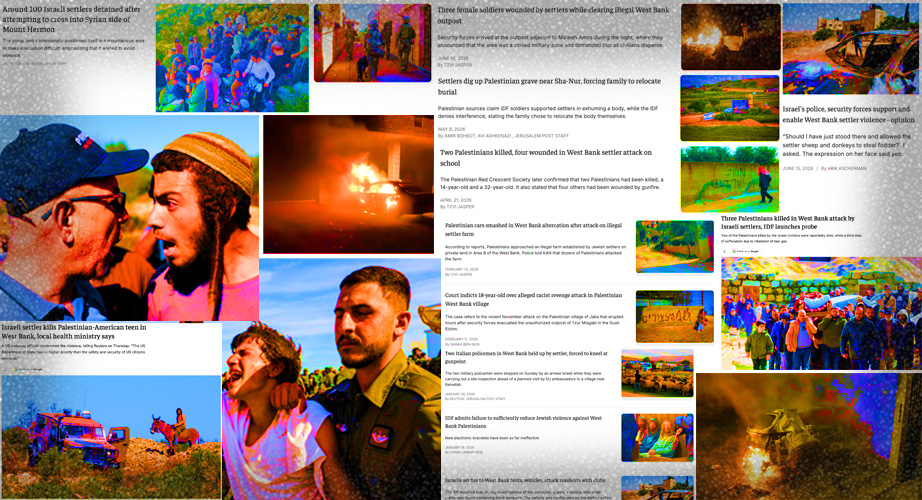
It’s a bad stretch over there, whatever you call it. About 100 Israeli settlers were detained this month trying to push across the border into the Syrian side of Mount Hermon to plant a new settlement. Three female soldiers were wounded, one with a broken nose, while clearing an illegal outpost near Ma’ale Amos, wounded by the very people they were sent to move along. A Palestinian family had to exhume and rebury their own father after vigilante criminals dug up his fresh grave near the resettled outpost of Sa-Nur, claiming he’d been buried too close to their fence. Two Palestinians were shot dead and four wounded when a mob attacked a boys’ school near al-Mughayyir, a fourteen-year-old among the dead. An eighteen-year-old was indicted for organizing a masked, convoy-style revenge raid on the village of Jaba, arson included, “Death to Arabs” spray-painted on the walls. Two Italian Carabinieri officers, traveling on diplomatic passports, were forced to kneel at gunpoint by a vigilante while scouting a route for an EU ambassadors’ visit, a sentence I had to reread twice because it sounded made up. The IDF itself admitted it failed to bring down the number of “nationalist” incidents in 2025. The number actually rose. Vigilantes torched tents and vehicles and beat residents with clubs outside Mukhmas in the middle of the night. In Khirbet Abu Falah, three Palestinians were killed in an overnight attack, two shot, one asphyxiated by tear gas. Even JPost’s own opinion page ran a piece arguing that Israeli police effectively enable the violence rather than stop it, alongside straight news coverage of a nineteen-year-old Palestinian-American shot dead during a raid on his village, the kind of story that gets the US State Department to put out a statement.
I made a collage of those headlines, all pulled from the same outlet Mrs. Pilichowski publishes in, the same page she links to as evidence the coverage is unfair to her community. Here’s where I have to be honest with her, and with myself: I don’t think the coverage is unfair. Every one of those stories checks out. Nothing there is fabricated. What’s true is that it’s incomplete. It’s a page built entirely out of the worst days, so of course it reads like the worst days are all there is, and it says nothing about the hundreds of thousands of people who never make that page at all because they’ve never done anything to earn a headline. That’s a real distortion. It’s just not the same complaint as “this didn’t happen.”
Here’s where I land, and it’s not complicated. I don’t need her to win the argument about percentages to find common cause with her. I need her, and the hundreds of thousands of people who live the way she describes (working, raising kids, building schools and pools and community life) to keep saying the sentence she already said: this is indefensible, and the people who do it belong in front of a judge. If she means that, and I have no reason to think she doesn’t, then we’re not actually far apart. A nineteen-year-old is dead and it wasn’t self-defense. Torching an orchard isn’t Zionism, it’s just arson with a flag on it. A soldier hurt by her own countrymen was hurt for nothing.
I’ll say the harder thing too, the one I have to keep reminding myself of even though I believe to my bones that this land is ours. We are living in a pre-messianic, unfinished, genuinely complicated reality, and nobody alive today gets to skip past that complexity by force. Palestinians in Jericho and Palestinians everywhere are, like all of us, made in the image of God, and I don’t believe for one second that God wants any of His children killing each other over a piece of land, however holy. Wanting this land to be ours and wanting Jews and Palestinians to stop dying are not in tension. They only look that way to people who’ve stopped believing peace is possible, and I refuse to be one of them.
What I won’t do is let “these are fringe acts” become the last word instead of the first one. A fringe that keeps producing arson, dead teenagers, and a police force held at gunpoint isn’t a rounding error. It’s a problem a community has to actually solve, out loud, in public, the way you’d want any group of people to police its own house. I don’t think Mrs. Pilichowski disagrees with that. I think she’d tell you the same thing over coffee that she wouldn’t quite fit into six hundred words defending her town’s honor to a foreign press corps.
So here’s my hand, extended. I’m not interested in a fight with people who live in Judea and Samaria because they believe, as I do, that this land is ours. I’m interested in a fight, a real one, alongside them, against anyone who thinks that belief gives them license to burn a farm, beat a teenager, point a rifle at a cop doing his job, or much worse stuff. That’s not a fringe position. That should be the whole tent.

― Tom Robbins