
AI Generated image
For the past couple of years I have been a regular presence in Pro-Palestinian TikTok lives. If you’re not familiar with the format: TikTok allows users to broadcast live video to their followers, and hosts can bring guests onto the stream to talk, debate, or just share the space. In the Israel-Palestine context, this has produced an entire ecosystem of live shows, some running for hours every night, where hosts and their audiences process the war in real time. I show up. I engage. I argue. This has not made me universally popular. I’ve been doxxed, sworn at, had my feed flooded with abuse, been called things I won’t repeat here. The standard treatment for someone who wanders into those spaces and refuses to perform the expected role.
I should say that Pro-Palestinian lives are not the only ones where I get a rough reception. I catch it on Pro-Israel lives too, regularly, for failing to be sufficiently and slavishly pro-Israel. TikTok is not a place where nuance has much of a constituency. But the Pro-Palestinian side is where I spend most of my time, because that’s where the more interesting and instructive things happen. Including this one.
In the early days of the war, the Pro-Palestinian lives were mostly discussion and debate, guests arguing about the conflict, hosts raging at Israel, the usual. But every once in a while all of that would stop. Someone would appear on the stream claiming to be in Gaza, describing their family’s situation, asking for help covering food or medical evacuation. The hosts would drop whatever conversation was happening and urge their audiences to flood the guest with TikTok coins, which convert to real cash. The guest would be treated with a kind of reverence that made any other topic feel indecent. Gaza, live, right now, needing your help. These hosts, I should mention, are some of the most committed Israel-haters I have ever had the displeasure of watching.
Then, slowly, something shifted. Even these hosts started asking questions. Turn your camera on. Can someone in Gaza vouch for you? We need to verify this. People who spent their evenings raging about Israeli war crimes, who would have called you a genocidal Zionist for asking a Palestinian anything harder than their coffee order, started running informal authentication checks on their own guests. Because enough of those guests, it turned out, were not in Gaza. Were not who they said they were. Were running a con on the people watching. This was not a fringe problem. Even Operation Olive Branch, one of the more serious and organized Gaza relief networks, had to build additional verification systems specifically to stop scammers from hijacking real Palestinians’ images and stories to steal donations meant for them.
I thought about that a lot when I started digging into where the larger Gaza money actually went.
Arab journalists are now describing what happened as the biggest fraud ever committed against the Arab and Muslim peoples. Not Israeli journalists. Not the IDF. Arab journalists. Between $3 and $4 billion raised in Gaza’s name since October 7, and a serious portion of it vanished somewhere between the donation page and the Strip.
The most recent and specific case is Algeria, where Arab media reported this week that Hamas politburo member Sami Abu Zuhri was arrested along with Yusuf Hamdan, son of longtime Hamas spokesman Osama Hamdan, on charges of embezzling Arab donations meant for Gaza. Hamdan had been Hamas’s official representative in Algeria, heavily involved in the group’s fundraising there. The Algerian government hasn’t officially confirmed the arrests. Hamas hasn’t denied them either.
You may remember Sami Abu Zuhri. Defending Hamas’s decision to launch the October 7 attack despite its toll in life and property, he told reporters: “The houses will be rebuilt. As for the martyrs, the wombs of our women will replace them many times over.” He said this from Qatar. He has apparently also been very busy in Algeria. Raising money.
Then there’s Mauritania, which produced a primary source you can’t dismiss. Bashir Abu Hattab, the Palestinian Authority’s own ambassador to the country, went on Mauritanian television and said it directly: “These donations have not reached the Palestinian people. This is a major scam that I refuse to let innocent, pure-hearted donors fall for.” The PA’s ambassador. On camera. In one of the Arab world’s poorest countries, where the people donating were not wealthy. Hamas’s local representative appeared on the same channel to rebut him, wearing colorful North African robes and assuring viewers that Mauritanian donors are unusually savvy people who cannot be easily fooled. Which is exactly what you say when people have just been fooled. Both the Algeria arrests and the Mauritania ambassador story are reported and sourced in Arabic; the English-language summary comes via Peacecomms, which links to the original Arabic reporting and the ambassador’s TV appearance.
The Turkey and Jordan piece is bigger and has more documentation behind it. A report from The Media Line published last November found that nearly $500 million collected in Gaza’s name never reached the Strip, ending up instead under the control of Muslim Brotherhood-linked networks operating out of Istanbul and Amman. The central organization is Waqf Al Umma, founded in Istanbul in 2013, which built a full multimedia fundraising operation over the past decade: celebrity clerics, emotional footage from Gaza, coordinated digital campaigns, livestreamed drives marketed as the largest ever for the Strip since the war began. A former insider described exactly how the money moved, or rather didn’t: the projects advertised in Jerusalem simply didn’t exist on the ground, funds were diverted into real estate deals with commissions taken at every step, and whenever anyone asked questions they were told the occupation made transparency impossible. In January 2024, Hamas itself publicly disavowed Waqf Al Umma along with two other organizations, Minbar al-Aqsa and Kulna Maryam, accusing them of exploiting outdated endorsements to channel donations through structures that bypassed Hamas’s oversight. The irony of Hamas complaining that a fundraising operation lacks accountability is genuinely difficult to process. The US Treasury separately sanctioned another Turkey-based charity, Filistin Vakfi, in June 2025, saying its president had “orchestrated fundraising efforts, exploiting Turkey’s position as a hub for Hamas’s clandestine financial operations.”
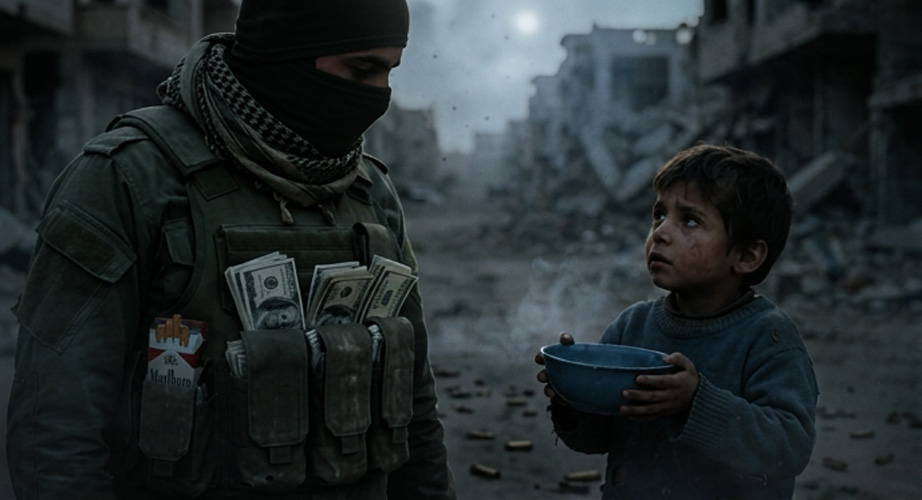
That covers money raised in Gaza’s name that went somewhere else. There’s a separate story about money that did reach Hamas and what happened to it inside Gaza. The BBC reported this past summer that Hamas has been paying roughly 30,000 so-called civil servants using a combination of secret cash reserves, black-market cigarette sales at up to 100 times prewar prices, and humanitarian aid it has systematically looted and either handed to loyalists or resold at inflated prices. The UN acknowledged that 88 percent of the aid trucks it had gathered to deliver to Gaza over recent months never reached their destination. Because of looting.

AI generated Image
And then there’s the leadership. Hamas’s top political figures, Ismail Haniyeh, Khaled Mashaal, and Moussa Abu Marzuk, held a combined estimated net worth of $11 billion, according to Israeli government figures, while living in Qatar and Turkey and traveling on private jets. Haniyeh’s son Maaz was known in Gaza as “the father of real estate” for his property holdings, accumulated while his father ran the organization nominally dedicated to liberating Palestine. He lived in Turkey. Haniyeh himself was assassinated in July 2024 in a Tehran guesthouse, which is not the fate of someone who was suffering alongside his people.
A Kuwaiti terrorism expert and retired navy officer named Suwaid al-Abkal wrote on X after the Algeria and Mauritania scandals broke: “We told you to check up on the money. We told you that Gaza and those who make money off Gaza aren’t the same thing. Now… who will hold accountable those who gathered funds with blood? Who will open the files of those who shielded themselves with slogans?”
That’s the question. And it’s being asked by people whose solidarity with Palestinians is not in any doubt, which is exactly why it lands differently than when Israelis say it.
The TikTok hosts figured it out eventually. It took them longer than it should have, but they got there. The Arab world is getting there too. The people who got robbed in this story aren’t just donors sitting in Kuwait or Mauritania who wanted to feel like they were doing something. They’re also the people in Gaza.

― Tom Robbins