
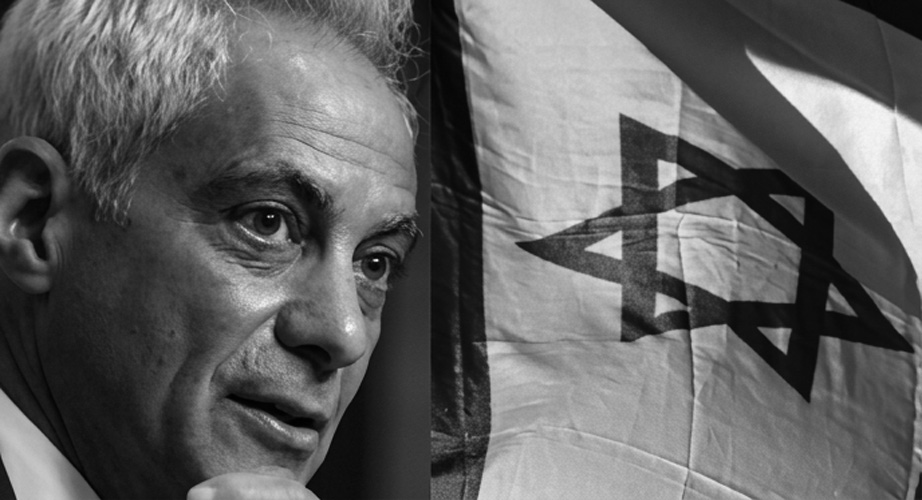
Rahm Emanuel gave a speech in Tel Aviv yesterday. OK. Cool, right? I met his niece, Rebekah Emanuel in Jerusalem in 2012 at one of those 2-day conferences that the city’s tourist infrastructure was built for. I may or may not have developed a teeny little crush on her in that time. I did not do anything about it, which may or may not have been wise, because this was a woman who graduated near the top of her Yale class with something like 29 straight As, Phi Beta Kappa, magna cum laude, the kind of fellowship résumé where you stop being impressed by any single line and start being impressed by the sheer accumulation of them. She used one of those fellowships to work at a hospice in Uganda. She’s Rahm Emanuel’s niece, actually, Yale and Harvard Business School, and these days does climate and social impact work out of Harvard’s innovation labs. She was totally out of my league.
Her grandfather, Dr. Benjamin Emanuel, died in 2019, and I went back and read his obituary. He was recruited into the Irgun as a young man in Mandate-era Jerusalem, but the underground didn’t let him fight on the front lines because he’d already lost a brother to a stray bullet during an earlier round of unrest. So they had him run communications between units instead. Later, when a British-based cell asked him to help mail letter bombs to England, he said no, he didn’t think that was the right way to do underground work, to kill people that way. He fought in 1948 anyway, as a medic, and by his own account never once fired or even loaded his gun the whole war, because he was a pacifist who happened to be fighting for his country’s survival. He pulled three wounded soldiers out from behind enemy lines under fire to prove it.
I mention all of this because it’s a genuinely more interesting family history than “tough guy Zionist grandfather,” which is the version I’d have guessed at before I actually read the obituary. Benjamin Emanuel was a man capable of picking up a rifle for his people and still drawing a hard moral line about what he would and wouldn’t do with it. That’s not a small inheritance to hand down. Which is what makes it worth asking what his grandson Rahm did with it.
He landed in Tel Aviv this week and told Israelis, in essence, that the deal is off.
Rahm Emanuel gave a speech at Tel Aviv University on Wednesday that is being covered as a tough love intervention from a longtime friend of Israel, and is being received, depending on who you ask, as either overdue realism or a preview of what a Democratic nominee’s Israel policy looks like once you strip out the donor-class euphemisms.
Here’s the case he made. Unconditional US support to Israel should end. Israel is wealthy enough to buy its own weapons like any other ally, so cut the special military aid arrangement. Sanction Israelis who attack Palestinians or their property, and the officials who cover for them. Ditch the two-state framework as a dead letter and replace it with something closer to the old Saudi Arab Peace Initiative, a broader regional deal where the whole Arab League normalizes with Israel in exchange for a path to Palestinian sovereignty that gets worked out later, somehow, by someone. He trashed Netanyahu at length: for torching the Iran deal and getting a worse outcome, for blowing off an opening with Syria’s new government, for having no plan for Gaza’s day after, and for presiding over settler violence in the West Bank that Emanuel says is actively costing Israel its standing in the world. That’s a fight over Iran’s nuclear ambitions, not Israel’s own, which is a different story entirely.
And then, because he’s Rahm, he also had a shot for the other side of the room. “From the river to the sea” and West Bank annexation are, in his framing, twin fantasies chanted by fanatics. He called Palestinian leadership corrupt. He said Arab states have cynically used the Palestinian cause as a slogan for decades without lifting a finger. This was not a speech written for one audience. It was written by a man trying to keep both halves of a room clapping at different times, which if you’ve ever watched Rahm operate is basically his entire professional signature.
Now, the reaction. Hillary Clinton posted on X calling it a candid, tough love speech that deserves attention from anyone who cares about the future of Israelis and Palestinians, which tells you something about which lane of the party is already lining up behind him. Meanwhile, per JTA’s reporting from inside the hall, when Emanuel got to the sanctions section he actually told the audience to hold your applause because they might not like what’s coming. They applauded anyway. Three separate times. For a call to sanction Israeli settlers and the banks that finance them, delivered on a stage in Tel Aviv, to a room that clapped through it. That detail tells you more about where segments of Israeli and Democratic opinion actually are right now than any op-ed reaction does.
So let me try to be annoying and hold four things at once, since apparently nuance doesn’t come in rounder numbers this week.
“Israel should be able to buy American arms under the same financial terms, the same restrictions, and the same requirements as every other trusted ally that abides by our laws.”
Thing one: ending the special aid relationship is a bigger deal than “Israel can afford its own weapons” makes it sound, and Emanuel knows it. The aid was never really charity to begin with. It’s closer to a loyalty discount that keeps Israel locked in as a captive customer of the American defense industry, since most of that money by law has to be spent on US-made hardware. That arrangement is doing double duty. It keeps American manufacturers, and American jobs, tied to Israeli defense spending, which is exactly why the aid has always had bipartisan muscle behind it in Congress regardless of who’s president. And it quietly caps how much Israel invests in building out its own weapons industry into something that could compete with American contractors on the open market, rather than just supplying itself. Cut the aid and you don’t just save Israel a subsidy, you cut American leverage over what Israel buys and free Israel to build and sell more of its own systems instead. If your stated worry is Israeli isolation, unwinding an arrangement that’s kept Israel tethered to Washington’s supply chain for decades is a strange way to address it.
Thing two: a lot of people are more outraged about the settler violence sanctions piece than the thing actually warrants. This is close to actual, existing Biden administration policy, applied to individuals who burn Palestinian orchards and torch cars, not to Israel as a state. You can think it’s the wrong lever, you can think it should be paired with equally sharp language about Palestinian incitement (his speech was thinner there, that’s a fair hit), but treating any accountability for settler violence as an attack on Israel’s legitimacy is its own kind of category error, and one I see a lot of keyboard hasbaristas making because it’s emotionally satisfying rather than because it’s accurate.
“The now-discredited path to a ‘two-state solution’ should be replaced by a 23-state solution: the 21 Arab nations that have exploited Palestinian rights as a slogan for decades now need to roll up their sleeves and stand up a governing authority capable of accepting the historic Jewish connection to this land.”
Thing three: the “23-state solution” is doing a lot of work for very little content, though credit where it’s due, it’s not pure vapor. Emanuel’s actual formulation puts the burden on the 21 Arab League states themselves, telling them they’ve “exploited Palestinian rights as a slogan for decades” and now need to “roll up their sleeves and stand up a governing authority” that accepts Israel’s historic claim to the land. That’s a real shift from the standard Arab Peace Initiative script, where the accountability mostly flows one direction, toward Israel. Making Arab states the ones on the hook for building Palestinian governance, rather than just collecting normalization as a reward, is a genuinely sharper idea than the two-state cliches Emanuel is trying to retire. But it’s still a directive, not a design. Full recognition from 21 Arab League states in exchange for a Palestinian entity whose sovereignty, governance, and security guarantees are all TBD is not a plan, it’s a shape of a plan, and Emanuel offering it as his big constructive alternative to annexation on the one hand, and to “river to the sea” maximalism on the other, is thinner than he’s letting on. If you’re going to spend half your speech saying both extremes are fantasy, your alternative can’t also be mostly vibes.
“Those chanting ‘from the river to the sea’ need to hear this loud and clear: they will never have their way. But those calling for a greater Israel must also hear this loud and clear: you’re never going to have your way, either. Both are fantasies chanted by fanatics.”
Thing four: the framing of Israeli annexationism and Palestinian eliminationism as two equivalent fantasies is genuinely worth objecting to, and not because Israel is beyond criticism. It’s because one of those fantasies is a faction within a functioning democracy that gets fought out in courts and elections and op-eds, and the other is the stated goal of the movement that murdered, raped, and kidnapped its way through southern Israel on Simchat Torah, and is now chanted at Israelis on college quads as if it’s a peace slogan. Symmetry there isn’t nuance. It’s a category error dressed up as evenhandedness, and it’s the one place where I think Emanuel, intentionally or not, borrowed the laziest move in progressive foreign policy rhetoric.
Where does that leave me? Honestly, closer to “this speech contains a real critique buried under a campaign speech” than either “Rahm betrayed the Jews” or “Rahm just said the quiet part out loud, good for him.” Netanyahu’s government has genuinely isolated Israel further than it needed to be. The settlement violence problem is real and Israeli society mostly knows it’s real. The absence of a serious day-after plan for Gaza is a genuine strategic failure, not a talking point. Emanuel isn’t wrong to say those things, and he isn’t the first to say them, he’s just the highest profile Democrat with 2028 written on his forehead saying them in a room full of cameras.
But I also don’t think you get to stand on a stage in Tel Aviv, three years removed from October 7th, spend one clause on Hamas and several paragraphs on Israeli settlers, decline to just say no when asked point blank whether Israel is committing genocide, and call the whole thing an act of friendship. Friends say no. Friends don’t treat “I’m open to discussing whether you’re guilty of the worst crime in the human vocabulary” as a diplomatically savvy answer. That part of the coverage, if accurate, is a real problem, and it’s the part where ambition is doing more talking than conviction.
Rebekah’s uncle is clever. Genuinely, legitimately clever, in the way that took him from the Clinton war room to the Obama West Wing to the mayor’s office in Chicago to an ambassadorship in Tokyo. But clever is exactly the wrong skill for this particular moment, because clever means reading the room and giving it exactly enough to keep you employable in it. Every position in that speech was pre-cleared for two different audiences before he ever said it out loud. That’s not courage. That’s choreography. What Israel actually needs from American politicians right now isn’t someone who can find the rhetorical sweet spot that plays in both a Tel Aviv University lecture hall and a Democratic primary debate stage. It needs someone willing to say the less popular true thing in both rooms, and eat whatever it costs him in at least one of them.
Rahm Emanuel has never once, in forty years of public life, eaten that cost. His own father held a rifle in 1948 and chose, on principle, never to fire it, and that restraint is the thing everyone in that family still calls courage. The grandson found a microphone in Tel Aviv this week and used it to fire in both directions at once, carefully enough that no one who mattered to his future ever had to feel the shot. That’s not tough love. That’s just a very good aim.
As for Rebekah, we’re still Facebook friends. She’s married now and has at least three kids of her own. Mazel Tov! She was out of my league in 2012, and she still is. Her uncle, it turns out, was once out of reach in a better way too. In 1991, with no cameras rolling and no primary left to win, he walked off Bill Clinton’s presidential campaign to spend two weeks repairing truck brakes on an Israeli base near the Lebanese border while Scuds fell on the country his father came from. Nobody was covering that. Nobody was clipping it for a highlight reel. That’s the version of him I wish had shown up in Tel Aviv this week, principled and committed and selfless, instead of the one who did, who has learned to make calculation look like conviction. It’s been a long time since Tel Aviv saw him without an audience, and I’m not sure, watching him work a room built for two audiences at once, that he remembers what that felt like either.

― Tom Robbins
- Bibi: The Supreme Court Can’t Pick October 7th Investigators Because They are All Leftists. Are They Though? - 10/23/2026
- Rabbi Dov Lior Says You Can “Take” Palestinian Olives. Let’s Grade the Excuses. - 10/22/2026
- A Defensible Call, a Terrible Meeting, and Cenk: What the Leaked CBS Tape Actually Shows - 10/18/2026