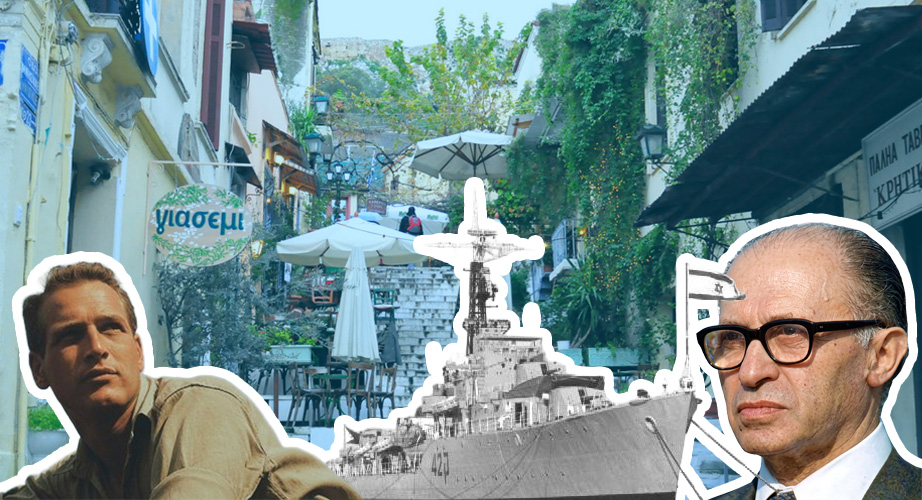
Athens in 1982, a ferry with no beds, my father’s sunken destroyer, and a song about a Walkman and heartbreak. A photo of a staircase showed up in my feed this week and the memories started flooding!
Mish posted a picture and asked if anyone knew where it was. Mish is South African, Jewish, loves Israel, has something north of thirty seven thousand followers on X, and we follow each other, which is the modern version of knowing somebody. The photo was a narrow lane, stone steps climbing away from the camera, tables and chairs set right on the treads, vines overhead, people eating and drinking on both sides.
I knew instantly. That’s the Mnisikleous Stairs in the Plaka neighborhood of Athens, the stepped lane that runs up toward Anafiotika under the Acropolis. It’s probably the single most photographed street in Greece that’s not a ruin.
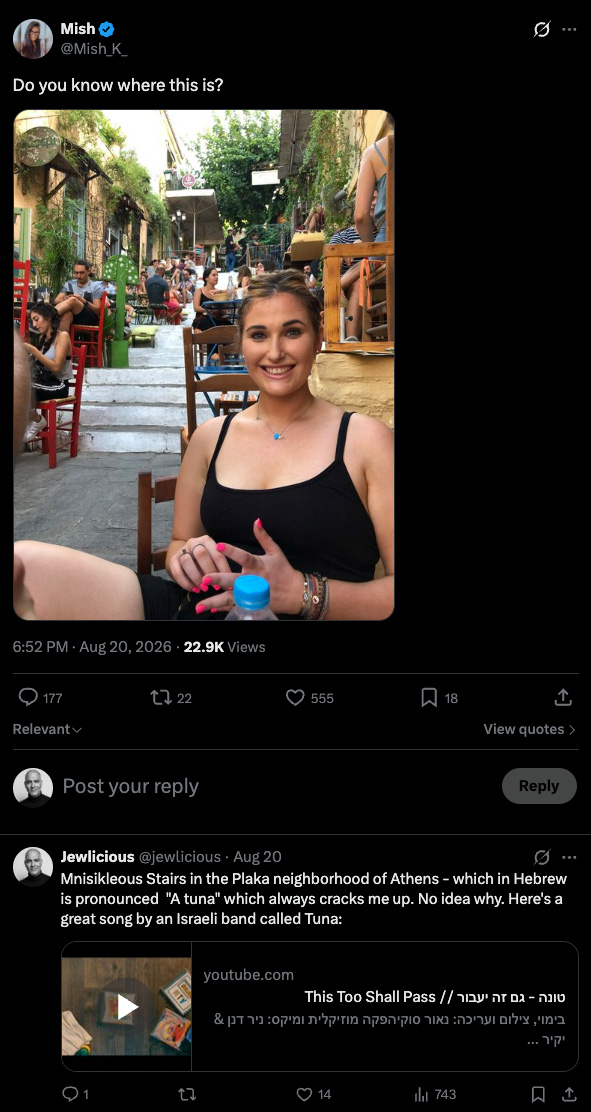
Of course I responded. And then I made the joke I always make, which is that the Hebrew word for Athens is אתונה, pronounced Atuna, which to an English speaker sounds exactly like “a tuna.” This has cracked me up for four decades and I’ve never fully understood why. Then, because I have zero restraint, I linked to “Gam Zeh Ya’avor,” This Too Shall Pass, by the Israeli rapper Tuna. Cheap segue. Fourteen likes. A normal Wednesday on the internet.
Except then I couldn’t stop thinking about it, because I’ve been on those steps, and the reason I was on those steps is a whole story about who I was at seventeen and what Israel was in January of 1982. The segue turned out to be less cheap than I intended.
Chomedey
I grew up in Chomedey, a district of Laval, the suburb across the river from Montreal. In the 1950s and 60s Jewish families did what Jewish families everywhere in North America were doing, which was leave the old immigrant streets downtown and buy a bungalow with a driveway somewhere with grass. Young Israel of Chomedey was founded in 1959 and at its peak had something like eight hundred families. There was a United Talmud Torah campus. There was a Jewish Y (the Quebec version of a typical American JCC). For a while it was a place with a vibrant Jewish life. It started off predominantly Ashkenazi and then in the 70s, Sephardic, overwhelmingly Moroccan Jews, started moving in.
By the time I was a teenager Chomedey’s Jewish community was already past its prime. People were moving back to the island, to Côte-Saint-Luc and Dollard, or leaving Quebec entirely, which a lot of Ashkenazi Anglos did after 1976 (Merçi Réné!). And as the Jews left, Greeks moved in. Today, Laval has one of the biggest Greek communities in Canada and a lot of it is in Chomedey. That’s just how neighborhoods work. One group sells and another group buys.
What I remember, though, is not demographics. What I remember is getting into fights. Constant, stupid, teenage fights, and a lot of them came with a soundtrack of the ordinary inherited Antisemitism that kids repeat without having any idea where they got it. I don’t want to overstate it and turn my adolescence into a pogrom, because it wasn’t that. It was schoolyard garbage. But it was schoolyard garbage with a specific flavor, and by the time I was sixteen I had built a whole theory in my head in which Greeks were, and I believe this is the technical term I used at the time, total fucking psychopaths.
I should say that I gave as good as I got. I’m still scrappy. It’s not a quality I’ve ever managed to put down, and at this point I’ve stopped trying. My business card literally says “Fight Me!”
When I got to Israel at seventeen to study at Hebrew University, and there was a break in January, and I had a little money, so I decided to go to Greece. Alone. Because why not. I told myself, and I’m pretty sure I actually believed it, that I was going to go figure out where these malakas (wankers) came from. That’s a genuinely insane reason for a seventeen year old to buy a boat ticket to another continent. It’s also, in retrospect, the least insane thing I did that year. Don’t even ask.
The boat
I didn’t fly. My decision to go to Greece was a last minute thing and there was no time for reservations. At Hebrew U. the only phones we had were wildly unreliable public pay phones that used Asimonim that had to be purchased ahead of time. Ain’t nobody got time fo’ dat. Instead I went to Haifa and and got on a ferry, and the ferry took me to Limassol in Cyprus, and then across to Rhodes, and then up through the islands to Piraeus which was a 15 minute cab ride to Athens. The crossing took two days and included a 3-hour stopover in Cyprus. This was a weekly service that ran year round, which which was great because I went in January. I bought deck passage, which was the cheapest ticket available and which entitled me to exactly one thing… floor.
In summer, deck passage means the actual deck, and people romanticize it, and they’re right to. In January it meant i had to get on board fast and claim a patch of carpet in a lounge, or a vinyl banquette, and then I slept in my coat with my backpack bag under my head while a few hundred people around me smoked incessantly. I brought my own food and my own water because the onboard options were both expensive and largely theoretical. My fellow passengers were Israelis, Cypriots, Greeks, Arabs of every possible religious configuration, a few newly released IDF soldiers, a lot of people moving household goods for some unknown reason, and in January almost no tourists at all. There was the inevitable dude with a guitar. By the second morning I knew everybody’s first name and nobody’s last name, a kind of friendship that only happens on boats.
Nobody on that ship thought I was seventeen. Everybody assumed twenty one, and I did nothing to correct them, and I didn’t look seventeen or act it, and the women I met that week responded accordingly. I’m not going to pretend that wasn’t a large part of the appeal of the entire journey.
Limassol, and three boats
I broke the journey in Cyprus for an afternoon, and I did it on purpose, for a reason that’s entirely my father’s fault. See, my dad was crew on the Eilat when Otto Preminger came to shoot Exodus, the 1960 Paul Newman picture out of the Leon Uris novel, the one with the Ernest Gold theme that every Jewish household on earth owned on vinyl. Wherever Israeli ships turn up in that film, that’s where my father was. He was an extra. He was in it. This didn’t really mean much in my house. My Dad isn’t much of a film buff and I doubt my sisters know about this little anecdote but for me? It was huge, especially given the significance of the movie to the perception of Israel in the West. And Eva Marie Saint. Damn! She’s still alive by the way, and she’s 102. But I digress.
Now, if you think about this for eleven seconds, the navy work almost certainly puts him with the Israel unit and not the Cyprus unit. I knew that. It didn’t matter. There was a Cyprus unit. My father was in Exodus, Exodus had a Cyprus half, therefore Cyprus. That’s how a seventeen year old builds a case, and I want to be honest that I haven’t entirely outgrown the method.
The Eilat didn’t last. My father’s service had ended a little more a couple years earlier, which means he wasn’t on board, and it also means he probably knew some of the men who were.
On October 21, 1967, four and a half months after the Six Day War ended, she was on patrol about fourteen miles off Port Said. Two Egyptian missile boats sitting inside Port Said harbour fired Soviet Styx missiles at her. Her radar showed nothing unusual, because the boats never left port. Two hits, then two more about an hour later, and she went down. Forty seven men died out of a crew of a hundred and ninety nine.
It was the first time in history that a warship was sunk by a guided missile fired from another ship, and navies all over the world tore up their assumptions and started again. Israel’s own answer was the Sa’ar boats and the Gabriel missile, and that is what won the naval war in 1973. It was also one of the opening blows of the War of Attrition, the grinding three year fight along the canal that most people have filed somewhere between 1967 and 1973 and stopped thinking about.
Twelve years after Egypt sank my father’s ship, Israel handed Egypt back the Sinai and signed a peace that has held ever since. Hold onto that for a minute, because I’m going to need it later.
Of course I got off the boat.
What I didn’t understand until this week, when I finally went and looked it up, is this. Preminger shot the Cyprus material between March and June of 1960, and the Cyprus locations were Famagusta and Kyrenia. Famagusta harbour is where they staged the blockade. And Famagusta and Kyrenia have both been on the far side of the Green Line since the Turkish invasion of 1974. Varosha, the resort quarter of Famagusta, had been fenced off and abandoned for eight years by the time I showed up, and it’s still fenced off now.
I had come to Cyprus for my father’s Exodus and my father’s Exodus was a hundred kilometres away behind a ceasefire line, in a city that had been emptied and locked. I’ve no memory of understanding this at the time. I think I walked around Limassol, ate something, and got back on the boat feeling vaguely like I had somehow accomplished something of great significance.
And there’s a second layer to this that I find almost unbearable, and I only assembled it this week.
The company running that line was Sol Lines, founded in Limassol in March 1977 by a Cypriot named Takis Solomonides, and it was the outfit that opened the Cyprus to Greece run and then kept it running through the winters when nobody else would bother. Its flagship was a ferry called the Sol Phryne, named after the owner’s daughter, built in Kobe, Japan in 1948 as a train ferry called the Taisetsu Maru. She had four funnels. She looked like something that had sailed out of a different century and gotten lost.
In February 1988 the PLO bought the Sol Phryne in Limassol harbour for six hundred thousand dollars, renamed her Al-Awda, the Return, and announced that she would carry a hundred and thirty five deportees into Haifa as a deliberate restaging of the Exodus. That was the entire point of the exercise. They said so. Yitzhak Shamir called it a declaration of war and, sure enough, she never left the harbour. Somebody swam out and put a limpet mine on her hull and blew a hole in her bottom.
I wasn’t on her. Sol Lines’ own company history says the Sol Phryne spent her first six years running Greece to Cyprus to Lattakia in Syria, and that Haifa only replaced Lattakia on that rotation around 1983, because no passenger traffic ever developed out of Syria. In January 1982 she was doing the Syria leg. My Israel service was covered by a different ship, and by two Greek competitors who had piled onto the same line and were all losing money on it.
But she worked out of Limassol. And I was in Limassol, for an afternoon, in January 1982, because of a movie called Exodus. There’s a very reasonable chance that I stood on that quay and looked directly at the boat that would be turned into the anti-Exodus, and registered nothing whatsoever, because I was seventeen and there was probably a girl. I should also add that by the end of June 1982, Israel had invaded Lebanon and had completely surrounded and blockaded West Beirut. Yasser Arafat and 14,000 armed PLO terrorists were stuck. A multinational force (MNF) was quickly arranged and all the PLO fighters were evacuated by September 1st, mostly to Tunis, using commercial Cypriot and Greek ferries, including, you guessed it, the Sol Phryne.
Plaka in January
Athens in winter is not the Athens anybody photographs.
The city sat under a brown lid of smog that Greeks called the nefos, and it was worst in the winter, because on top of the traffic every apartment block in the basin was burning heating oil. You could taste the air. Everybody complained about it constantly, the way people complain about weather they can’t leave.
I got a bed in a cheap pension in Plaka. Everyone did. In August, Plaka was the landing zone for every backpacker moving between Europe and the islands and Egypt and Turkey. In January it was nearly empty. Half the tavernas were shuttered for the season. It rained. The stone steps were slick and the cats were miserable and the handful of travelers who were around found each other fast, because there was nobody else, and we sat in the same three places every night for a week.
Which is how I picked up one of the few reliable rules I’ve acquired in my life. There are always Swedish women travelling. Always. Whatever the country, whatever the month, whatever the weather happens to be doing, somewhere in the middle of it there are two or three Swedish women moving through, dressed considerably better than you are for the conditions, entirely unbothered, reading a paperback in a language you’re never going to make any progress on. Cold, wet, fogged in, half shuttered January Athens didn’t thin them out in the slightest. Why would it. They’re Swedish. That’s a mild spring to them.
And if you’re seventeen, and everybody has decided you’re twenty one, and the total off season population of Plaka comes to roughly nine people of whom four are Swedish, then things happen. Sue me.
What I didn’t know at the time is that I had walked into Plaka at a very specific moment in its life. The neighborhood had spent the sixties and seventies coming apart. The architect Dionysis Zivas, who led the team that eventually “saved” it, later said there were ninety clubs operating in Plaka and half the residents had gone, and the only ones who stayed were the ones who couldn’t afford to leave. Discos, bouzouki joints, neon, noise, drugs. His rescue plan went into effect in January 1979, and the first thing it did was start turning the streets into pedestrian zones.
In January 1982 Plaka was mid-surgery, and in the off season you could see the surgery clearly, because there were no crowds in the way. Streets torn up and being repaved. Scaffolding on the neoclassical facades. Shuttered storefronts where a club had just been closed down, next to one that was somehow still open and still blaring. And the whole country was three months into a political fever, because Greece had joined the European Community the previous January, PASOK had won in October, Melina Mercouri was the brand new Culture Minister, and everything that had been suppressed since the colonels was suddenly out in the open and extremely loud.
And the Mnisikleous steps were there, without the tables on them, because it was January. Just steps, and rain, and laundry, and old women who lived there watching me the way you watch weather. Anafiotika above them was still a village where people actually lived rather than a mass lineup for a photograph.
What I was actually looking for
I did look for Jewish Athens. Of course I did. I was a kid out of a Jewish day school who had been in Jerusalem for months, and I couldn’t walk through a European city without doing the thing we all do, which is scan for traces.
There’s less there than you would expect, and the reason is grim and specific. After the Ottomans took Athens in 1456, Mehmed II granted the city’s inhabitants the right to forbid Jews from settling there. During the exact centuries when Plaka’s lanes were forming, there was no Jewish quarter, because there was barely any community. A few Spanish refugees trickled in after 1492. A French traveler in 1705 counted fifteen or twenty families. Whatever existed was destroyed in the War of Independence, and the modern Athens community only really starts after 1834, when the city became the capital. Sixty Jews in 1878. Two hundred fifty by 1887. Official recognition in 1889. They settled in Thiseio and Petralona and traded out of Monastiraki, and the flea market down there’s still called Yusurum after the Jewish family from Smyrna who opened the first antique shop in it.
The old stuff is much older than any of that, and it’s in the Ancient Agora, a ten minute walk downhill from those steps. There’s a building there that archaeologists think was a synagogue, somewhere between the third century and the fifth. A marble plaque carved with a menorah and a lulav turned up in the Agora near a statue of Hadrian. And this is very likely the general neighborhood of the synagogue where Paul argued with the Jews and the God-fearing Greeks in Acts 17, which means there were Jews having an argument about theology in Athens roughly two thousand years before I showed up to have my own arguments about whatever with people I met there.
The two working synagogues, Etz Hayyim and Beth Shalom, face each other on Melidoni Street near Thiseio. The Jewish Museum of Greece existed, having been founded in 1977, though it wasn’t yet in the beautiful Plaka townhouse it occupies now. I don’t remember finding it. I probably walked past it.
But I did find something out, and it’s the reason the trip didn’t work out the way seventeen year old me had planned. Greece lost a higher proportion of its Jews in the Holocaust than almost any country in Europe. Somewhere between eighty and ninety percent. Thessaloniki, which had been one of the great Jewish cities of the world, a city where Jews were the largest single group for centuries, was emptied and it’s Jews sent to Auschwitz in 1943. Something like forty six thousand people were erased in a few months.
And Athens did better, and it did better because of Greeks. Archbishop Damaskinos instructed churches to issue false baptismal certificates and publicly protested the deportations, which almost nobody in occupied Europe did. The Athens police chief, Angelos Evert, issued thousands of forged identity cards. On Zakynthos the mayor and the bishop were ordered to hand over a list of the island’s Jews and handed over a list with two names on it, their own, and every single Jew on that island survived the war. Both men are recognized at Yad Vashem as Righteous Among the Nations.
I went to Greece carrying a theory about Greeks, and the theory didn’t survive contact. What I got instead was the ordinary adult fact, which is that a nationality is not a personality. The kids who took swings at me in a parking lot in Chomedey were the grandchildren of a country that both murdered and hid its Jews, and mostly of a country that did neither and just watched. Same as everywhere. I didn’t fully process this at seventeen. I processed maybe forty percent of it, which is a respectable batting average for that age.
What Israel was, that winter
And here is the part that has been sitting in my chest since I saw that photograph.
I got back on a boat and went back to Jerusalem, and the Israel I went back to is a country I can barely explain to anyone under forty.
The economy was a disaster. Inflation had run about a hundred and thirty three percent in 1980 and roughly a hundred percent in 1981 and would hit a hundred and thirty one and a half percent in 1982. The old shekel had replaced the lira in February 1980 and was already melting in your hand. You changed money in small amounts because holding shekels for a week was a decision you paid for.
And the Prime Minister was Menachem Begin. Likud. The former head of the Irgun. The man Ben-Gurion refused to name out loud. And in that specific period he was, and I understand exactly how this reads in 2026, the moral one.
He had signed Camp David with Anwar Sadat in 1978 and the peace treaty in March 1979, and he was giving back the entire Sinai. Oil fields, airbases, settlements, all of it. Sadat had been shot dead at a military parade in Cairo three months before I got on that ferry, on October 6, 1981, and everybody assumed the treaty would die with him, and it didn’t. Hosni Mubarak kept it. And the last phase of the withdrawal, the one that included dragging Israeli families out of Yamit and then bulldozing the town, was three months in front of me and was tearing the country in half while I was sleeping on a carpet in a ship’s lounge.
A Likud prime minister traded land for peace with the largest Arab army in the world, over the screaming objections of a large part of his own base, and the peace held, and it has held ever since through absolutely everything. That’s the thing I asked you to hold onto. The country Begin made that peace with is the country that had put four missiles into my father’s ship twelve years earlier and killed forty seven of his people. It got made anyway.
In June 1977, in one of his first acts in office, Begin took in Vietnamese boat people. An Israeli freighter called the Yuvali found sixty six of them adrift in the South China Sea, out of food and water, after ships from East Germany, Norway, Japan and Panama had all sailed past them. Israel took them and gave them citizenship. Between 1977 and 1979 about three hundred sixty six Vietnamese refugees were admitted. Begin explained it by talking about the St. Louis, the ship carrying nine hundred Jews that went from harbor to harbor in 1939 and was turned away everywhere. He said that, given that, it was natural to give these people a haven.
Say what you want about the man. He said what he was going to do, and then he did it.
Jacobo Timerman was in the country. Timerman was an Argentine Jewish newspaper publisher who had been kidnapped and tortured by the junta and held without charge for two and a half years, in significant part because he was a Jew, and Israel got him out and he landed in Tel Aviv in 1979. His book about it, Prisoner Without a Name, Cell Without a Number, came out in 1981 and was everywhere. He was a living argument for the entire premise of the state. He would turn around within the year and publish a furious book attacking the Lebanon war, and then leave, and the argument about him would get very ugly. But not yet. Not that winter.
The dining scene was terrible (though the quality of the Shawarma was at its golden age, never to be replicated again) and there was suddenly Chinese food in Tel Aviv, which felt like a transmission from the future. Yisrael Aharoni had opened Yin Yang on Rothschild Boulevard in 1981 and more or less single handedly convinced Israelis that dinner at a restaurant could be something other than schnitzel. Meanwhile the Vietnamese Israeli Prime Minister Begin had taken in were quietly starting to cook, and some of their kids ended up running restaurants, and one of them, Vaan Nguyen, even grew up to be an Israeli poet.
Contemplate that for a moment. We had a broke-ass country, with triple digit inflation, run by a right wing prime minister, who was both handing back territory and taking in refugees.
And it was before the war. The first Lebanon war started on June 6, 1982. Everything I’m describing sits on the other side of that line. That January was one of the last stretches of time when the perception of Israel abroad was relatively uncomplicated. Foreigners volunteered at Kibbutzim, we could go visit Gaza City, shop and go to the beach. The Sinai (prior to its return to Egypt that year) was full of young travellers, many naked, many high, chilling in Bedouin encampments. Israel was… interesting.
Gam zeh ya’avor
I made a tuna joke on the internet and linked a song, and the song is called This Too Shall Pass, and I picked it for the pun and then realized I had picked it correctly for entirely different reasons.
If you haven’t heard it, the setup is that Tuna is is sitting with a friend whose heart has just been broken, and he opens by admitting he has no clichés to offer, and then he offers the drink instead. Come on, we will drink, we will drown out your angst. It’s the most useful thing anybody has ever said to anybody in that condition. And then he tries to be diplomatic about the woman, because that’s what you’re supposed to do. Maybe you two will get back together. Maybe there’s still a wedding in this somewhere. Maybe it’s too early to start talking dirt. He doesn’t make it. The diplomacy holds for about two lines and then it collapses and he turns on her, hard, with one of the ugliest phrases in spoken Hebrew, on his friend’s behalf. Anyone who has ever been a real friend at three in the morning knows exactly what that moment is. It’s both an ugly thing to say and it’s the right thing to say, and those aren’t always different.
Then comes the chorus, and the chorus is the reason the song is actually about everything I’ve just written. It’s a list. He rattles off the disposable furniture of the recent past, Netscape, Blockbuster, Napster, the Walkman, Tamagotchis, the Macarena, Crocs, grunge, the Y2K bug, and about thirty more, and after each batch he says that this too will pass. The refrain doesn’t even promise a full recovery. It says time heals everything, and then immediately hedges and settles for most of it, which is the most honest thing in the whole song.
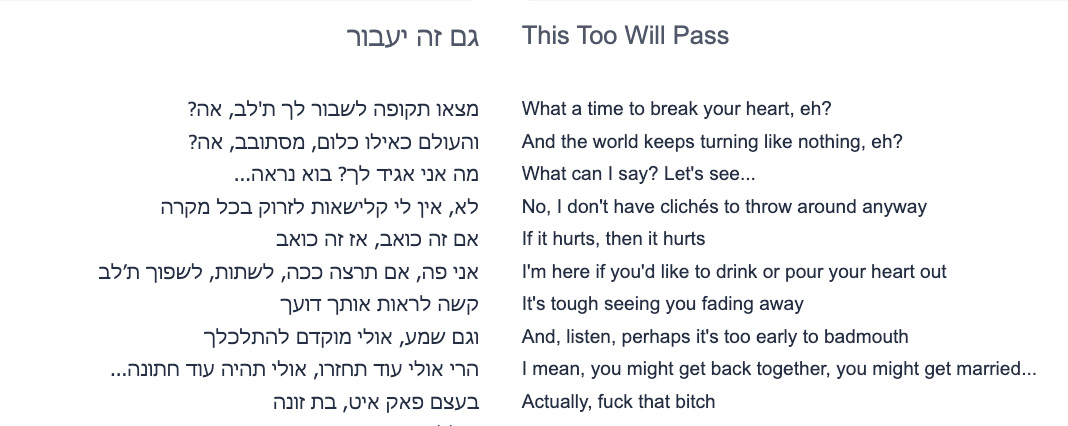
And at the very end of the list, buried among the Tamagotchis and the dead TV channels, he drops in loneliness. Just slips it in as one more thing on its way out. That’s the trick, and it’s a good one. You put the unbearable thing in the same list as the Walkman, and you make it survivable by making it ordinary.
The Mnisikleous Stairs are now a photograph. Not a place, a photograph. There are people on those steps right now whose entire relationship with them is fifteen seconds of video. Plaka got “saved”, deliberately and carefully and by good people with good intentions, and the saving is what finished it. The clubs went, the Pensions were replaced by cute boutique hotels and AirBnBs, the residents came back, the facades got repainted, and the neighborhood turned into a beautiful preserved thing that nothing happens in. Whatever was actually alive moved to Exarcheia, and then to Psyrri, and then to Gazi.
Jerusalem, where I live now, is doing its own version. Blocks of the Old City and the areas around it are being smoothed into an experience. Fancy hotels in stone buildings, luxury condos encased in Jerusalem stone, in close proximity to the Kotel, curated authenticity, the whole shebang. I love this city even as I watch it turn into an expensive playground for the wealthy, a veritable living, breathing theme park of biblical proportions.
Chomedey is not Jewish anymore in the way it was. Young Israel sold its building in 2016. Eight hundred families down to under two hundred, most of them not even living there, keeping their membership for the cemetery and the High Holidays. They couldn’t get a minyan together in the morning. The building went to a foundation and the understanding was that it would be given to the local Armenian community. That’s a perfectly fine outcome. It’s also an ending. The Moroccan/Sephardic Jews are still there, but there are now two Sephardic synagogues that don’t talk to each other and a Moroccan Chabad Rabbi is in charge of the Ashkenazi Conservative Shaar Shalom synagogue that rents space to the Orthodox, Ashkenazi Young Israel congregation. I still shake my head when I think about it. But at least the young Greek hooligans aren’t beating anyone up anymore.
As for Israel? We’re more fortified, better armed and more technologically dominant than Begin could have ever dreamed. On October 7 the border gave way in a morning and twelve hundred people were murdered in their homes. In the years since, the open revulsion aimed at Jews and Israelis has run higher than anything I have ever seen in my life. Beyond anything I could have ever imagined, even.
The Likud prime minister of that winter gave back Sinai, took in Vietnamese boat people, and explained himself by talking about the St. Louis.
The trouble with gam zeh ya’avor is this. Everybody quotes it as an idea meant to encourage comfort. It was never comfort. It’s a description, and a cold one. It promises nothing whatsoever about what comes next. It just says nothing holds. The Ottoman ban on Jews in Athens passed. Thessaloniki passed. Famagusta passed, and is still sitting there behind a fence. My father’s ship passed, off Port Said, in about two minutes. Begin passed. The four funnelled steamer in Limassol harbour passed, and got a mine put on her hull. The cheap pensions passed. The kid who got into fights in a parking lot in Laval and then took a winter ferry to Greece to work out why, passed, and is now me, writing about a staircase.
Whatever we’re in right now will pass too. I’m not going to pretend I know into what.
But if you ever find yourself on those steps, and I hope you do, walk the ten minutes downhill to the Agora and find the plaque with the menorah on it. Somebody carved that in the fourth century, in a city that would later spend four hundred years not letting us live there. We’re still here and the plaque is still here and the guy who carved it had no idea either.
Thanks for the photo, Mish.
Anyway. A tuna. Still fucking funny.

― Tom Robbins
- NAZA Wins at Venice on Rosh Hashanah: What We Missed - 9/13/2026
- What is Actually Going on in Qusra? - 8/31/2026
- Stairs, Ships, Swedish Babes, Menachem Begin and a Tuna - 8/27/2026