


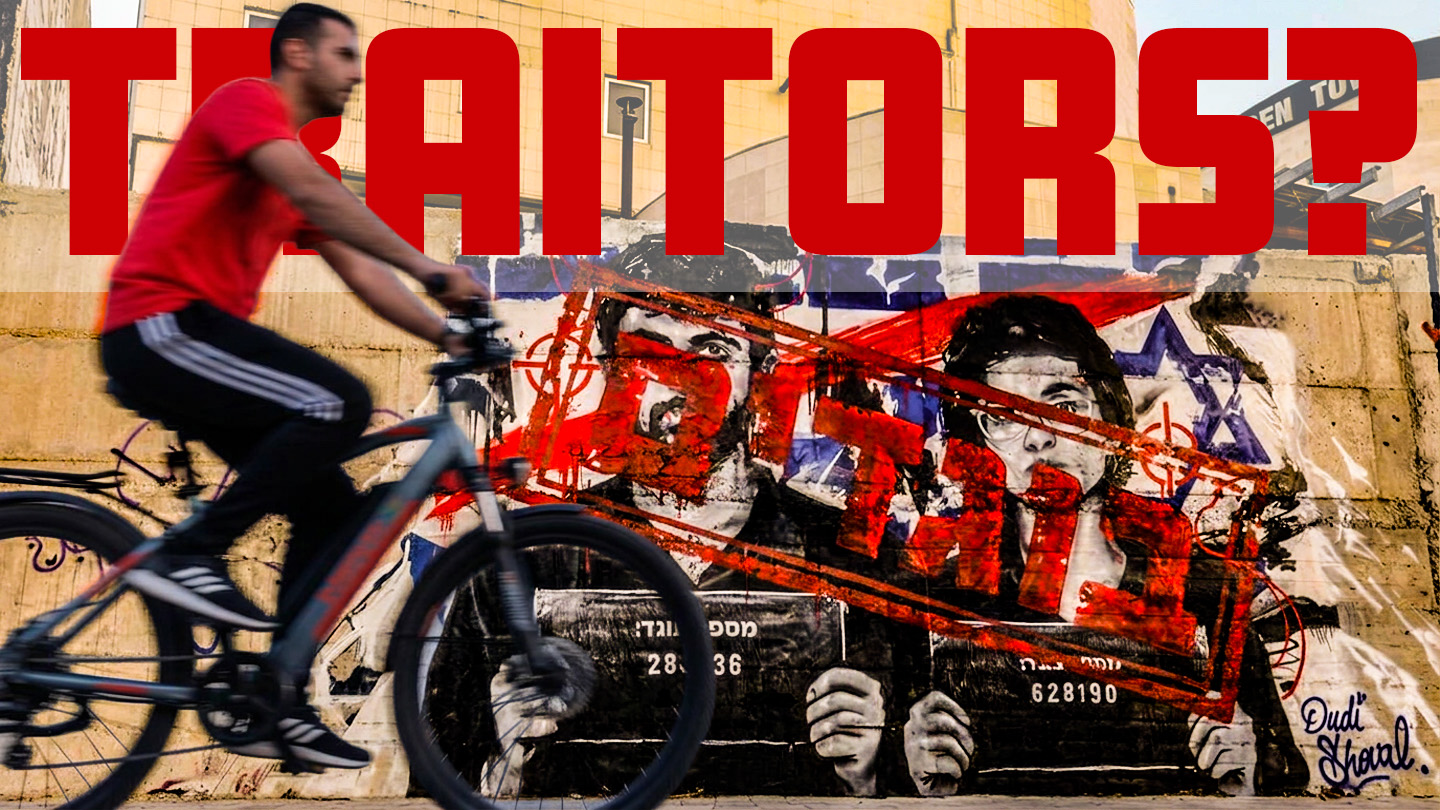
I haven’t seen NAZA. I mention this up front because it seems to be the one thing I have in common with nearly everyone in Israel who is currently furious about it. The film hasn’t screened there, so apart from a few Israeli critics who happened to be in Venice, an entire country is reacting to a movie it hasn’t watched. That includes the Culture Minister, the Prime Minister, whoever spray-painted “traitors” on a wall in Ashdod on Tuesday, and, if Calcalist’s film critic is right, the IDF spokesperson who declared the film false. Uh. Based. noticed this too, as did the more than 1,600 Israeli film professionals who signed a petition pointing it out.
For those just joining us: NAZA is the new documentary by Yuval Abraham and Rachel Szor, two of the four directors of No Other Land, the West Bank documentary that won the Oscar last year. The new film is built on anonymized interviews with 24 Israeli soldiers and officers, most of them from military intelligence, about how airstrike targets in Gaza were chosen. The title is the army’s Hebrew acronym for collateral damage, the number of civilians a strike is expected to kill. It premiered at Venice on September 10, received a standing ovation of about 25 minutes, and two days later won the Special Jury Prize, while observant Jews were offline for Rosh Hashanah. ck has the story of that timing here.
Then the reactions arrived. Culture Minister Miki Zohar accused the filmmakers of treason and promised to revoke their citizenship. (ck has already explained that a culture minister has no power to do any such thing.) Tally Gotliv, a former Likud MK now running with Otzma Yehudit, accused them of fabricating the whole thing. The IDF chief of staff called the film a blood libel, a term which, as Uh. Based. rightly notes, has a specific and terrible history and shouldn’t be spent on a documentary. Netanyahu called the film’s reception “shocking” and part of global Antisemitic incitement, and on Thursday announced that his government will seek a law stripping citizenship from Israelis who “defame” soldiers abroad, citing NAZA by name.
Not to get too technical, but none of this is new
The allegations at the heart of NAZA were published years ago, in English and in Hebrew, by an Israeli outlet. NBC notes that the film builds on reporting from 2023 to 2025 by +972 Magazine, its Hebrew-language sister site Local Call, and the Guardian. The filmmakers don’t pretend otherwise. Their director’s statement for Venice says many of the film’s revelations were published almost as soon as they learned them.
Nor were these articles obscure. In November 2023, +972 and Local Call described what they called a “mass assassination factory” and reported that the army had loosened its limits on how many civilians a strike could kill. In April 2024 came Lavender, the AI system that, according to the report, marked tens of thousands of Gazans as suspected militants, paired with a tracking tool nicknamed “Where’s Daddy?” that timed strikes for when targets were at home with their families. The Guardian ran its own version the same day. In August 2025, the same partnership reported that Unit 8200, the army’s signals intelligence unit, stored intercepted Palestinian phone calls on Microsoft’s Azure cloud servers. A few weeks later they published a leaked army database behind the claim that 83 percent of Gaza’s dead were civilians.
Anyone with a browser could read all of this, in Hebrew or English, for free. Szor has said as much: the point of the film isn’t new information but hearing the people who built and ran these systems describe them on camera. (To be precise, reviews mention a points-based targeting system and a claim that homes were destroyed to keep Palestinians from returning, neither of which I can trace to the earlier articles. So: almost nothing new. The core of it is two years old.)
We have been having this argument for two years
If you spend any time arguing with anti-Israel accounts online, and I spend more than I’d like to admit, these claims are old acquaintances, and so are the rebuttals. When Lavender came out, the IDF denied using AI to decide who is a terrorist. West Point’s Lieber Institute published a legal analysis describing Lavender and its sister system, the Gospel, as tools that point human analysts toward possible targets rather than machines that pick them. The British defense think tank RUSI noted that without access to the systems themselves, nobody outside the IDF can verify the claims either way. On the 83 percent figure, CAMERA and others argued that a list of named militants was never going to include every fighter killed, so everyone missing from it can’t simply be counted as a civilian.
The IDF’s answer to the film is mostly the same point: 24 anonymous people whose names and roles nobody can check. That’s fair, and I’d make it myself. It has also made a more specific one. Interviewees in the film describe strikes where up to 500 civilian deaths were considered acceptable, and the IDF says no strike expecting anything close to that number was ever planned, approved, or carried out. That’s a factual claim someone can test, and as ck argued, it did more for Israel’s case than any threat against the filmmakers could.
Fairness requires two footnotes. First, the reporting hasn’t always lost: Microsoft’s own review found evidence supporting parts of the Azure story. Second, when Time Out’s critic calls NAZA “inarguable” as journalism, it’s worth remembering that verifying journalism isn’t a film critic’s job, and a standing ovation isn’t a fact-check.
A standard is only a standard if you use it twice
For nearly three years, a certain crowd has insisted that the reports of sexual violence on October 7 don’t meet their bar. Testimony isn’t proof, they say. Where’s the forensic evidence? I’d bet more than a few of those same people are now applauding a film built entirely on 24 witnesses whose names, units, and faces we will never know.
The October 7 accounts came from eyewitnesses and first responders, many of them named. In March 2024, a UN team led by the Secretary-General’s special representative on sexual violence in conflict found reasonable grounds to believe that rape had occurred at several locations that day. You can argue about how strong either body of evidence is. What you can’t do, honestly, is demand a courtroom for one and wave the other through because you like where it points.
The rule binds me too. If I say NAZA’s anonymous testimony can’t be checked, I don’t get to treat anonymous accounts I happen to agree with as gospel. (For what it’s worth, some on the pro-Palestinian side have found a way to be inconsistent in a different direction. As Uh. Based. documented, some accounts attacking the film this week want the NAZA soldiers in the dock, while accusing Abraham of spreading “fabricated” October 7 rape claims. For them, testimony counts or doesn’t depending entirely on who stands accused.)
So why the outrage now?
Last week, as far as the Culture Minister was concerned, Abraham and Szor were filmmakers. This week they’re traitors. The allegations haven’t changed. When Lavender ran in 2024, nobody in government called for stripping anyone’s citizenship.
I’m not the only one asking. Yair Raveh, the film critic at the Israeli business daily Calcalist, pointed out that Abraham has been publishing these investigations on Local Call for years without anyone coming for his passport, mostly because, as Raveh put it, nobody reads them. Put the same material in a film, add a festival, a red carpet, and a 25-minute ovation, and it leads the evening news.
There’s also the calendar. Israelis vote on October 27, six weeks from now. The latest Channel 13 poll, taken on Tuesday in the middle of all this, has Likud at 18 seats, its lowest showing yet, with Gadi Eisenkot’s new party leading at 22. Netanyahu’s bloc as a whole has nonetheless pulled ahead, 54 to 52, carried by the parties to Likud’s right: Ben Gvir at 8, the Smotrich and Feiglin merger at 8, and Ofer Winter’s new party at 6.
A party in Likud’s position doesn’t need to convert anyone. It needs its own voters, the ones disappointed enough to stay home, to show up anyway. Elections are often decided less by who changes their mind than by who bothers to vote, and nothing gets a discouraged voter to the polls like a villain.
A film nobody in Israel can watch makes an ideal villain, because nobody can argue about its contents, only denounce it. It even comes with a European standing ovation to be offended by. The same Channel 13 poll found that 68 percent of Israelis don’t believe the film’s claims and 48 percent think it shouldn’t be shown in Israel at all. In other words, most of the country has reached a verdict on a film it hasn’t seen, which means a politician can denounce it at no cost and possibly pick up a few votes in the process.
So look at who is talking loudest. Zohar, as Uh. Based. caught in the Hebrew, tied his outrage directly to his cinema funding reform. Gotliv, fresh from switching to Ben Gvir’s party, gets to tell voters the army should have hit harder. Even Avigdor Liberman, who sits in the opposition and competes for some of the same right-wing voters, piled on. And Netanyahu is proposing a citizenship law with the Knesset already dissolved, so it almost certainly can’t pass before the election and exists mainly to be applauded.
None of this means the anger is fake. Plenty of Israelis are genuinely furious, some with good reason. Nor will a manufactured cause célèbre rescue Likud’s numbers by itself. But if it gets a few thousand discouraged voters to the polls in an election this close, a minister will consider his Sunday night post on X well worth it. The filmmakers gain nothing from that, and neither does the IDF. The parties that need their base angry on October 27 gain plenty.
The best publicity money can’t buy
If the worry is that a film amplifies its message in a way an article can’t, consider what the response has amplified.
On Wednesday evening, dozens of people protested outside Szor’s family home, and the family reportedly fled. The “traitors” graffiti in Ashdod had the directors’ faces on it. Abraham has been through this before: after his 2024 speech at the Berlin festival, a mob came to his family’s house looking for him, and his mother left. Forty-three Israeli rights organizations have now issued a joint statement asking the government to stop.
Each of these incidents has run in newspapers across Europe and America. The phenomenon has a name, the Streisand effect, in which trying to suppress something makes far more people want to see it. Uh. Based. watched it happen the same week to Macklemore, an opening act few people had thought about in a decade, who became a free-speech martyr the moment someone had him pulled from a tour. NAZA might otherwise have played festivals and a handful of art-house cinemas. It has now received publicity no distributor could afford. Abraham’s acceptance speech called out Israeli politicians and journalists denying the film “without even seeing it,” and they had given him that line days earlier. Anyone abroad who claims Israel punishes its dissenters now has a cabinet minister on record trying to prove them right. By November the ministers will have moved on to other fights, and Israel’s defenders will still be answering for those quotes.
I study nineteenth-century France, so I’ll keep this brief. When a government decides that the answer to an embarrassment is to brand someone a traitor, history tends to judge the government more harshly than the accused. N’est-ce pas, Alfred?
The answer to a documentary is an argument, and the arguments against this one exist. Some of us have been making them for two years. Raveh puts it simply: if the claims are lies, refute them, and if they’re true, the people responsible should answer for them. A crowd outside someone’s parents’ house is not a refutation, and neither is a citizenship bill that can’t pass. Both are, however, excellent marketing, for the film and for anyone who needs you angry enough to vote.
I’d like to watch NAZA, preferably in Israel if the 48 percent will allow it, and then form an opinion. I realize that’s a radical approach this week.




Did Hey Alma rip off your post here: https://www.heyalma.com/the-controversy-over-the-israeli-film-naza-explained/
Yes. Yes they did.