

Israel’s 2026 election is on Tuesday, October 27, and here is the short version of the polls: almost certainly, nobody wins outright. We did an all hands on deck situation to figure out what’s going to happen, this post itself was uploaded by someone in the US, and the final wording is theirs. Thanks to everyone who helped, the math geeks, election experts, Claude AI, ChatGPT, Gemini etc. We took every final poll, checked how accurate each pollster was in the last four elections, and simulated the election 50,000 times. Here is what came out:
- Netanyahu’s camp gets a majority in about 1 out of 100 simulations. In no version of our model did it go above 7 in 100. In a typical run it lands around 52 seats. You need 61 of the 120 seats in the Knesset to form a government.
- The camp trying to replace him also falls short. Gadi Eisenkot and his likely partners also land around 52.
- The biggest party is a coin toss. Eisenkot’s new party and Netanyahu’s Likud each come out at about 22 seats.
- The Arab parties hold about 15 seats, and that is where the arithmetic gets stuck. Neither camp has said it wants them in a government.
So the real story starts on Wednesday morning: weeks of coalition bargaining, and a real chance of a seventh election since 2019.
Who’s running: a cheat sheet
Israel doesn’t vote for a prime minister. You vote for a party. Seats are handed out in proportion to the national vote, and whoever can stitch together 61 seats from several parties becomes prime minister. That’s why everyone talks about “blocs”: groups of parties that will probably back the same person.
There are three blocs this time, plus one party that won’t commit.
| Party | Leader | Who they are, in one line | Camp |
|---|---|---|---|
| Likud | Benjamin Netanyahu | The main right-wing party; Netanyahu is the sitting prime minister | Netanyahu |
| Shas | Aryeh Deri | Ultra-Orthodox party of Sephardi and Mizrahi Jews | Netanyahu |
| United Torah Judaism | Yaakov Asher | Ultra-Orthodox party of Ashkenazi Jews; its big issue is keeping yeshiva students out of the army | Netanyahu |
| Otzma Yehudit | Itamar Ben-Gvir | Far right; Ben-Gvir is national security minister | Netanyahu |
| Religious Zionism-Zehut | Bezalel Smotrich | Pro-settlement religious right; Smotrich is finance minister | Netanyahu |
| Amcha Yisrael | Ofer Winter | New right-wing party led by a retired general; backs Netanyahu | Netanyahu |
| Yashar! | Gadi Eisenkot | New centrist party led by a former army chief of staff; the leading challenger | Opposition |
| Beyachad (Together) | Naftali Bennett | Former PM Bennett’s centre-right party, now merged with Yair Lapid‘s Yesh Atid | Opposition |
| The Democrats | Yair Golan | The merged Labor and Meretz; the Zionist left | Opposition |
| Yisrael Beiteinu | Avigdor Liberman | Secular right, strong with Russian-speaking voters; hostile to the ultra-Orthodox parties | Opposition |
| The Reservists-Economic Party | Yoaz Hendel and Yaron Zelekha | Moderate right, built around army reservists; says it isn’t in the “anyone but Bibi” camp | Uncommitted |
| Joint List | Yousef Jabareen | Alliance of three Arab parties: Hadash, Ta’al and Balad | Arab parties |
| Ra’am | Mansour Abbas | Islamist-rooted Arab party; the first Arab party to join an Israeli government, in 2021 | Arab parties |
We count Winter in Netanyahu’s camp because he has said he backs Netanyahu for prime minister. We keep Hendel’s party separate because he hasn’t picked a side.
Why the polls disagree
Israeli polls are paid for by TV channels and newspapers. Each one hires a polling company, which asks about 500 to 1,000 people how they’ll vote and turns the answers into seats. Nine outlets published final polls this week.
Seven of them agree: Netanyahu’s camp sits at 48 to 51 seats. Two see something very different:
- Channel 14, a right-wing channel, has Netanyahu’s camp at 62, a majority. Its polls are run by Shlomo Filber, who ran Likud’s 2015 campaign. He was also a state witness in Case 4000, one of the corruption cases against Netanyahu.
- i24 News has Netanyahu’s camp at 58. Its pollster is Direct Polls, the company Filber founded, now run by Tzuriel Sharon.
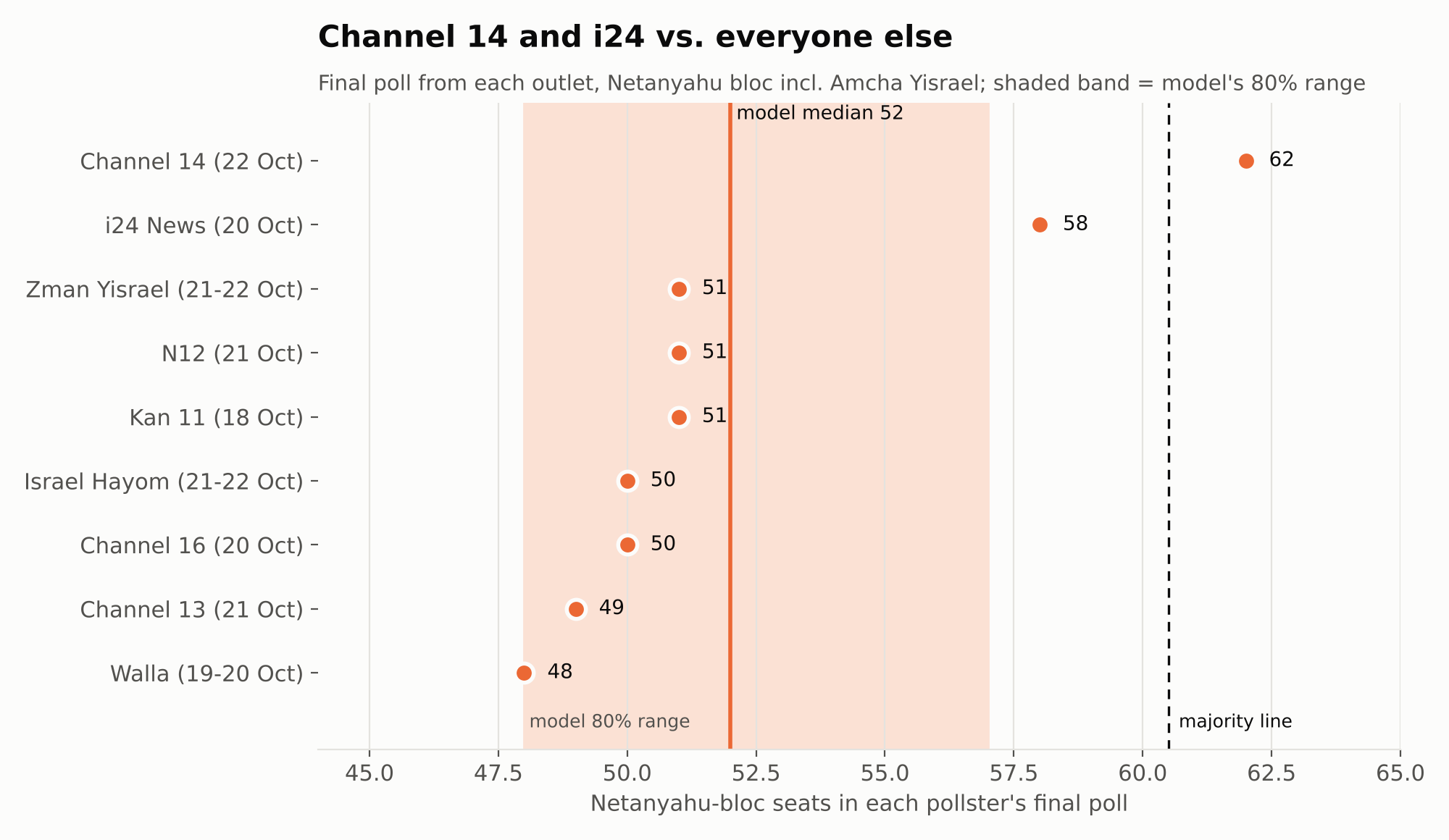
Dot chart of each outlet’s final poll for Netanyahu’s camp: Channel 14 at 62 and i24 at 58, while the other seven sit between 48 and 51
Before you write them off, know this: in 2022, Direct Polls came closest to the real result of any pollster. Every other pollster had Netanyahu’s camp at 60 or 61. It got 64. Direct Polls said 62.
So who should you believe? Not anybody’s gut feeling, including ours. That’s why we did the math.
How we did the math
We used the same basic method that American forecasters like FiveThirtyEight made famous, adjusted for Israel. It has four steps.
- Grade every pollster. We dug up each company’s last poll before the 2019, 2020, 2021 and 2022 elections and compared it to what actually happened.
- Trust the accurate ones more. A pollster with a good record counts for more in our average. One with a bad record counts for less. Nobody gets thrown out.
- Fix known habits. If a pollster has always been a seat or so too low on the right, we nudge its number up by about that much. These fixes are small, about one seat at most.
- Run the election 50,000 times. Polls are never exactly right, so the computer adds the kinds of misses Israeli polls have actually made in the past. The biggest of those misses is the one all pollsters share, because in Israel they tend to be wrong together. Then it applies the real rules for handing out seats, 50,000 times over. If Netanyahu wins a majority in 650 of those runs, that’s about a 1% chance.
Two things we learned along the way are worth knowing.
All the pollsters tend to miss in the same direction at the same time. In 2022 they all had Netanyahu’s camp about 3 seats too low. In September 2019 they all had it about 4 seats too high. So “the polls always underestimate the right” isn’t true. Sometimes they do, sometimes they don’t.
Direct Polls really does have a good record, and we gave it extra weight. But its edge was always small: it used to be 1 or 2 seats to the right of everyone else, and in 2021 and 2022 that was the right call. This year Channel 14 and i24 are 8 to 12 seats to the right of everyone else. Nothing in their history backs a gap that big. And since both of them claim the same track record, they share one vote in our average instead of getting two.
Our most likely result
This is the single most likely outcome, with all 120 seats handed out. “Likely range” means that in 8 out of 10 of our simulations, the party landed inside it.
| Party | Seats | Likely range | Camp |
|---|---|---|---|
| Yashar! (Eisenkot) | 22 | 19 to 25 | Opposition |
| Likud (Netanyahu) | 22 | 19 to 24 | Netanyahu |
| Beyachad (Bennett and Lapid) | 14 | 11 to 16 | Opposition |
| The Democrats (Golan) | 9 | 7 to 10 | Opposition |
| Joint List | 9 | 7 to 11 | Arab parties |
| Shas (Deri) | 8 | 6 to 9 | Netanyahu |
| United Torah Judaism | 8 | 6 to 9 | Netanyahu |
| Otzma Yehudit (Ben-Gvir) | 8 | 7 to 10 | Netanyahu |
| Religious Zionism-Zehut (Smotrich) | 7 | 5 to 8 | Netanyahu |
| Yisrael Beiteinu (Liberman) | 7 | 6 to 9 | Opposition |
| Ra’am (Abbas) | 6 | 4 to 7 | Arab parties |
| Amcha Yisrael (Winter) | 0 | 0 or 4 | Netanyahu |
| The Reservists (Hendel) | 0 | 0 or 4 | Uncommitted |
Add it up: Netanyahu’s camp 53, Eisenkot’s camp 52, Arab parties 15. Nobody is close to 61.
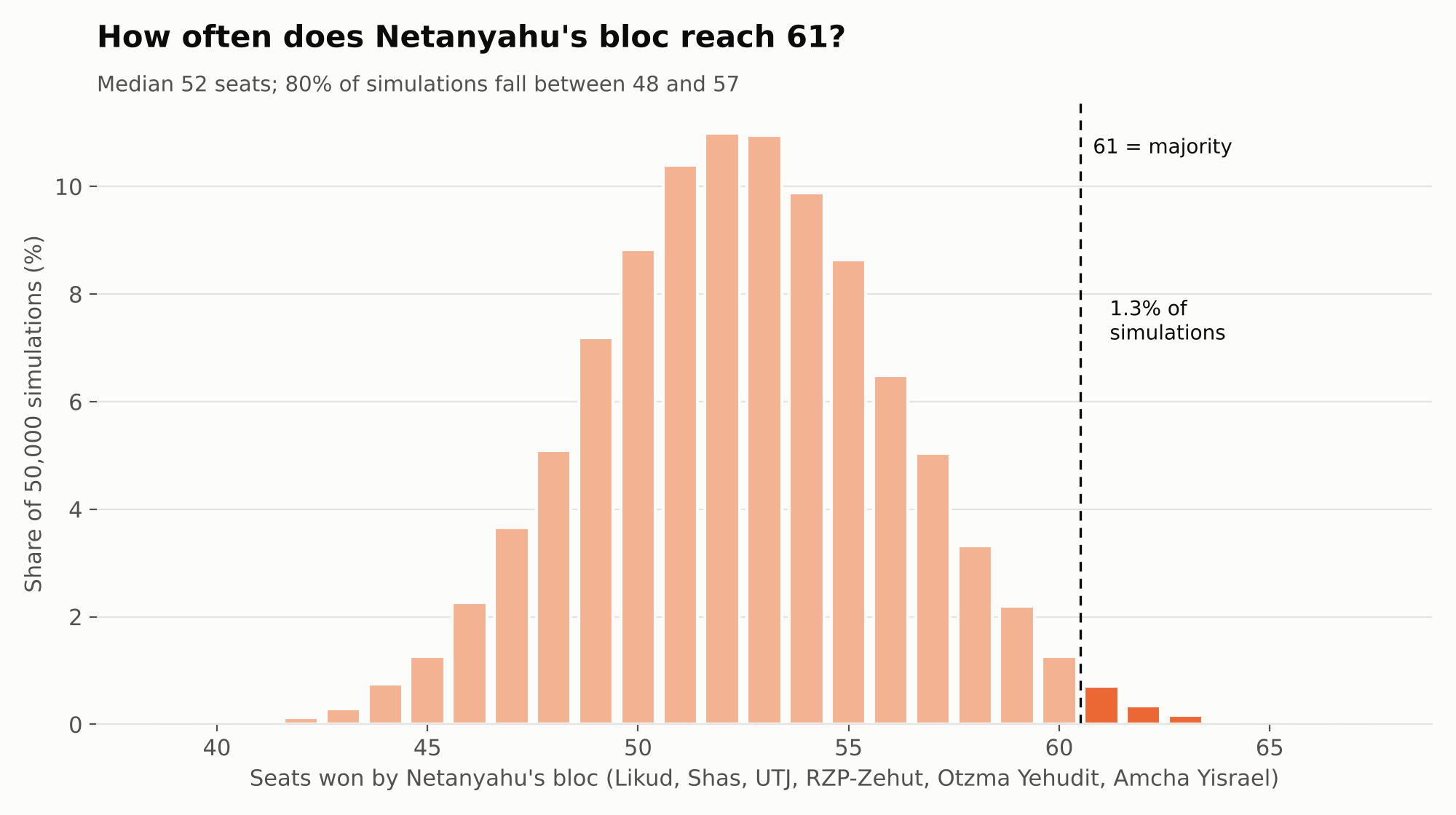
Bar chart of 50,000 simulated elections: Netanyahu’s camp most often wins 50 to 54 seats and reaches 61 in about 1% of runs
Don’t read the exact numbers too literally. Any party can easily be two or three seats off. What held up across all 50,000 runs is the overall picture: Likud and Yashar neck and neck, both camps in the low 50s, and the Arab parties holding the balance.
The two parties at zero matter most. Here’s how often each combination came up in our runs: both miss (45%), only Hendel’s party gets in (27%), only Winter’s gets in (15%), both get in (7%). In the remaining 5% or so, Ra’am misses the threshold. Here is how things change if just one of them gets in:
- If only Hendel’s Reservists get in (27% of our runs): they take 4 seats, mostly at the right’s expense. Netanyahu’s camp drops to about 49, Eisenkot’s camp stays at 52, and Hendel holds 4 seats nobody can count on.
- If only Winter’s party gets in (15% of our runs): Netanyahu’s camp rises to about 56 and Eisenkot’s falls to about 49. This is Netanyahu’s best realistic case, and he’s still 5 seats short.
What about Channel 14’s 62? To get there, the polls would have to miss by more than they did in any of the last four elections. We ran the whole model again in several different ways: as a plain average, without Channel 14 and i24, and with both of them given full weight. Netanyahu’s chance of a majority never went above 3%. Even when we made the polls’ past mistakes 50% bigger, it reached only about 6%.
The parties on the edge
A party needs at least 3.25% of the national vote to get into the Knesset. That works out to about 4 seats. Fall even slightly short and you get zero, and every vote cast for you is thrown away.
This matters a lot. In 2022, two parties opposed to Netanyahu, Meretz and Balad, missed the line by a hair. That’s a big reason Netanyahu’s camp won 64 seats with just under half of the votes.
This time two parties are right on the line:
| Party | What the final polls said | Gets in, in our runs | If it misses, who benefits |
|---|---|---|---|
| Amcha Yisrael (Winter) | From 1.5% (Channel 14) to 4 seats (N12, Channel 16) | 23% | Eisenkot’s camp: the votes are lost from Netanyahu’s side |
| The Reservists (Hendel) | From 1.9% (Channel 14) to 3.6% (Zman Yisrael) | 36% | Mostly Netanyahu’s camp: Hendel’s seats come largely from the right |
The irony: Channel 14, the poll most friendly to Netanyahu, has Winter, a Netanyahu ally, at just 1.5%. Ra’am is also closer to the line than it looks, but it gets in in 95% of our runs.
Who could govern with whom
Numbers are only half of it. The other half is who has sworn never to sit with whom. Here is what the leaders have said publicly:
- Eisenkot won’t serve under Netanyahu, “not even in a rotation agreement” (JPost). He has said he won’t depend on the Arab parties. He is open to Shas on his own terms, but he wants to end the blanket army exemptions for yeshiva students (AIJAC).
- Bennett says he won’t sit with Netanyahu “in any formation” (Times of Israel). He has also ruled out repeating his 2021 partnership with Ra’am.
- Liberman says no Netanyahu, no Shas, no United Torah Judaism, no Ra’am, no Joint List, and no minority government (JPost). He says Likud without Netanyahu “can be a significant partner.”
- Hendel will join only a coalition of Zionist parties, and he won’t sit with the ultra-Orthodox parties. Unlike the others, he says he isn’t in the “anyone but Bibi” camp (JPost).
- Deri (Shas) says Shas won’t join any government unless the status of yeshiva students is settled in law (Times of Israel). United Torah Judaism wants a draft law “without sanctions and without quotas.”
- Winter backs Netanyahu but says he’ll stay out of any government until a draft law for the ultra-Orthodox passes.
- The Joint List won’t join a government but has left the door open to supporting one from outside. Ra’am has signaled the same about a government that ends Netanyahu’s rule (AIJAC).
Now put that next to our numbers. For each possible government, here is how often it had 61 seats in our simulations, and what stands in its way.
| Possible government | Has 61 seats in | What stands in the way |
|---|---|---|
| Netanyahu’s current coalition comes back | 1% of runs | The numbers. And Shas and Winter both want a draft law first |
| Eisenkot, Bennett, Golan, Liberman, plus Hendel | 4% of runs | The numbers |
| The same, plus Ra’am, like the 2021 Bennett-Lapid government | 31% of runs | Bennett and Liberman have ruled out Ra’am; Hendel wants only Zionist parties |
| Eisenkot’s camp governing as a minority, with Arab parties voting for it from outside | 97% of runs | Liberman says no minority government, not even a temporary one |
| Eisenkot, Bennett and Golan with Shas and United Torah Judaism, without Liberman | 36% of runs | Eisenkot wants to end the draft exemptions that Shas and UTJ want written into law |
| A unity government of Likud, Yashar, Beyachad and Yisrael Beiteinu | 92% of runs | Eisenkot, Bennett and Liberman all refuse to sit with Netanyahu. It works only if Likud picks someone else |
The honest conclusion: as of today, no option has both the seats and willing partners. For any government to form, somebody will have to break a campaign promise. The possible outcomes are: an Arab-backed arrangement Liberman would have to swallow, an ultra-Orthodox deal Eisenkot would have to swallow, a unity government without Netanyahu at the top, or another election.
What to watch on election night
Polls close at 10 pm Israel time on Tuesday. The TV channels release exit polls the same minute. Four things to look for:
- Winter and Hendel. If the exit polls show either one near 4 seats, treat it as unknown until the real count. A few thousand votes decide it, and either result moves the blocs by about 4 seats.
- Arab turnout. It has been the biggest blind spot in Israeli polling. High turnout in Arab towns pushes Netanyahu’s camp down. Low turnout pushes it up.
- Likud versus Yashar for first place. Being the biggest party doesn’t make you prime minister, but it shapes the story and the pressure in the first weeks.
- Don’t trust the first numbers too much. In 2022 the exit polls gave Netanyahu’s camp 61 or 62, and the final count gave him 64. Official results usually take a few days, because some votes, like soldiers’ ballots, are counted last.
The fine print
This forecast has limits, and you should know them.
- Four past elections is not much history for grading pollsters. That’s why we pulled every grade toward average instead of trusting it fully.
- Some numbers weren’t published. A few polls said a party was below the line without giving a percentage, so we assumed 2% to 2.5%. Walla published only bloc totals and a few parties; we filled in the rest from the same pollster’s previous poll.
- Vote-sharing deals are left out. Pairs of parties sign “surplus vote” agreements that can move one seat between them. Five pairs signed this time, including Likud with Religious Zionism-Zehut and Yashar with the Democrats.
- This is not a prediction of who becomes prime minister. That gets decided in coalition talks, not at the ballot box.
The full model, the data and the code are available for anyone who wants to check our work. If you want a zip file with everything send an email to ck@jewlicious.com and we’ll hook you up.
Final polls used (fieldwork 18 to 22 October): N12, Channel 13, Israel Hayom, Kan 11, Channel 16, Walla, i24 News, Channel 14, Zman Yisrael.
Past polls and results: Wikipedia’s poll tables for 2022, 2021, 2020 and September 2019.
Coalition positions: Eisenkot, Liberman, Hendel, Bennett, Deri, AIJAC, surplus deals.

― Tom Robbins